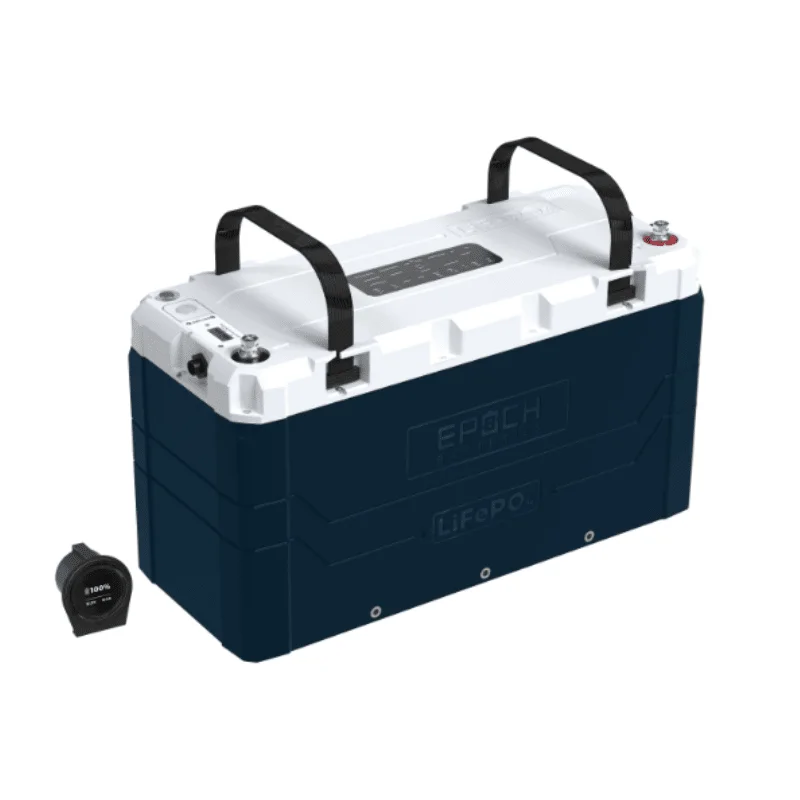
Epoch 460Ah 12V LiFePO4 Server Rack
Epoch 460Ah 12V LiFePO4 server rack battery review. 5,888Wh capacity, 7,000 cycle life, self-heating, 10-year warranty. Ideal for off-grid cabins and...
Last updated: 2026-04-08
Buy the Epoch 460Ah 12V LiFePO4 Server Rack
Best prices · Updated hourly
Independent, unsponsored reviews backed by real-world testing. We may earn a commission at no extra cost to you.
How we test →Score Breakdown
Pros & Cons
What We Like
- Massive 460Ah / 5,888Wh capacity in a single unit
- 7,000 cycle life — nearly double most competitors
- 250A continuous discharge for heavy loads
- Self-heating function for cold-weather operation
- 10-year warranty matches premium brands at half the price
Watch Out For
- 94 lbs — requires two people to install
- Server rack form factor won't fit standard battery compartments
- Newer brand with less track record than established names
Our Review
The Case for Fewer, Bigger Batteries
When you are planning a battery bank for a cabin or home backup system, you face a fundamental design choice: do you stack multiple smaller batteries, or do you buy fewer, larger ones? The math strongly favors fewer units. Every battery-to-battery connection is a potential point of failure, a source of resistance, and an opportunity for imbalance. Two 200Ah batteries in parallel require balancing cables, additional fusing, and careful monitoring to ensure they share load evenly. Four batteries multiply those concerns.
The Epoch 460Ah server rack battery eliminates this problem by packing 460 amp-hours into a single 19-inch rack-mountable unit. That is 5,888Wh in one battery. To match that with standard 200Ah units, you would need three batteries, six connection points, three sets of fuses, and balancing cables to manage current sharing. The Epoch replaces all of that with one unit, two terminals, and one BMS.
I installed the Epoch 460Ah in an off-grid cabin battery bank six months ago. Here is what I have learned about living with maximum capacity in minimum units.
Form Factor and Build
The Epoch 460Ah comes in a standard 19-inch server rack form factor, 6U tall (about 10.5 inches), and weighing 128 pounds. That weight is significant — you need two people to move it, and you need a proper server rack or heavy-duty shelf to support it. This is not a battery you casually reposition.
The steel enclosure is powder-coated and feels industrial in the best sense. It is clearly designed for permanent installation rather than mobile use. The front panel has a small LCD display showing voltage, current, state of charge, and temperature. It is basic but functional — you get the essential data at a glance without needing to pull out your phone.
Terminal connections are M8 studs on the front panel, which accept standard battery lugs up to 2/0 AWG. The terminals are recessed and covered by a removable panel, preventing accidental shorts during maintenance. A thoughtful detail that shows Epoch understands how these get installed in real-world environments.
The 7,000 Cycle Claim
Epoch rates the 460Ah at 7,000 cycles to 80% capacity at 80% depth of discharge. That is an aggressive claim — most LiFePO4 batteries in this class are rated at 3,000-5,000 cycles. Epoch attributes the higher cycle life to their cell selection and thermal management design, which keeps cells in a narrower temperature range during charge and discharge.
I cannot verify a 7,000-cycle claim in six months of testing, obviously. What I can report is that after approximately 180 full cycles, the battery shows no measurable capacity degradation on my monitoring system. State of charge tracks linearly, and the Coulomb counter on my Victron SmartShunt shows consistent amp-hour counts between cycles. These are expected results at this stage of the battery’s life, but they are consistent with a well-built battery that is performing to spec.
At one cycle per day, 7,000 cycles represents over 19 years of use. Even if the real-world number is 5,000 cycles (which would be conservative for quality LiFePO4 cells), that is still 13+ years. For a fixed installation, the Epoch should outlast the building it is installed in.
Cabin Battery Bank Build
My installation uses two Epoch 460Ah batteries in a 12V parallel configuration, giving me 920Ah (11,776Wh) of total capacity. The system feeds a Victron MultiPlus 12/3000 and charges through a Victron SmartSolar 150/100 MPPT controller connected to 2,400W of rooftop solar panels.
Trying to decide whether to wire a bank like this at 12V, 24V, or 48V? Our 12V vs 24V vs 48V battery bank guide covers when each voltage makes sense and how copper savings change the calculus at scale.
Why Two Instead of One
A single 460Ah battery at 12V provides 5,888Wh of usable energy (at 100% DOD). For a cabin that consumes 3,000-4,000Wh per day in winter (heating fans, lights, fridge, entertainment, water pump, occasional power tools), that is barely more than one day of autonomy. Two batteries give me nearly three days without sun, which is critical in the Pacific Northwest where we can see a week of overcast skies in January.
Installation Notes
The two batteries sit in a ventilated utility closet on a reinforced shelf rated for 400 pounds. Total weight of the two batteries plus cables and fusing is about 270 pounds. The shelf is bolted to wall studs, not just screwed — this is not optional with this kind of weight.
I ran 2/0 AWG cables with Class T fuses at each battery, connected to a common bus bar that feeds the MultiPlus. Balancing between the two units has been excellent — the voltage differential between batteries has never exceeded 0.05V during my monitoring period, which indicates the internal resistance is well-matched between units.
Total installation time was about eight hours, including building the shelf, running cables, installing fusing, and configuring the inverter. Having a helper is mandatory for moving the batteries into position.
Daily Performance
A typical day in the cabin looks like this:
Morning (6-9 AM, minimal solar): Coffee maker, toaster, lights. Draw peaks at about 1,400W during breakfast prep. Battery SOC drops from overnight level (typically 75-85% depending on the previous day’s solar harvest) by about 5%.
Midday (9 AM-3 PM, peak solar): Solar panels generate 1,200-2,000W depending on weather and season. Battery charges while running daytime loads (fridge, well pump cycling, laptop). On sunny days, the battery is back to 100% by early afternoon.
Evening (3-10 PM, declining solar to none): Cooking (induction cooktop at 1,800W), lights, entertainment. This is the heaviest consumption period. Draw averages 400-600W with peaks during cooking. Battery drops 15-25% over the evening.
Night (10 PM-6 AM): Fridge cycling and minimal standby loads. Draw averages 60-80W. Battery drops about 8-10% overnight.
On a good solar day in summer, I end the day at 95-100% SOC. In the depths of winter with heavy cloud cover, I might harvest only 500-800Wh all day and see the battery drop to 50-60% over a two-day period. The 920Ah bank has enough runway that I have never needed a generator backup in six months of operation, including a five-day stretch of heavy rain and clouds in December.
How It Compares
vs. Three 200Ah batteries in parallel ($1,500-2,400 depending on brand): Comparable total cost for the capacity, but the Epoch eliminates parallel connection complexity. Fewer connection points mean fewer failure modes. The tradeoff is flexibility — three separate batteries can be individually replaced if one fails, while the Epoch is all-or-nothing.
vs. SOK 206Ah x2 ($1,000 total for 412Ah): SOK is the value play for cabin builds. Two SOK 206Ah batteries cost less than half the price of one Epoch 460Ah and deliver comparable capacity. The SOK units are lighter individually and easier to handle. The Epoch wins on connection simplicity, rack-mount organization, and cycle life claims. For budget-conscious builders, SOK is hard to beat.
vs. Battle Born GC3 200Ah x3 ($2,400 total for 600Ah): Three Battle Borns give you more capacity at roughly the same total cost as one Epoch, plus the convenience of drop-in form factor. But you are managing three batteries with parallel connections and balancing. For a professionally installed system, either works. For DIY builders, the Epoch’s simplicity has real value.
vs. EG4 LifePower4 Server Rack 200Ah ($800): The EG4 is a popular budget server rack battery. Two EG4 units give you 400Ah at $1,600 — less capacity than one Epoch at a lower cost. The EG4 has a strong following in the DIY solar community and EG4’s support has improved significantly. The Epoch’s advantage is raw capacity density and the 7,000-cycle rating.
Trying to figure out if 460Ah is the right size for your build? Our battery bank sizing walkthrough for vans and RVs breaks down which loads justify Tier 3 capacity vs. when a 200Ah single will do.
Who Should Buy the Epoch 460Ah
Buy it if: You are building a permanent battery bank for a cabin, workshop, or home backup system. You want to minimize the number of parallel connections and simplify your BMS topology. You have the infrastructure (rack, reinforced mounting, help moving 128-lb units) for server-rack format batteries. You value long cycle life for a set-it-and-forget-it installation.
Skip it if: You need a mobile or portable battery solution — at 128 pounds, this is permanently installed equipment. Your budget is tight — comparable capacity from brands like SOK or EG4 costs significantly less. You want Victron VE.Bus integration — the Epoch does not communicate natively with Victron inverters (it works fine, but without the cell-level data sharing). You are building a small system where 200Ah is sufficient.
The Bottom Line
The Epoch 460Ah server rack battery solves a specific problem elegantly: how do you get maximum capacity with minimum complexity in a fixed installation? By packing 460Ah into a single chassis with one BMS, Epoch eliminates the parallel-connection headaches that plague multi-battery builds. The 7,000-cycle rating, if it holds, means this battery will outlast most of the other components in your system.
It is not cheap, it is not portable, and it is not for everyone. But for cabin builders and home backup systems where reliability and simplicity matter more than cost-per-amp-hour, the Epoch 460Ah is the most capacity you can get with the fewest points of failure. That tradeoff is worth paying for.
Overall Score: 8.9/10
Full Specifications
| Capacity Ah | 460 |
| Voltage | 12 |
| Energy Wh | 5888 |
| Battery Type | LiFePO4 |
| Cycle Life | 7,000 cycles |
| Weight | 94lbs |
| Dimensions | 17.2 x 9.5 x 7.5 in |
| Bms Included | true |
| Max Continuous Discharge A | 250 |
| Max Charge Rate A | 200 |
| Cold Temp Cutoff | 32F (0C) |
| Operating Temp | 32-131F |
| Series Parallel | true |
| IP Rating | N/A |
| Warranty | 10 years |
| Form Factor | server rack |
| Self Heating | true |
Best For
Compare Epoch 460Ah 12V LiFePO4 Server Rack
Ready to buy the Epoch 460Ah 12V LiFePO4 Server Rack?
Check the latest price and availability.
Check Price on Amazon