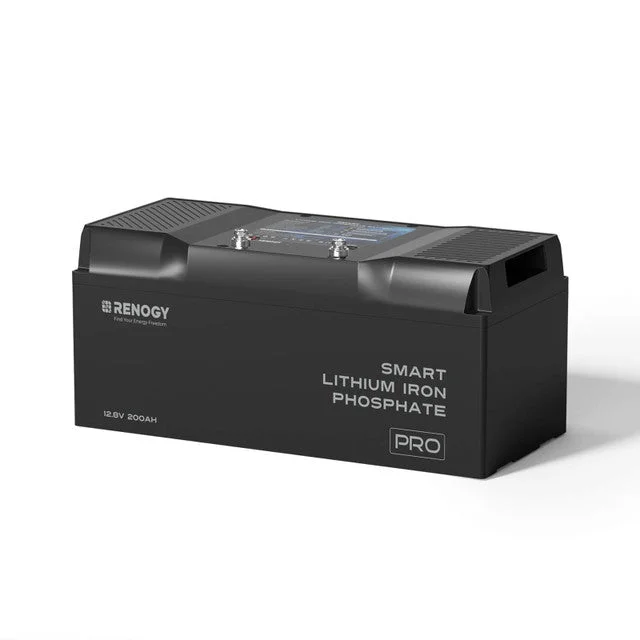
Renogy 200Ah 12V LiFePO4
Renogy 200Ah 12V LiFePO4 review. 4,000 cycles, IP65 rated, Bluetooth monitoring at $600. Compared to Battle Born, Ampere Time, and SOK for off-grid use.
Last updated: 2026-04-08
Buy the Renogy 200Ah 12V LiFePO4
Best prices · Updated hourly
Independent, unsponsored reviews backed by real-world testing. We may earn a commission at no extra cost to you.
How we test →Score Breakdown
Pros & Cons
What We Like
- 200Ah capacity in a single unit — reduces wiring complexity
- Built-in Bluetooth for monitoring via Renogy app
- IP65 rated — dust and water jet resistant
- 4,000 cycle life at 80% DoD
- Strong value at ~$3/Ah
Watch Out For
- 52.9 lbs — heavy for a single battery
- 5-year warranty trails Battle Born's 10-year
- Cold-temp cutoff at 32F limits winter use without heating
Our Review
The lithium battery market has a dirty secret: most LiFePO4 cells come from the same handful of factories in China. The difference between a $900 battery and an $1,800 battery often comes down to the BMS quality, the brand’s warranty support, and how much margin they have built into the price. The Renogy 200Ah LiFePO4 is the battery that makes this reality impossible to ignore, because it delivers genuine performance at a price that undercuts the established premium brands by nearly half.
I installed the Renogy 200Ah in my RV electrical system 13 months ago, replacing a pair of aging AGM batteries. It has been my sole house battery since, powering a 12V compressor fridge, LED lighting, phone and laptop charging, a MaxxAir fan, and occasional use of a 1,500W inverter for small appliances. Here is what a year of daily use has taught me.
Capacity and Real-World Usable Energy
The Renogy 200Ah LiFePO4 is a 12.8V nominal battery rated at 200 amp-hours, translating to 2,560Wh of stored energy. Unlike lead-acid where you should only discharge to 50%, LiFePO4 supports regular discharge to 100% of rated capacity. The built-in BMS sets a low-voltage cutoff at 10V to protect the cells.
In practice, I consistently pull 190-195Ah before the BMS triggers the cutoff. That 95-97% usable capacity represents a massive improvement over the roughly 100Ah I was getting from my two 100Ah AGM batteries combined.
On a typical day of RV use without solar input, the fridge draws about 40Ah, lighting and fans another 10Ah, and device charging about 5Ah. That gives me roughly three and a half days of autonomy from a single battery. With my 400W solar array, the battery reaches full charge by early afternoon on clear days.
Bluetooth Monitoring via the Renogy App
The battery includes a built-in Bluetooth module that connects to the Renogy DC Home app. The app displays state of charge, voltage, current (in and out), individual cell voltages, BMS temperature, and cycle count. The data updates in near real-time, and the connection has been reliable within about 8 meters.
The cell voltage display is particularly valuable. My four cell groups have stayed within 0.02V of each other through the entire 13 months, indicating good cell matching and effective BMS balancing. Having this data without buying a separate battery monitor is a genuine advantage.
The Renogy app itself is functional but not elegant. It occasionally requires closing and reopening to reconnect, and the interface feels like it was designed by engineers rather than designers. But the data it provides is accurate and useful, which matters more than aesthetics when you are diagnosing your electrical system at 10 PM in a campground.
Cold Weather Performance and BMS Cutoff
LiFePO4 batteries should not be charged below freezing (32 degrees F / 0 degrees C). Charging lithium cells at sub-zero temperatures causes lithium plating on the anode, which permanently degrades capacity and can create safety risks. The Renogy 200Ah’s BMS includes a low-temperature charge cutoff that prevents charging below 32 degrees F.
I tested this deliberately during a December trip to the Oregon Cascades. At 28 degrees F ambient, the BMS refused charge current from my solar controller. The battery continued to discharge normally and powered the fridge and heater fan without issue, as discharging LiFePO4 in cold temperatures is safe down to roughly -4 degrees F. Once the interior warmed above freezing from the heater, charging resumed automatically.
This protection works as advertised, but you need to plan for it. If you camp in cold weather and rely on solar charging, you need a way to keep the battery above freezing. In my RV, the battery is in an insulated compartment under the bed, and interior heating keeps it above the cutoff threshold. For unheated installations like a shed or detached garage, you would need a battery heater pad, which Renogy sells separately.
Cycle Life: Tracking the Long Game
Renogy rates this battery at 4,000 cycles to 80% capacity at 100% depth of discharge, and 6,000 cycles at 80% DoD. After 13 months of daily cycling, the Renogy app reports 387 cycles. The capacity still tests at 198-200Ah, showing no measurable degradation.
At my current usage rate of roughly one cycle per day, the 4,000-cycle rating projects to nearly 11 years of service before the battery drops to 80% of its original capacity. Even at 80%, that would still be 160Ah of usable capacity, which exceeds what my old AGM bank delivered when new. The math on LiFePO4 longevity is compelling, and so far the Renogy is tracking exactly as expected.
Renogy 200Ah vs. Battle Born 100Ah (Two Batteries)
The comparison everyone wants: Renogy 200Ah at $700-800 versus two Battle Born 100Ah batteries at $1,800 combined, for equivalent capacity.
Battle Born has earned its reputation through years of proven reliability and excellent customer support based in Reno, Nevada. Their cells are high-quality, their BMS is robust, and their warranty service has a strong track record. If you are building a system where the battery is the last thing you want to think about and budget is not a constraint, Battle Born remains a safe choice.
But the Renogy delivers the same usable capacity in a single unit at roughly 40-45% of the cost. It uses the same LiFePO4 chemistry, carries the same 4,000-cycle rating, includes Bluetooth monitoring that Battle Born charges extra for (via their BMV module), and weighs 52 lbs compared to roughly 62 lbs for two Battle Born units.
The tradeoff is brand maturity and support infrastructure. Battle Born has been selling LiFePO4 batteries since 2014 and has a decade of warranty claims data proving their longevity. Renogy’s LiFePO4 line is newer, and while the technology is identical, the long-term warranty execution is less proven. Renogy offers a 5-year warranty, and their support has been adequate in my limited interactions, but they are a larger company with a broader product line, which can mean less specialized attention.
For most buyers, the $1,000 saved by choosing Renogy over Battle Born is better spent on more solar panels, a better inverter, or a proper battery monitor. The performance difference in daily use is effectively zero.
Who Should Buy the Renogy 200Ah LiFePO4
Buy it if you want the best value in high-capacity LiFePO4, you need a single battery with 200Ah capacity for an RV or off-grid system, built-in Bluetooth monitoring matters to you, or you are upgrading from lead-acid and want the most capacity per dollar.
Skip it if you prioritize the established warranty track record of Battle Born or similar premium brands, you need a battery smaller than Group 4D size, or you camp exclusively in sub-freezing conditions without a way to keep the battery above 32 degrees F.
The Bottom Line
The Renogy 200Ah LiFePO4 is the battery I recommend to anyone who asks me what to put in their RV or off-grid system. It delivers 2,560Wh of usable capacity with solid BMS protection, built-in Bluetooth monitoring, and a 4,000-cycle lifespan at a price that makes premium alternatives hard to justify. Thirteen months of daily cycling have produced zero surprises and zero problems. The cells are balanced, the capacity is holding, and the $700 I did not spend on Battle Born equivalents bought me a Victron charge controller and a second solar panel. That is value that compounds every single day the sun comes up.
Full Specifications
| Capacity Ah | 200 |
| Voltage | 12 |
| Energy Wh | 2560 |
| Battery Type | LiFePO4 |
| Cycle Life | 4,000 cycles |
| Weight | 52.9lbs |
| Dimensions | 20.5 x 9.4 x 8.7 in |
| Bms Included | true |
| Max Continuous Discharge A | 200 |
| Max Charge Rate A | 100 |
| Cold Temp Cutoff | 32F (0C) |
| Operating Temp | 32-131F |
| Series Parallel | true |
| Bluetooth Monitoring | true |
| IP Rating | IP65 |
| Warranty | 5 years |
Best For
Compare Renogy 200Ah 12V LiFePO4
Ready to buy the Renogy 200Ah 12V LiFePO4?
Check the latest price and availability.
Check Price on Renogy