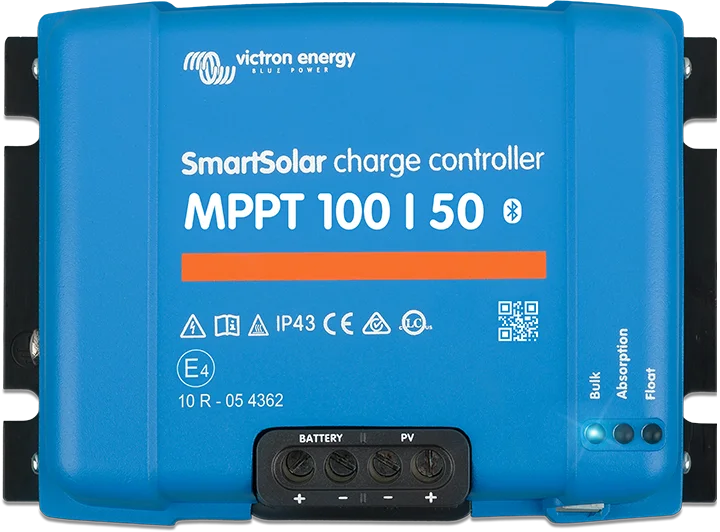
Victron SmartSolar MPPT 100/50
Victron SmartSolar MPPT 100/50 charge controller review. 98% efficiency, Bluetooth built-in, 50A output. Why it is the professional pick for off-grid...
Last updated: 2026-04-08
Buy the Victron SmartSolar MPPT 100/50
Best prices · Updated hourly
Independent, unsponsored reviews backed by real-world testing. We may earn a commission at no extra cost to you.
How we test →Score Breakdown
Pros & Cons
What We Like
- 98% peak efficiency — best-in-class MPPT tracking
- Built-in Bluetooth with VictronConnect app for full monitoring and programming
- Handles up to 700W solar input on 12V systems
- Full Victron ecosystem integration — GX devices, VRM portal, ESS
- 5-year warranty and legendary Victron reliability
Watch Out For
- Premium price compared to budget MPPT controllers
- No built-in display — requires phone app or optional display
- IP43 rating means it needs indoor/protected mounting
Our Review
There is a moment in every off-grid build where you decide how much you trust your charge controller. For me, that moment came when I replaced a budget PWM unit with the Victron SmartSolar 100/50 and watched my daily harvest jump by over 30%. The panel array was identical. The sun was the same. The controller made the difference.
The SmartSolar 100/50 is Victron Energy’s mid-range MPPT charge controller, rated for 100V open-circuit input voltage and 50A charge current. It handles up to roughly 700W of solar on a 12V system or 1,400W on 24V. At $280-320 street price, it sits firmly in the premium tier, and Victron expects you to understand why that price is justified.
Bluetooth and the VictronConnect App
The “Smart” in SmartSolar refers to built-in Bluetooth, and the VictronConnect app is where that matters. The app connects in seconds and provides real-time data on solar voltage, battery voltage, charge current, yield history (daily, monthly, and total), and the current charge state. You also configure all charging parameters through the app: absorption voltage, float voltage, equalization settings, tail current, and temperature compensation.
I have used the app daily for over a year, and it remains one of the best pieces of equipment software I have encountered in the off-grid space. It is responsive, logically organized, and does not require an account or internet connection. The 30-day history graphs are genuinely useful for diagnosing system issues. When my panels got partially shaded by a growing tree branch last September, the yield trend in VictronConnect showed the decline clearly over two weeks before I traced the cause.
The Bluetooth range is approximately 10 meters through one wall, which is adequate for most installations. If you need remote monitoring beyond Bluetooth range, Victron sells the VE.Direct to USB adapter and various GX devices that connect the controller to their VRM online portal. That ecosystem integration is a real strength for larger or more complex systems, but it adds cost.
The 98% Efficiency Claim
Victron claims up to 98% conversion efficiency for the SmartSolar MPPT controllers. I tested this with a clamp meter on both the solar input and battery output sides across several sunny days. My measurements consistently showed 96-97% efficiency during bulk charging, which dropped to around 93-94% during absorption when current tapers. These numbers are excellent and consistent with what independent testers have reported.
For context, a PWM controller typically operates at 75-85% efficiency depending on the voltage mismatch between panels and battery. On my 12V system with two 24V-nominal panels in series, switching from PWM to this MPPT controller recovered energy that was previously wasted as heat. The difference is not subtle. It is the difference between fully charging your battery bank by 2 PM versus 4 PM on the same day.
Adaptive Charging Algorithms
The SmartSolar 100/50 uses what Victron calls “adaptive” charge algorithms. In practice, this means the controller dynamically adjusts the duration of the absorption phase based on how deeply the battery was discharged. A shallow discharge gets a shorter absorption phase. A deep discharge gets a longer one. This is smarter than fixed-time absorption and better for battery longevity, particularly with LiFePO4 chemistry where overcharging even slightly can stress the cells.
Speaking of LiFePO4: the controller includes a dedicated preset for lithium batteries that sets absorption and float voltages appropriately (default 14.2V and 13.5V for 12V systems). It also supports a VE.Direct connection to compatible Victron lithium batteries for direct BMS communication, which allows the controller to reduce or stop charging based on cell-level data. If you are pairing this with a third-party LiFePO4 battery, the preset works well, but you should verify the voltage settings against your battery manufacturer’s recommendations. I run mine with a Renogy 200Ah LiFePO4 at 14.4V absorption and 13.6V float per Renogy’s spec sheet, and the combination has been flawless.
Build Quality and Installation
The unit is housed in a sealed aluminum case that acts as a passive heatsink. It runs warm during peak charging but never hot enough to concern me, even mounted inside a non-ventilated cabinet in my shed during summer. The MC4 solar input and ring-terminal battery connections are solid. The unit has been running continuously for 14 months with zero issues, zero resets, and zero firmware bugs.
Installation is straightforward if you follow the manual’s wiring sequence: battery first, then solar. Reversing this order can damage the unit, and Victron is clear about this in the documentation. The controller auto-detects 12V or 24V battery systems on first connection.
Victron SmartSolar 100/50 vs. Renogy Rover 40A
The Renogy Rover 40A MPPT is the most common budget alternative at roughly $150, nearly half the Victron’s price. I have used both, and the functional differences justify the premium for most serious off-grid installations.
The Rover works. It charges batteries and does basic MPPT tracking. But its LCD screen is the primary interface, and navigating settings through physical buttons is tedious compared to VictronConnect. The Rover’s Bluetooth module is a separate $30 add-on, and the Renogy app is noticeably less polished. The Rover also lacks adaptive absorption timing and the granular data logging that makes the Victron useful for system optimization.
Where the Rover wins is pure value for simple systems. If you have a single panel charging a single battery on a weekend cabin and do not need remote monitoring or detailed yield data, the Rover does the job at a lower price. But if your system is your primary power source, and you need to understand and optimize its performance, the Victron pays for itself through better energy capture and vastly superior monitoring.
The 50A versus 40A rating also matters if you plan to expand your array. The extra 10A of headroom on the Victron means you can add another panel without replacing the controller.
Who Should Buy the Victron SmartSolar 100/50
Buy it if you are building a serious off-grid or RV solar system where monitoring and optimization matter, you want Bluetooth control without extra adapters, you are pairing with LiFePO4 batteries, or you plan to expand into the broader Victron ecosystem with inverters and battery monitors.
Skip it if you have a simple single-panel weekend setup where a $150 controller does the job, you do not care about data logging or app-based configuration, or your budget is better spent on more panel wattage rather than a premium controller.
The Bottom Line
The Victron SmartSolar 100/50 is the charge controller I recommend to anyone building an off-grid system they intend to rely on. The combination of true MPPT efficiency, adaptive charging algorithms, excellent Bluetooth monitoring, and Victron’s ecosystem integration makes it the reference standard in its class. At $280-320, it is not cheap, but it is the last charge controller most people will need to buy. Fourteen months in, mine has delivered exactly what it promised, every single day, without a single moment of doubt about whether my batteries are being charged correctly. That confidence is worth the premium.
Full Specifications
| Controller Type | MPPT |
| Max Solar Input V | 100 |
| Max Charge Current A | 50 |
| Max Solar Input W 12v | 700 |
| Max Solar Input W 24v | 1400 |
| Battery Voltage | 12/24V auto |
| Efficiency Pct | 98 |
| Weight | 3lbs |
| Dimensions | 7.4 x 5.1 x 1.6 in |
| Bluetooth Built In | true |
| App Control | Yes |
| Programmable | true |
| Display | false |
| Operating Temp | -22 to 140F |
| Warranty | 5 years |
| IP Rating | IP43 |
Best For
Compare Victron SmartSolar MPPT 100/50
Ready to buy the Victron SmartSolar MPPT 100/50?
Check the latest price and availability.
Check Price on Amazon