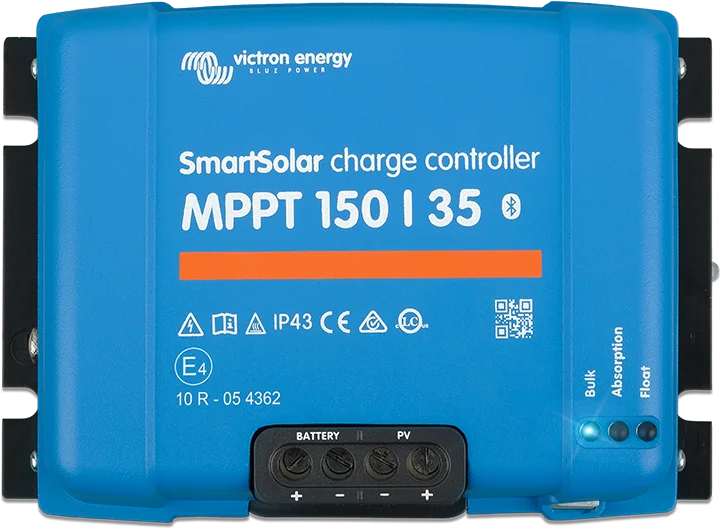
Victron SmartSolar MPPT 150/35
Victron SmartSolar MPPT 150/35 review. 150V input, 48V battery support, Bluetooth, 98% efficiency. Ideal for longer string runs and larger off-grid...
Last updated: 2026-04-08
Buy the Victron SmartSolar MPPT 150/35
Best prices · Updated hourly
Independent, unsponsored reviews backed by real-world testing. We may earn a commission at no extra cost to you.
How we test →Score Breakdown
Pros & Cons
What We Like
- 150V max input allows longer solar string runs with less wire loss
- Supports 12V, 24V, and 48V battery systems
- 98% peak efficiency — best-in-class MPPT tracking
- Built-in Bluetooth with VictronConnect app
- 5-year warranty and proven Victron reliability
Watch Out For
- 35A output limits it to ~500W on 12V systems
- No built-in display — phone app required
- IP43 rating — needs protected mounting location
- Higher price than budget alternatives with similar amperage
Our Review
The number before the slash in a Victron SmartSolar model tells you the maximum PV input voltage. The number after tells you the maximum charge current. The 150/35 accepts up to 150V of solar input and delivers up to 35A of charge current. That 150V input ceiling is the defining feature — it fundamentally changes how you can wire your solar array.
Why 150V Input Matters
Most budget MPPT controllers top out at 100V input. The Victron SmartSolar 100/50, for example, handles 100V maximum. This means you are limited to shorter series strings or must wire panels in parallel, which increases current and requires thicker, more expensive cables. With long distances between panels and battery bank — common in ground-mounted arrays or panels on an outbuilding — voltage drop becomes a real problem at high current.
The 150/35 solves this by allowing you to wire more panels in series, raising the string voltage and proportionally reducing current. A string of three 40V panels in series sends 120V at relatively low current through thin, inexpensive wire over runs of 50 feet or more with minimal voltage drop. The MPPT controller then steps this high-voltage, low-current input down to your battery voltage at higher current. The result is more of your solar energy reaching your batteries instead of being lost as heat in the wiring.
For a 12V battery system, the 35A charge output translates to roughly 500W of solar capacity. For a 24V system, that doubles to approximately 1,000W. For a 48V system, you can handle up to 2,000W — a substantial array managed by a single $220 controller.
The Victron Ecosystem
Built-in Bluetooth connects to the VictronConnect app for monitoring, configuration, and historical data. You can view daily yield, track charging stages, adjust battery charge profiles, and see real-time PV voltage and current. The data quality and app experience are meaningfully better than budget competitors.
The SmartSolar 150/35 integrates with the broader Victron ecosystem via VE.Direct. Connect it to a Victron GX device and you get remote monitoring through the Victron Remote Management portal, system-wide energy management, and integration with Victron inverters and battery monitors. This ecosystem connectivity is what separates Victron from nearly every competitor at any price point.
Battery compatibility covers flooded, AGM, gel, and LiFePO4 chemistries with user-adjustable charge algorithms. The LiFePO4 profile includes proper temperature compensation when paired with a Victron temperature sensor.
The Compromises
At 35A, the charge current is modest for larger systems. If you have a big battery bank and want to maximize charge speed, the 150/50 delivers 50A for about $100 more. The 35A rating is appropriate for small to medium systems — a 200Ah LiFePO4 bank charges at roughly 0.175C, which is well within safe limits.
The $220 price is not budget territory. An Epever Tracer 4210AN delivers 40A of MPPT charging for $100. The extra $120 buys you higher input voltage capacity, Bluetooth, VE.Direct integration, the Victron ecosystem, and a 5-year warranty. Whether that premium is justified depends on your system’s complexity and your need for monitoring.
Who Should Buy It
Buy the SmartSolar 150/35 if you have long wire runs between panels and batteries, want to series-wire panels for efficiency, or are building within the Victron ecosystem. The 150V input is the reason to choose this over cheaper alternatives.
Skip it if your panels sit within 10 feet of your battery bank and you are on a tight budget. The Epever Tracer 4210AN or Renogy Rover 40A provides adequate MPPT charging for less than half the price, with the trade-off of lower input voltage limits and no ecosystem integration.
Full Specifications
| Controller Type | MPPT |
| Max Solar Input V | 150 |
| Max Charge Current A | 35 |
| Max Solar Input W 12v | 500 |
| Max Solar Input W 24v | 1000 |
| Max Solar Input W 48v | 2000 |
| Battery Voltage | 12/24/48V auto |
| Efficiency Pct | 98 |
| Weight | 2.9lbs |
| Dimensions | 7.4 x 5.1 x 1.6 in |
| Bluetooth Built In | true |
| App Control | Yes |
| Programmable | true |
| Display | false |
| Operating Temp | -22 to 140F |
| Warranty | 5 years |
| IP Rating | IP43 |
Best For
Compare Victron SmartSolar MPPT 150/35
Ready to buy the Victron SmartSolar MPPT 150/35?
Check the latest price and availability.
Check Price on Amazon