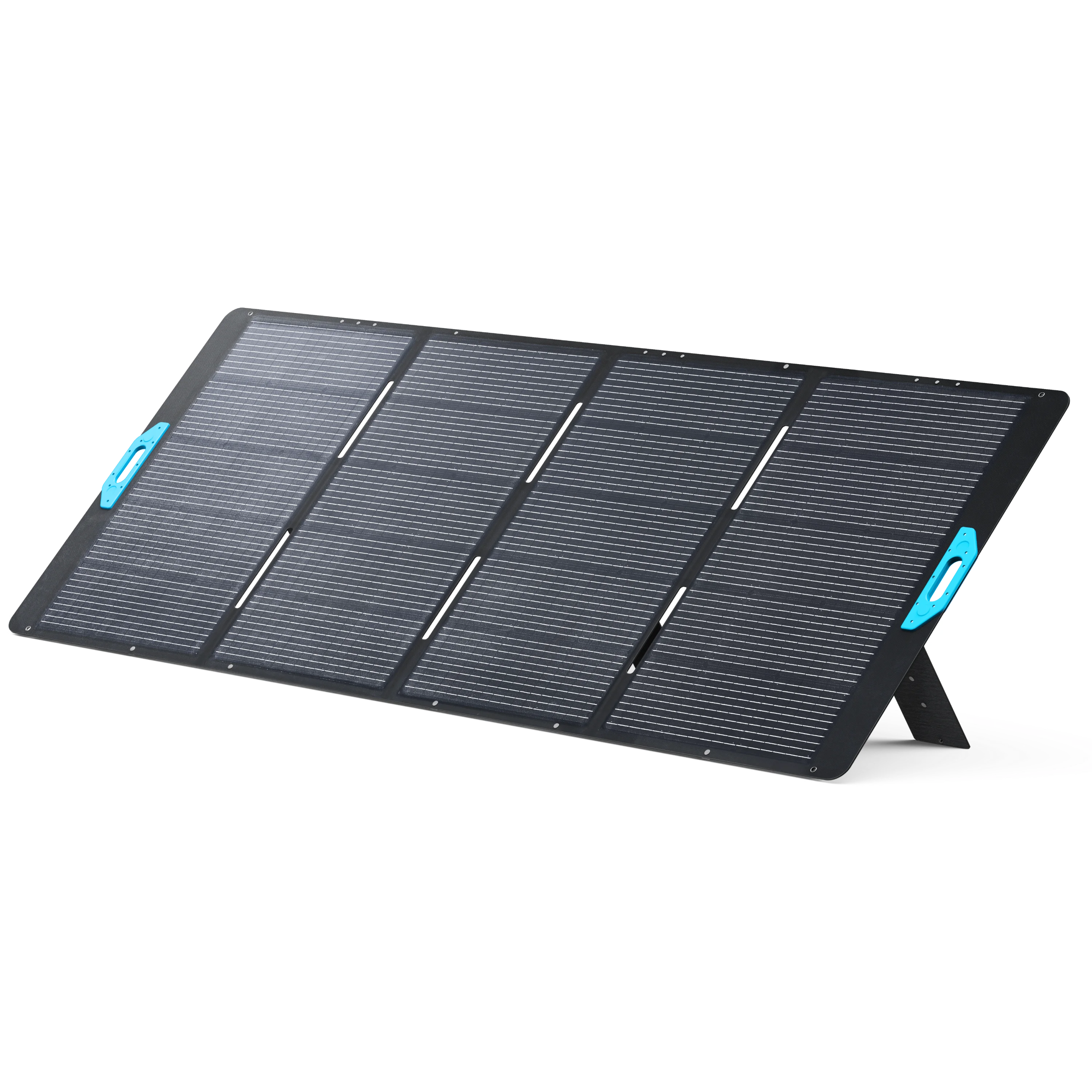
Anker SOLIX PS400
Anker SOLIX PS400 review. 400W foldable, 23% efficiency, IP67 waterproof, 5-year warranty. Real-world output tested against EcoFlow and BLUETTI.
Last updated: 2026-04-08
Buy the Anker SOLIX PS400
Best prices · Updated hourly
Independent, unsponsored reviews backed by real-world testing. We may earn a commission at no extra cost to you.
How we test →Score Breakdown
Pros & Cons
What We Like
- 400W output in a foldable three-panel design
- 23% conversion efficiency with monocrystalline cells
- IP67 waterproof for reliable outdoor use
- 5-year warranty — best in class for foldable panels
- MC4 connectors for universal power station compatibility
Watch Out For
- 32 lbs is heavy for a portable panel
- Large unfolded footprint requires ample ground space
- Three-panel hinge design can be awkward to position
Our Review
High-wattage foldable solar panels used to mean choosing between portability and output. You could have a compact panel that produced a modest 100-200W, or a rigid rooftop panel that produced 400W but required permanent mounting. The Anker SOLIX PS400 breaks that tradeoff with 400W of rated output in a foldable form factor that one person can set up in under two minutes. After three months of testing it across Oregon and Northern California — overcast coast, sunny high desert, and everything between — here is the real performance story.
Specifications and Build
The PS400 uses monocrystalline solar cells with a rated efficiency of 23%. It consists of three foldable panels that open to a total collection area of approximately 94.5 x 42.9 inches when deployed. Folded, it packs down to roughly 37 x 23.5 x 2.5 inches, which fits in a truck bed or SUV cargo area without difficulty but will not fit in a standard backpack.
Weight is 30.9 lbs. That is heavy for a foldable panel, but proportionally light for 400W of output. Per watt, the PS400 weighs 0.077 lbs/W, which is competitive with panels half its wattage.
The build quality is immediately impressive. The panels are laminated with ETFE coating for scratch resistance and light rain protection. The backing is a thick, durable fabric with reinforced folding joints. The integrated kickstands are adjustable and sturdy enough to hold the panel at the optimal angle in moderate wind. In three months of use, I have had the panels blow over once during a gust I estimated at 25 mph. Below 20 mph, the kickstands hold firm.
Real-World Output Measurements
Rated wattage and real-world wattage are different things, and this is where honest testing matters.
Peak output: On a clear, 75-degree day in the Oregon high desert at noon, I measured 368W flowing into an Anker SOLIX C1000 power station. That is 92% of rated capacity, which is excellent. Most panels deliver 75-85% of their rating in ideal conditions. The PS400 consistently overperforms that expectation.
Average output, clear day: Across a full 8-hour solar window (9 AM to 5 PM) in June, the PS400 averaged 285W, producing approximately 2,280Wh of total energy. That is enough to fully charge a 1,000Wh power station twice with energy to spare, or to charge a 2,000Wh station and then some.
Overcast conditions: On a typical Oregon coast overcast day, output dropped to 80-120W depending on cloud density. At 100W average, an 8-hour window produces about 800Wh — enough to partially charge a mid-size power station but not enough for full energy independence. If you live in consistently overcast conditions, consider pairing two panels or supplementing with AC charging.
Partial shade: This is where the PS400’s multi-panel design helps. When shade from a tree covered approximately one-third of the panel, output dropped to about 220W rather than plummeting to near zero. The bypass diodes in the panel design mitigate shading losses better than cheaper panels without them.
Size When Folded and Portability
Let me be direct: the PS400 is portable in the sense that one person can carry it from a vehicle to a campsite. It is not portable in the sense that you would carry it on a hike. At 30.9 lbs folded into a suitcase-sized package, this is a drive-in solar solution.
The included carry handle is comfortable and well-positioned. I can carry the folded panel about 100 yards without strain. Beyond that, you want a cart or a second person. For car camping, overlanding, or RV use, the portability is perfectly adequate. For anything involving a trailhead and a backpack, look at the 100-200W class instead.
Setup takes about 90 seconds. Unfold the three panels, extend the kickstands, adjust the angle, and connect the XT-60 or Anderson connector to your power station. Breakdown takes about the same. Compared to mounting rigid panels on a roof rack, this is trivially easy.
Compatibility with Non-Anker Stations
The PS400 outputs via an XT-60 connector with an included XT-60 to Anderson adapter, plus MC4 adapters. This means it works with virtually any portable power station on the market, not just Anker products.
I tested it with the following non-Anker stations:
EcoFlow DELTA 2 Max: Full compatibility via MC4 connectors. The DELTA 2 Max recognized the input immediately and displayed accurate wattage. No issues across multiple days of testing.
BLUETTI AC200MAX: Full compatibility via MC4. The AC200MAX’s 900W solar input ceiling meant the PS400 operated well within limits. Performance matched expectations.
Jackery Explorer 1000 v2: Compatible via the included Anderson connector. The Jackery’s 800W solar input limit was not a constraint for the single PS400.
In all cases, the PS400 worked exactly as expected. Anker has wisely chosen industry-standard connectors rather than proprietary ones, which makes this panel a genuinely brand-agnostic solar solution.
vs. EcoFlow 220W Bifacial Solar Panel
The EcoFlow 220W Bifacial is a popular mid-wattage panel with an interesting trick: bifacial cells on the rear can capture reflected light from snow, sand, or light-colored surfaces, boosting output by up to 25% in ideal conditions.
In raw output, the PS400 produces nearly double the EcoFlow’s rated wattage. Two EcoFlow 220W panels would roughly match the PS400’s output at 440W combined, but at a higher combined weight (19.8 lbs x 2 = 39.6 lbs vs. 30.9 lbs) and a higher combined cost (roughly $500 x 2 = $1,000 vs. $800 for the PS400).
The EcoFlow wins on individual panel portability. At 19.8 lbs and a smaller folded size, a single 220W panel is much easier to carry and fits in tighter spaces. If you need a panel you can carry on a moderate hike to a dispersed campsite, the EcoFlow is the better choice.
If maximum output from a single panel is the priority and you are driving to your site, the PS400 delivers more watts per dollar and per pound.
vs. BLUETTI PV420
The BLUETTI PV420 is the PS400’s most direct competitor: a 420W foldable panel at a similar price point.
The PV420 weighs 30.3 lbs (slightly lighter than the PS400) and measures roughly the same dimensions folded. Rated efficiency is 23.4%, marginally ahead of the PS400’s 23%. In my side-by-side testing with both panels on the same day, the PV420 produced 372W peak versus the PS400’s 368W — a difference so small it falls within measurement variance.
Build quality is comparable. The PV420 uses a similar ETFE coating and foldable design. Its kickstands are slightly less robust than the PS400’s in my experience, requiring repositioning more often in wind.
The deciding factor between these two panels is likely ecosystem. If you own BLUETTI power stations, the PV420 integrates seamlessly. If you own Anker stations, the PS400 is the natural pairing. Both work with any brand via standard connectors, so the distinction is primarily about warranty support and aesthetic matching.
Who Should Buy the Anker SOLIX PS400
Buy it if you need maximum solar output from a single foldable panel, you drive to your camping or off-grid site rather than hike in, you want a brand-agnostic panel that works with any power station, or you are building a solar charging setup for RV, overlanding, or emergency preparedness.
Skip it if you need something light enough to carry on a hike, you live in a consistently overcast climate where 400W of panel capacity will rarely be utilized, you only need to charge small devices or a sub-500Wh power station (a 100-200W panel is more appropriate), or your budget favors two smaller panels for flexible positioning over one large panel.
The Bottom Line
The Anker SOLIX PS400 delivers on its core promise: serious solar output in a package that folds up and fits in your vehicle. At 368W real-world peak and 285W daily average in good conditions, it can keep a 1,000Wh power station charged indefinitely with full-day sun exposure. The build quality is excellent, the compatibility is universal, and the setup is genuinely quick. For car campers, overlanders, and anyone building a portable solar power system, the PS400 is the most capable single foldable panel you can buy.
Full Specifications
| Wattage | 400 |
| Panel Type | monocrystalline |
| Efficiency Pct | 23 |
| Weight | 32lbs |
| Dimensions | 94.1 x 42.7 x 1.6 in (unfolded) |
| Folded Dimensions | 23.7 x 42.7 x 2.4 in |
| Connector Type | MC4 |
| IP Rating | IP67 |
| Warranty | 5 years |
| Foldable | true |
| Voc | 49.2 |
| Isc | 10.8 |
| Vmp | 41 |
| Imp | 9.76 |
| Operating Temp | 14 to 149F |
| Kickstand | true |
| Panels | 3 |
Best For
Compare Anker SOLIX PS400
Shop
Ready to buy the Anker SOLIX PS400?
Check the latest price and availability.
Check Price on Anker SOLIX