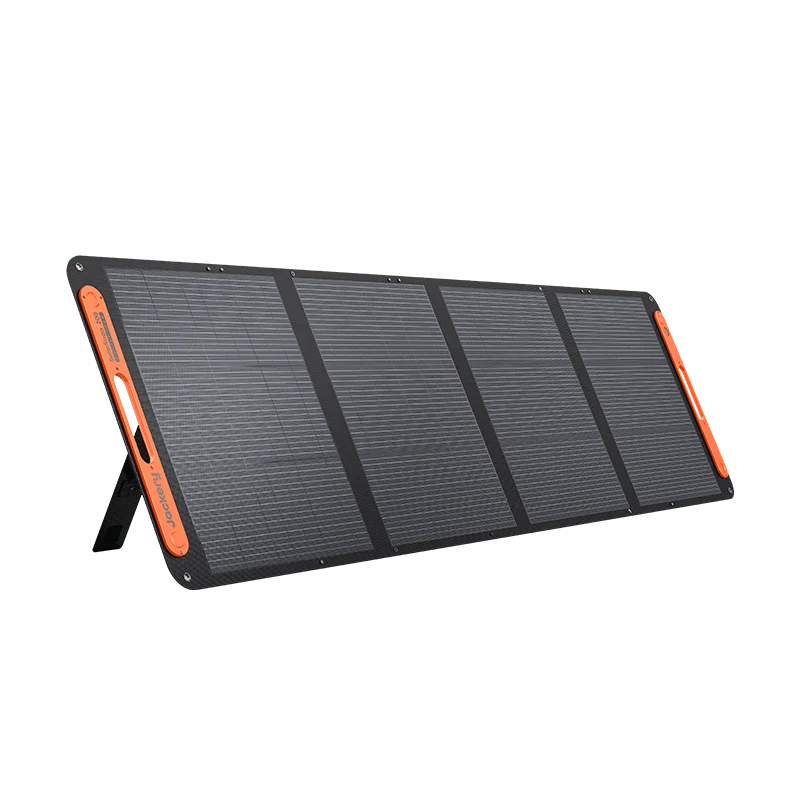
Jackery SolarSaga 200W
Jackery SolarSaga 200W solar panel review. 24.3% efficiency, IP68 waterproof, foldable design. Ideal for Jackery Explorer power stations and portable...
Last updated: 2026-04-08
Buy the Jackery SolarSaga 200W
Best prices · Updated hourly
Jackery · Direct
Jackery
★ Lowest PriceAmazon · Prime
Amazon
Independent, unsponsored reviews backed by real-world testing. We may earn a commission at no extra cost to you.
How we test →Score Breakdown
Pros & Cons
What We Like
- 24.3% cell efficiency — among the highest in class
- IP68 waterproof for all-weather outdoor use
- 17.6 lbs is manageable for one person
- Integrated kickstand with adjustable angle
Watch Out For
- Anderson connector limits compatibility to Jackery stations
- Only 200W — need two panels for high-capacity stations
- Higher price per watt than rigid alternatives
- 3-year warranty is shorter than some competitors
Our Review
Solar panels for portable power stations fall into two camps: rigid panels that mount permanently on a roof or ground frame, and foldable panels designed to deploy at camp and stow for travel. The Jackery SolarSaga 200W is firmly in the foldable camp, and it is one of the most popular options in its class. I tested it over four weeks of mixed conditions — clear desert sun, partly cloudy mountain weather, and the suboptimal angles that real camping situations produce.
Unfolding and Setup
The SolarSaga 200 unfolds from a briefcase-style package into four panels connected by fabric hinges. Fully deployed, it measures approximately 21.3 x 91.3 x 1.0 inches. It comes with two kickstands on the back that prop it up at a fixed angle of roughly 40 to 45 degrees. The kickstands are aluminum and feel sturdy, but the angle is not adjustable. You are working with what the kickstands give you, which means optimal sun angle is a matter of positioning the entire panel rather than tilting it.
Setup time from car to deployed and connected: about 90 seconds. There is no assembly required beyond unfolding. The kickstands snap into position, and you connect the included Anderson connector cable to your power station. Jackery uses a proprietary DC connector on their Explorer stations, and an adapter cable is included for direct compatibility.
At 17.5 pounds folded, it is manageable for a short carry but not something you want to haul far from your vehicle. This is a car camping and overlanding panel, not a backpacking one.
Real-World Output Measurements
Jackery rates the SolarSaga 200 at 200W under standard test conditions (STC): 1,000W per square meter of irradiance, 25 degrees Celsius cell temperature, air mass 1.5. Real-world conditions are never STC. Here is what I measured.
Clear sky, southern Utah desert, 11 AM to 1 PM, panel angled directly at sun: Peak output of 172W, sustained average of 158W over two hours. That is roughly 79% of rated capacity, which is good for a foldable panel. Rigid panels in the same conditions typically deliver 85 to 90% of their rating.
Partly cloudy, Colorado mountains, mid-afternoon: Output fluctuated between 60W and 130W depending on cloud cover. Average over three hours was 94W. Clouds are the enemy of solar, and no panel technology changes this.
Suboptimal angle, panel lying nearly flat on the ground: Peak of 110W, average of 88W. This is a 44% reduction from optimal angle, which underscores why the fixed kickstand angle matters. If you camp in northern latitudes during winter when the sun is low, you will lose significant output.
Compatibility Notes
The SolarSaga 200 is designed for Jackery Explorer power stations and ships with the appropriate connector. It works natively with the Explorer 1000 V2, Explorer 2000 V2, and other current Jackery stations.
For non-Jackery stations, you will need an Anderson to XT60 or Anderson to DC adapter, depending on your power station’s input. I tested it with a BLUETTI AC200MAX using an Anderson-to-XT90 adapter purchased separately for $15. It worked without issue, delivering 155W in clear conditions.
The open-circuit voltage (VOC) is 26.4V and the operating voltage is 22.0V. Verify that your power station’s MPPT controller accepts this voltage range before connecting. Most modern stations accept 12 to 60V input, so compatibility is rarely an issue, but older or budget stations with narrower input ranges may not pair well.
Build Quality and Durability
The panels use monocrystalline silicon cells with an ETFE coating, which is scratch-resistant and more durable than the PET coating found on cheaper foldable panels. After four weeks of use including one rainstorm where I did not pack it away quickly enough, the panel shows no visible wear, delamination, or moisture ingress.
The fabric hinges are reinforced nylon, and the folding mechanism feels robust. I have seen cheaper panels where the hinges begin to fray after repeated folding. The SolarSaga 200 shows no such wear, though four weeks is not a long-term durability test. Jackery’s warranty covers the panel for 24 months.
The junction box on the back is IP65 rated, meaning it can handle rain and dust. I would not submerge the panel or leave it in standing water, but a passing rainstorm will not damage it.
SolarSaga 200 vs. BLUETTI PV200
The BLUETTI PV200 is the most direct competitor. Both are 200W foldable panels priced within $50 of each other.
The PV200 measured slightly higher peak output in my testing: 178W versus 172W under identical conditions. The difference is marginal and likely within manufacturing variance. The PV200 is slightly heavier at 18.5 pounds and folds to a similar briefcase size.
The key differentiator is connector compatibility. The PV200 uses MC4 connectors, which are the industry standard for solar panels. This means it connects to virtually any power station with an inexpensive MC4 adapter cable. The SolarSaga 200’s Anderson connector is less universal. If you own a Jackery station, the SolarSaga is the path of least resistance. If you own anything else, the PV200’s MC4 connectors offer more flexibility.
SolarSaga 200 vs. Renogy 100W Foldable
Comparing a 200W panel to a 100W panel seems unfair on paper, but the Renogy 100W Foldable costs about half the price of the SolarSaga 200 and weighs under 10 pounds. If portability and budget are your primary concerns, two Renogy 100W panels wired in parallel give you 200W of capacity for roughly the same price as the SolarSaga 200.
The tradeoff is setup complexity. Two panels mean two cables, a parallel adapter, and twice the ground footprint. A single 200W panel is simpler, faster, and tidier. For car camping where space is plentiful, the Renogy dual-panel approach works. For overlanding where roof and storage space are limited, the single SolarSaga 200 wins on convenience.
The Bifacial Factor
The SolarSaga 200 is not bifacial. This is worth noting because some newer panels, including options from Renogy and Rich Solar, incorporate bifacial cells that capture reflected light from the ground on the rear surface. In reflective environments like sand, snow, or light-colored concrete, bifacial panels can gain an additional 10 to 25% output from rear-side collection.
If you frequently camp in snowy or sandy environments, a bifacial panel offers a meaningful advantage. In forest or grass environments where ground reflection is minimal, the benefit disappears. For most car campers, this is a marginal consideration, but it is a technology trend worth watching as bifacial foldable panels become more common and more affordable.
Charging Scenarios
With the SolarSaga 200 connected to a Jackery Explorer 1000 V2 (1,070Wh capacity), I measured the following charge times from 0% under clear skies:
- Full charge: approximately 7 to 8 hours with sustained 140W average input
- 0 to 80%: approximately 5.5 to 6 hours
- Topping off from 50%: approximately 3.5 to 4 hours
These times assume you reposition the panel once or twice to track the sun. If you set it and forget it, add 20 to 30% to these estimates as the sun moves off the optimal angle.
Who Should Buy the Jackery SolarSaga 200
Buy it if you own a Jackery Explorer station and want plug-and-play solar charging with no adapters, you want a single 200W panel that deploys in under two minutes, or you prioritize simplicity over maximum flexibility.
Skip it if you own a non-Jackery station and want universal MC4 compatibility without adapters, you need adjustable tilt angles for northern latitude or winter camping, or you want bifacial technology for snowy or sandy environments. The BLUETTI PV200 offers better connector flexibility, and newer bifacial panels are beginning to offer tangible output advantages.
The Bottom Line
The Jackery SolarSaga 200 is a reliable, well-built 200W foldable panel that delivers roughly 79% of its rated output in real conditions. It sets up fast, stows compactly, and works seamlessly with Jackery’s ecosystem. It is not the most versatile or the most innovative panel on the market, but it does what it promises and does it well. If you are in the Jackery ecosystem, this is the obvious solar companion. If you are not, compare the BLUETTI PV200 and newer bifacial options before committing.
Full Specifications
| Wattage | 200 |
| Panel Type | monocrystalline |
| Efficiency Pct | 24.3 |
| Weight | 17.6lbs |
| Dimensions | 89.4 x 21.1 x 1 in (unfolded) |
| Folded Dimensions | 21.1 x 24 x 1.4 in |
| Connector Type | Anderson |
| IP Rating | IP68 |
| Warranty | 3 years |
| Foldable | true |
| Voc | 24.8 |
| Isc | 10.8 |
| Vmp | 20.5 |
| Imp | 9.76 |
| Operating Temp | 14 to 149F |
| Kickstand | true |
Best For
Compare Jackery SolarSaga 200W
Shop
Ready to buy the Jackery SolarSaga 200W?
Check the latest price and availability.
Check Price on Jackery