Last updated: April 2026
Essential Tiny House Off-Grid Equipment
Five equipment categories make up a complete tiny house off-grid system. Each card links to our best-for guides with tiny-house-specific recommendations.
Battery Banks
LiFePO4 battery banks sized for tiny house daily loads. Compact enough for under-floor or closet mounting, powerful enough for full-comfort living.
- ✓ 5kWh minimum for basic loads
- ✓ 10-15kWh for full-comfort living
- ✓ LiFePO4 for daily cycling and compact size
Solar Panels
Roof-mounted panels optimized for the limited footprint of a tiny house. Maximize wattage per square foot with high-efficiency monocrystalline panels.
- ✓ 1,600-3,200W roof-mounted array
- ✓ High-efficiency panels (22%+) to maximize roof space
- ✓ Ground-mount supplement for foundation builds
Water Filtration
Gravity filters for rainwater harvesting and well water, inline filters for municipal connections, and UV purifiers for comprehensive treatment.
- ✓ Gravity filter for rainwater and well water
- ✓ Inline filter for municipal hookups
- ✓ UV purifier for untreated sources
Inverters
Pure sine wave inverters and hybrid inverter-chargers that serve as the brain of your tiny house electrical system.
- ✓ 3,000W for standard tiny house loads
- ✓ 5,000W+ if running heat pump or induction cooktop
- ✓ Hybrid inverter-charger for generator/grid backup
Portable Power Stations
An alternative to a full battery-inverter system for budget builds or as a backup power source for critical loads.
- ✓ 2-4kWh units for budget tiny house setups
- ✓ Expandable systems that grow with your needs
- ✓ Good stepping stone before full electrical install
Battery Bank Sizing for Tiny Houses
Your battery bank is the heart of your tiny house electrical system. Size it based on your daily consumption multiplied by your desired days of autonomy (typically 1.5-2 days to handle cloudy weather without a generator).
Sizing Formula
Battery Bank (kWh) = Daily Consumption (kWh) x Days of Autonomy
Example: 6kWh/day x 2 days = 12kWh battery bank. With LiFePO4 batteries at 100% usable depth of discharge, that is exactly 12kWh of battery capacity needed.
Power Consumption Reference
| Appliance | Draw | Daily Est. |
|---|---|---|
| Full-size refrigerator | 100-200W | 1,200-2,400Wh |
| LED lighting (whole house) | 20-50W | 120-300Wh (6h) |
| Laptop + phone charging | 50-100W | 200-400Wh |
| Induction cooktop (single) | 1,200-1,800W | 600-900Wh (30 min) |
| Mini-split heat pump | 500-1,200W | 4,000-9,600Wh (8h) |
| Water pump | 40-100W | 80-200Wh (2h) |
| Washing machine | 300-500W | 300-500Wh (1 load) |
| Ventilation fans | 10-30W | 60-180Wh (6h) |
Solar Panel Roof Constraints
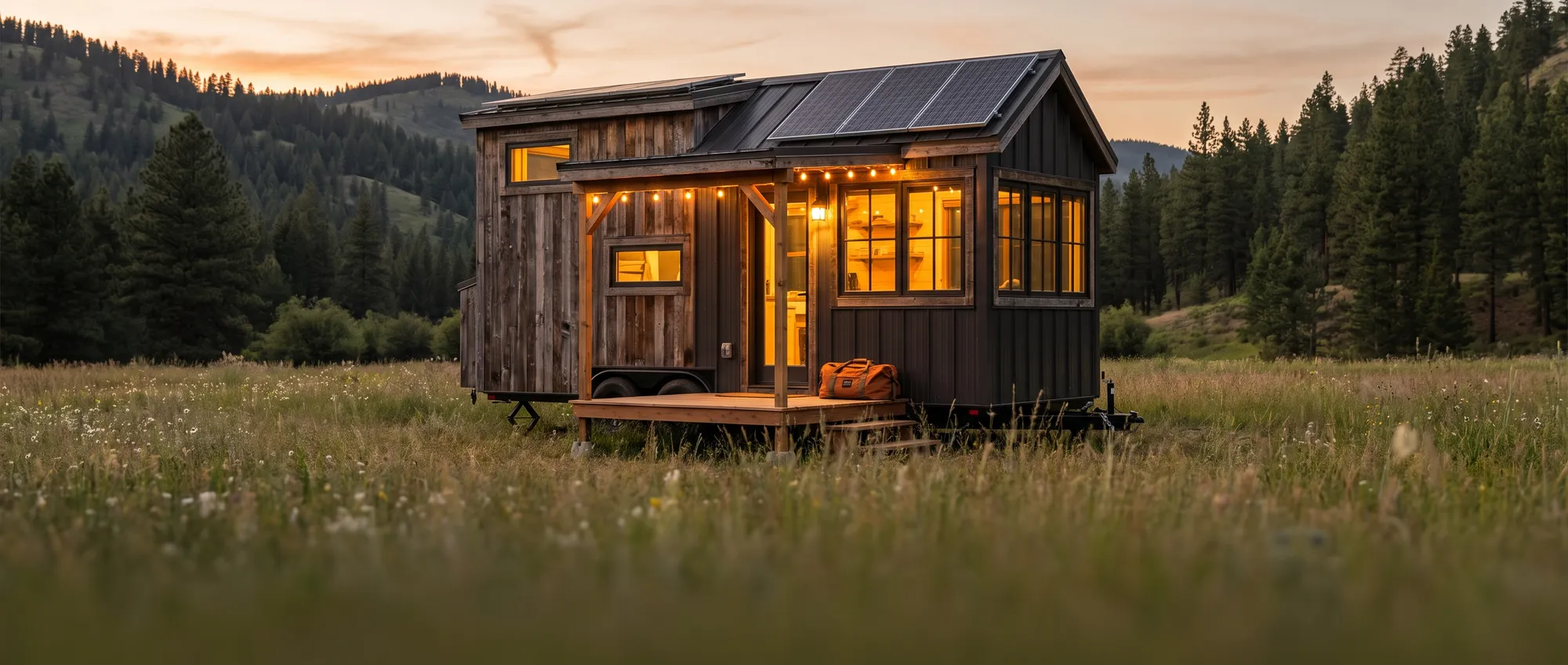
Tiny house roofs are your biggest limitation. A typical tiny house on wheels (THOW) has a roof area of roughly 170-240 sq ft, but usable panel space is less after accounting for slope, vents, skylights, and edge setbacks.
Tiny House on Wheels
- • Usable roof: 120-180 sq ft after vents and setbacks
- • Fits 4-8 standard 400W panels (1,600-3,200W)
- • Weight matters: ~50 lbs per panel on trailer frame
- • Shed-style roofs maximize south-facing area
- • Tilt angle fixed by roof pitch (consider adjustable mounts)
Tiny House on Foundation
- • Same roof space, but no weight constraint
- • Can supplement with ground-mounted array
- • Ground mounts allow seasonal tilt adjustment
- • Easier wiring runs to a dedicated utility closet
- • Pole-mounted trackers are an option for maximum yield
Water Filtration for Tiny Houses
Your water source dictates your filtration needs. Tiny houses on wheels often connect to municipal water at RV parks or collect rainwater, while foundation builds may have well access.
On Wheels (Mobile)
- ✓ Inline carbon filter for municipal/RV park hookups
- ✓ Gravity filter for rainwater or stream water
- ✓ Portable water tank (50-100 gal) with 12V pressure pump
- ✓ UV purifier for additional safety with untreated sources
On Foundation (Permanent)
- ✓ Well pump with sediment pre-filter
- ✓ Whole-house multi-stage filtration system
- ✓ Rainwater cistern with first-flush diverter
- ✓ Gravity-fed system from elevated tank (zero power)
Budget Tiers for Off-Grid Tiny Houses
Your off-grid investment scales with your comfort expectations. All three tiers deliver energy independence -- they differ in convenience and capacity.
Budget Tier
$3,000 - $5,000
Essential off-grid capability with lifestyle compromises. Best for part-time use or minimal needs.
- Power: 2-3kWh portable power station
- Solar: 400-800W portable panels
- Water: Gravity water filter + propane water heater
- Inverter: Built into power station
Trade-offs: No AC, limited simultaneous loads, propane dependence for cooking and heating
Mid-Range Tier
$8,000 - $15,000
Comfortable daily living with most modern conveniences. The sweet spot for most tiny house owners.
- Power: 10kWh LiFePO4 battery bank
- Solar: 1,600-2,400W roof-mounted array
- Water: Gravity filter + UV purifier + small pressure pump
- Inverter: 3,000W pure sine wave inverter-charger
Trade-offs: May need generator backup in extended cloudy weather
Premium Tier
$18,000 - $30,000+
Full independence with zero compromises. Heat pump, induction cooking, washer, and multi-day autonomy.
- Power: 15-20kWh LiFePO4 battery bank
- Solar: 2,400-3,200W roof + optional ground array
- Water: Whole-house multi-stage filtration + tankless electric water heater
- Inverter: 5,000W+ hybrid inverter-charger
Trade-offs: Higher upfront cost, but lowest long-term operating expense