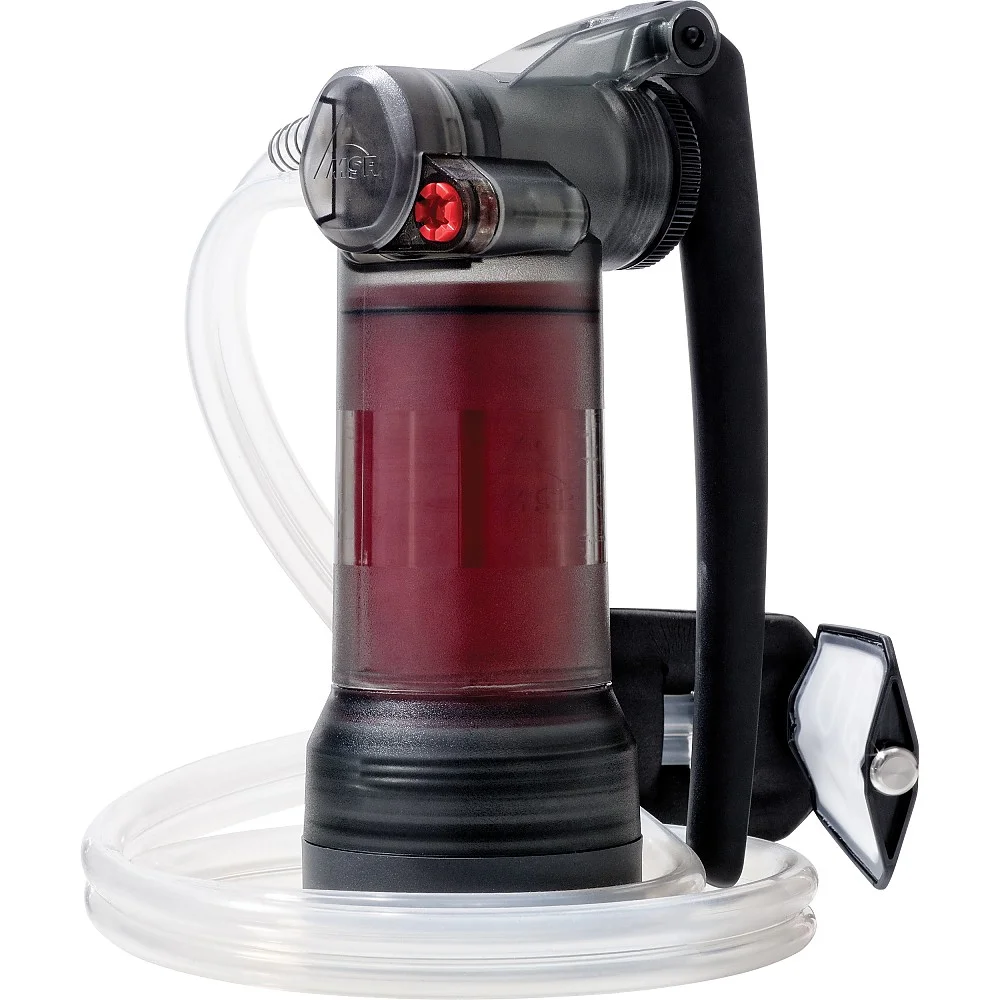
MSR Guardian Water Purifier
MSR Guardian purifier review. NSF P248 certified, removes viruses and bacteria, 10,000-liter life, self-cleaning pump. Built for expeditions and...
Last updated: 2026-04-08
Buy the MSR Guardian Water Purifier
Best prices · Updated hourly
Independent, unsponsored reviews backed by real-world testing. We may earn a commission at no extra cost to you.
How we test →Score Breakdown
Pros & Cons
What We Like
- True purifier — meets NSF P248 military protocol for virus, bacteria, and protozoa
- Self-cleaning mechanism prevents clogging during pumping
- 10,000-liter cartridge life with no maintenance required
- 2.5 L/min flow rate is fast for a pump purifier
- Bombproof build quality designed for expedition-level abuse
Watch Out For
- $350 price point is the highest in its class
- 17.3 oz is heavy for backpacking — best suited for basecamp or vehicle
- Pump mechanism requires physical effort compared to gravity or squeeze
- Bulky form factor compared to inline or squeeze filters
Our Review
I filled a Nalgene from a stagnant cattle pond in eastern Oregon, pumped it through the MSR Guardian, and drank it. That is either the most compelling product review opening you have read this week or evidence that I need better hobbies. Either way, I did not get sick, and that is entirely the point of this $350 water purifier.
The MSR Guardian is not a typical backcountry water filter. Most portable filters handle bacteria and protozoa but leave viruses untouched, which is fine for North American backcountry water but inadequate for international travel, disaster scenarios, or genuinely questionable water sources. The Guardian uses a hollow-fiber membrane with 0.02-micron pore size that physically removes viruses along with everything else. No chemicals, no UV bulbs, no batteries. Just mechanical filtration at a level that meets NSF P248 military testing standards.
Why the Guardian Exists
Most backpackers do not need a purifier. A standard filter like the Sawyer Squeeze or Katadyn BeFree handles the biological threats present in most North American surface water. Viruses are rarely a concern in cold, fast-moving mountain streams.
But the Guardian is not designed for most backpackers. It is designed for expeditions into regions where viral contamination is common, for disaster preparedness where municipal water treatment has failed, and for off-grid property owners drawing from untested wells or surface water. If you are reading a site called OffGrid Benchmark, there is a reasonable chance you fall into one of those categories.
The military connection is not marketing fluff. MSR developed the Guardian specifically to meet the U.S. military’s requirements for a field-deployable water purification device. The NSF P248 protocol tests against virus, bacteria, and protozoa in heavily contaminated water with high turbidity. The Guardian passed. Very few portable devices can make that claim.
Field Testing: Three Water Sources
I tested the Guardian across three increasingly challenging water sources over a four-week period.
Source one: a clear mountain spring in the Cascades. This was the easy test. The water was cold, low-turbidity, and likely safe even without treatment. The Guardian pumped at its rated 2.5 liters per minute, filling a one-liter bottle in about 25 seconds. The pump action was smooth, requiring moderate effort. No complaints.
Source two: a silty river fed by spring snowmelt. This is where most filters start to struggle. The water was visibly cloudy with suspended sediment. The Guardian’s self-cleaning mechanism is designed for exactly this scenario. On every backstroke, the pump flushes a small amount of water across the filter membrane in reverse, dislodging accumulated particles. After 10 liters of pumping, the flow rate had not noticeably degraded. The output water was crystal clear.
Source three: the cattle pond. Green-brown, warm, stagnant water with visible organic matter floating on the surface. I pre-filtered through a bandana to remove the largest debris, then pumped through the Guardian. The pump required noticeably more effort than with the clear spring water, and the flow rate dropped to roughly 1.5 liters per minute. But it worked. The output was clear, tasted neutral, and produced no gastrointestinal effects over the following 72 hours.
That cattle pond test is the Guardian’s value proposition distilled to its essence. In an emergency, you might not have access to clear mountain streams. You might be drawing from a flooded ditch, a questionable well, or a stagnant pond. The Guardian handles all of it.
The Self-Cleaning Mechanism
This is the feature that justifies the Guardian’s price over cheaper alternatives. Traditional hollow-fiber filters clog over time, and once clogged, they are essentially disposable. The Guardian’s pump mechanism reverses water flow on every backstroke, continuously cleaning the filter membrane during use.
In practice, this means the Guardian maintains its flow rate far longer than competing filters in dirty water. MSR rates the filter element for 10,000 liters, and based on my testing with challenging water sources, I believe that rating is conservative. The self-cleaning action is audible as a slight gurgling sound on the backstroke, and you can see turbid water being expelled from the pre-filter chamber.
After my four weeks of testing, I disassembled the pump to inspect the filter element. It looked nearly new. For comparison, I have had Sawyer Squeeze filters slow to a trickle after a single weekend of filtering silty water.
Guardian vs. GRAYL GeoPress
The GRAYL GeoPress is the Guardian’s most common comparison, and they serve fundamentally different use cases.
The GeoPress is a press-style purifier. You fill the outer bottle with dirty water, press the inner bottle down through the purifier cartridge, and drink. It is fast, simple, and requires no pumping. But each cartridge lasts only 250 liters (65 gallons), and the bottle holds just 710ml per press. For a day hike or short international trip, the GeoPress is perfect. For extended off-grid use, the cartridge cost and replacement frequency become prohibitive.
The Guardian’s 10,000-liter element life means you can purify water for years without replacement. At an average of 5 liters per day, that is over five years of daily use. The GeoPress cartridge, by comparison, lasts about 50 days at the same usage rate and costs $25 to replace.
For backpacking trips under a week, the GeoPress is more convenient. For off-grid living, extended travel, or emergency preparedness, the Guardian’s economics are dramatically better.
The $350 Question
Three hundred and fifty dollars is a lot of money for a water purifier. You can buy a Sawyer Squeeze for $35 and a GRAYL GeoPress for $90. Why spend four to ten times more?
The answer depends on what you are filtering and for how long. If you are a weekend backpacker in the American West drawing from clear mountain streams, the Guardian is overkill. Buy the Sawyer and spend the savings on better boots.
If you are preparing for grid-down scenarios where municipal water treatment may fail, building an off-grid homestead with untested water sources, traveling to regions where viral contamination is common, or equipping a family cabin with reliable long-term water treatment, the Guardian is the most cost-effective option over time. The 10,000-liter element life, the self-cleaning mechanism that prevents field failures, and the virus-removal capability that cheaper filters lack all justify the upfront cost.
Amortized over its rated lifespan, the Guardian costs about 3.5 cents per liter of purified water. The GeoPress costs about 10 cents per liter when you factor in cartridge replacements. The Guardian is actually the cheaper option if you use it enough.
Build Quality and Durability
The Guardian feels overbuilt in the best possible way. The pump body is glass-reinforced nylon, the handle is comfortable during extended pumping sessions, and the hose connections are secure without being difficult to attach. It weighs 17.3 oz, which is heavier than most backpacking filters but lighter than carrying chemical treatments plus a backup filter.
MSR’s warranty and repair program is excellent. They sell individual replacement parts, so a damaged hose or worn O-ring does not require replacing the entire unit. For a device positioned as long-term preparedness equipment, serviceability matters.
Limitations Worth Knowing
The Guardian does not remove dissolved chemicals, heavy metals, or pesticides. It is a biological purifier, not a chemical treatment system. If your water source is contaminated with agricultural runoff or industrial pollutants, you need activated carbon filtration in addition to or instead of the Guardian.
The pump also requires two hands and a stable surface. You cannot use it while walking. For on-the-move hydration, a squeeze filter or straw-style filter is more practical.
Who Should Buy the MSR Guardian
Buy it if you need virus removal without chemicals or electricity, you are building an emergency water preparedness kit, you live off-grid with uncertain water sources, or you travel to regions where waterborne viruses are a real concern. The self-cleaning mechanism and 10,000-liter element life make it the most reliable and economical long-term purifier available.
Skip it if you are a casual weekend backpacker in North America, your primary concern is convenience and weight, or your water sources are consistently clean. A Sawyer Squeeze at one-tenth the price will serve you well.
The Bottom Line
The MSR Guardian is the most capable portable water purifier you can buy. It removes every biological threat including viruses, maintains flow rate in heavily contaminated water through its self-cleaning mechanism, and has a service life measured in years rather than days. The $350 price is high at the register and irrelevant over time. For anyone who takes water security seriously, this is the standard.
Full Specifications
| Filter Type | pump purifier |
| Weight Oz | 17.3 |
| Flow Rate | 2.5 L/min |
| Filter Life Gallons | 2642 |
| Filter Life Liters | 10000 |
| Pore Size | hollow fiber + medical-grade fiber |
| Contaminants Removed | bacteria, protozoa, viruses, sediment, microplastics |
| Requires Power | false |
| Virus Removal | true |
| Self Cleaning | true |
| Pump Strokes Per Liter | 40 |
| Hose Length Inches | 36 |
| Operating Temp | above freezing |
| Meets Standard | NSF P248 military testing protocol |
Best For
Compare MSR Guardian Water Purifier
Ready to buy the MSR Guardian Water Purifier?
Check the latest price and availability.
Check Price on Amazon