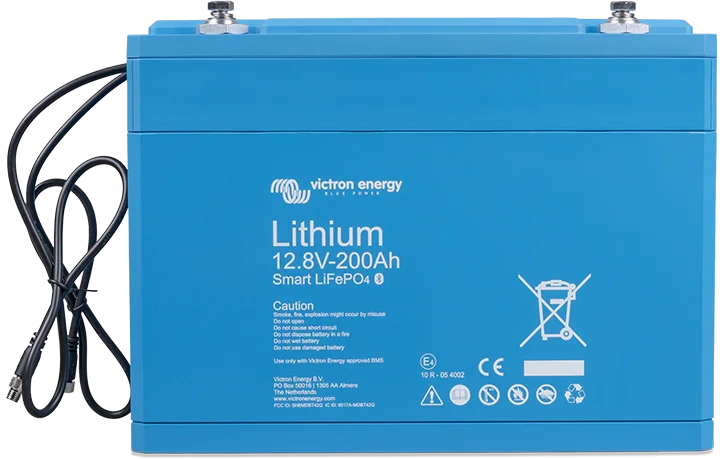
Victron Smart Lithium 12.8V 200Ah
Victron Smart Lithium 12.8V 200Ah review. 5,000 cycles, Bluetooth monitoring, full VE.Bus ecosystem integration. Why professionals and serious...
Last updated: 2026-04-08
Buy the Victron Smart Lithium 12.8V 200Ah
Best prices · Updated hourly
Independent, unsponsored reviews backed by real-world testing. We may earn a commission at no extra cost to you.
How we test →Score Breakdown
Pros & Cons
What We Like
- 5,000 cycle life — among the longest in the industry
- Full Victron ecosystem integration via VE.Bus and Bluetooth
- 200A charge AND discharge rate enables rapid cycling
- Built-in Bluetooth for real-time monitoring via VictronConnect app
- Industry-leading BMS with cell balancing and multi-level protection
Watch Out For
- Premium pricing at $8/Ah — 4x the cost of budget alternatives
- 41F cold cutoff is more restrictive than competitors
- Requires Victron VE.Bus BMS for full ecosystem features
- 55.1 lbs — heavier than most 200Ah competitors
Our Review
The $1,600 Question
Let me get the uncomfortable part out of the way first: the Victron Smart Lithium 12.8V 200Ah battery costs around $1,600. A Battle Born 100Ah — arguably the most popular LiFePO4 battery in the off-grid world — runs about $800 for 100Ah. So you are paying roughly the same per amp-hour, except Battle Born has years of proven track record at that price point and a passionate community behind it.
So why would anyone choose the Victron? I asked myself that same question before I installed one. Six months later, I have the answer, and it comes down to one word: integration.
What Makes This Battery “Smart”
The Victron Smart Lithium is not just a box of LiFePO4 cells with a BMS. It is a battery that was designed from the ground up to be a node in the Victron ecosystem. Every cell is individually monitored, and that data is accessible in real time through Bluetooth and VE.Bus.
Cell-Level Monitoring
Most lithium batteries give you a single voltage reading for the entire pack. The Victron Smart Lithium reports individual cell voltages, which matters more than most people realize. Cell imbalance is one of the primary failure modes in lithium battery packs. When one cell drifts higher or lower than the others, the BMS has to compensate, reducing usable capacity and potentially shortening battery life. With the Victron, I can see exactly what each cell is doing and catch imbalance issues before they become problems.
Through VictronConnect, I can pull up a real-time view of all four cells, their individual voltages, the pack temperature, and the BMS status. This is not data I check every day, but when I am troubleshooting a charging issue or optimizing my system, it is invaluable.
VE.Bus Integration
This is the feature that separates the Victron battery from every competitor. When connected to a Victron inverter-charger like the MultiPlus through a VE.Bus BMS, the battery and inverter communicate directly. The battery tells the inverter its exact state of charge, temperature, and cell voltages. The inverter adjusts its charging parameters in real time based on that data.
What does this mean in practice? The charging algorithm is not just following a pre-programmed voltage curve — it is dynamically adapting to what the battery actually needs. If the cells are cold, the charge rate reduces automatically. If one cell is slightly higher than the others, the charger can adjust to allow the BMS to balance. If the battery reaches its low-voltage cutoff, the inverter shuts down cleanly before the BMS has to hard-disconnect, which is gentler on the entire system.
Compare this to a non-communicating battery where the inverter is essentially guessing based on voltage alone. It works, but it is not optimal.
Installation and Configuration
Installing the Smart Lithium is straightforward if you are already in the Victron ecosystem. The battery connects to a VE.Bus BMS (sold separately, about $150), which then connects to your MultiPlus or Quattro. A smallBMS or VE.Bus BMS v2 handles the communication layer and provides pre-alarm and disconnect signals.
I will be honest — the VE.Bus BMS adds complexity compared to just bolting in a Battle Born and connecting cables. You need to wire the BMS pre-alarm output to the inverter’s auxiliary input, configure the charge disconnect and load disconnect relays, and set up the system in VictronConnect. It took me about three hours to get everything configured and verified, compared to about 30 minutes for a standard drop-in battery.
But once it is configured, you never touch it again. The system manages itself, and you get monitoring data that would require aftermarket equipment with any other battery.
Real-World Performance
I have been running the Smart Lithium 200Ah as the sole house battery in my cargo trailer for six months. The system includes a Victron MultiPlus 12/3000, SmartSolar 100/50 MPPT, Cerbo GX, and 800W of rooftop solar.
Capacity: The full 200Ah is usable. Some batteries advertise 200Ah but the BMS cuts off at 10-20% remaining. The Victron delivers its rated capacity consistently, which I have verified through multiple full discharge cycles monitored on the Cerbo GX.
Charge acceptance: The battery accepts charge at up to 200A (1C rate), which means my 120A MultiPlus charger and 50A solar controller can both charge simultaneously without the BMS throttling. Fast charging from 20% to 100% takes about 90 minutes from shore power alone.
Cold weather: I have used the battery in temperatures down to 25°F. The internal heating is not built-in (unlike some competitors), but the VE.Bus BMS communication prevents charging below freezing automatically. On cold mornings, I run the inverter for 20 minutes to warm the trailer interior before the solar charging kicks in. Not ideal, but safe.
Cycle life: Victron rates the Smart Lithium at 2,500 cycles to 80% capacity at 80% depth of discharge. That is lower than some competitors claiming 4,000-5,000 cycles, though Victron’s number is independently verified and conservatively stated. At one cycle per day, that is nearly seven years of daily use.
How It Compares
vs. Battle Born 100Ah ($800 x2 for 200Ah = $1,600): Nearly identical cost for 200Ah. Battle Born is drop-in simple — literally remove your lead-acid, install the Battle Born, done. No BMS to wire, no VE.Bus to configure. If you are not running a full Victron system, Battle Born is the smarter buy. If you are running Victron components, the Smart Lithium’s integration makes the system greater than the sum of its parts.
vs. Renogy 200Ah ($700): Less than half the price of the Victron. The Renogy is a solid budget battery with Bluetooth monitoring (pack-level, not cell-level). For a basic system with a standalone inverter, the Renogy delivers excellent value. You are trading ecosystem integration and cell-level monitoring for significant cost savings.
vs. SOK 206Ah ($500): The value king. SOK offers slightly more capacity at less than a third of the Victron’s price. Build quality is good, the metal case is robust, and the community support is excellent. But there is no VE.Bus, no cell-level monitoring through external devices, and no direct inverter communication.
vs. Epoch 460Ah Server Rack ($2,400): Different form factor entirely. If you are building a fixed installation (cabin, home backup) and need maximum capacity per unit, the Epoch’s server rack format is more space-efficient. But it does not talk to Victron equipment natively.
Who Should Buy the Victron Smart Lithium
Buy it if: You are building a complete Victron system with a MultiPlus or Quattro inverter-charger. You want cell-level monitoring and automated charge management. You are a professional installer who needs to specify equipment with verified specifications and deep system integration. You value data and remote monitoring through the Cerbo GX and VRM portal.
Skip it if: You are not running Victron inverter-charger equipment — the VE.Bus integration is the primary value proposition, and without it, you are paying a premium for a battery that performs comparably to options at half the price. You want a simple drop-in replacement for lead-acid. Your budget is tight and you would rather allocate funds to solar panels or a bigger inverter.
The Bottom Line
The Victron Smart Lithium 200Ah is not a battery for everyone. It is a battery for systems. If you are building a Victron-based off-grid installation where every component communicates, shares data, and optimizes collectively, the Smart Lithium is the battery that completes that vision. The cell-level monitoring, VE.Bus communication, and automated charge management create a system that is genuinely more than the sum of its parts.
If you are just looking for a good 200Ah LiFePO4 battery, there are excellent options at $500-800 that will serve you well. But if you are building the kind of system where you want to pull up your phone, see every cell voltage, know exactly how many amp-hours you consumed overnight, and trust that your inverter and battery are coordinating perfectly — the Victron is worth every dollar of that $1,600.
Overall Score: 9.0/10
Full Specifications
| Capacity Ah | 200 |
| Voltage | 12.8 |
| Energy Wh | 2560 |
| Battery Type | LiFePO4 |
| Cycle Life | 5,000 cycles |
| Weight | 55.1lbs |
| Dimensions | 20.5 x 10.6 x 8.0 in |
| Bms Included | true |
| Max Continuous Discharge A | 200 |
| Max Charge Rate A | 200 |
| Cold Temp Cutoff | 41F (5C) |
| Operating Temp | 41-122F |
| Series Parallel | true |
| IP Rating | N/A |
| Warranty | 5 years |
| Bluetooth | true |
Best For
Compare Victron Smart Lithium 12.8V 200Ah
Ready to buy the Victron Smart Lithium 12.8V 200Ah?
Check the latest price and availability.
Check Price on Amazon