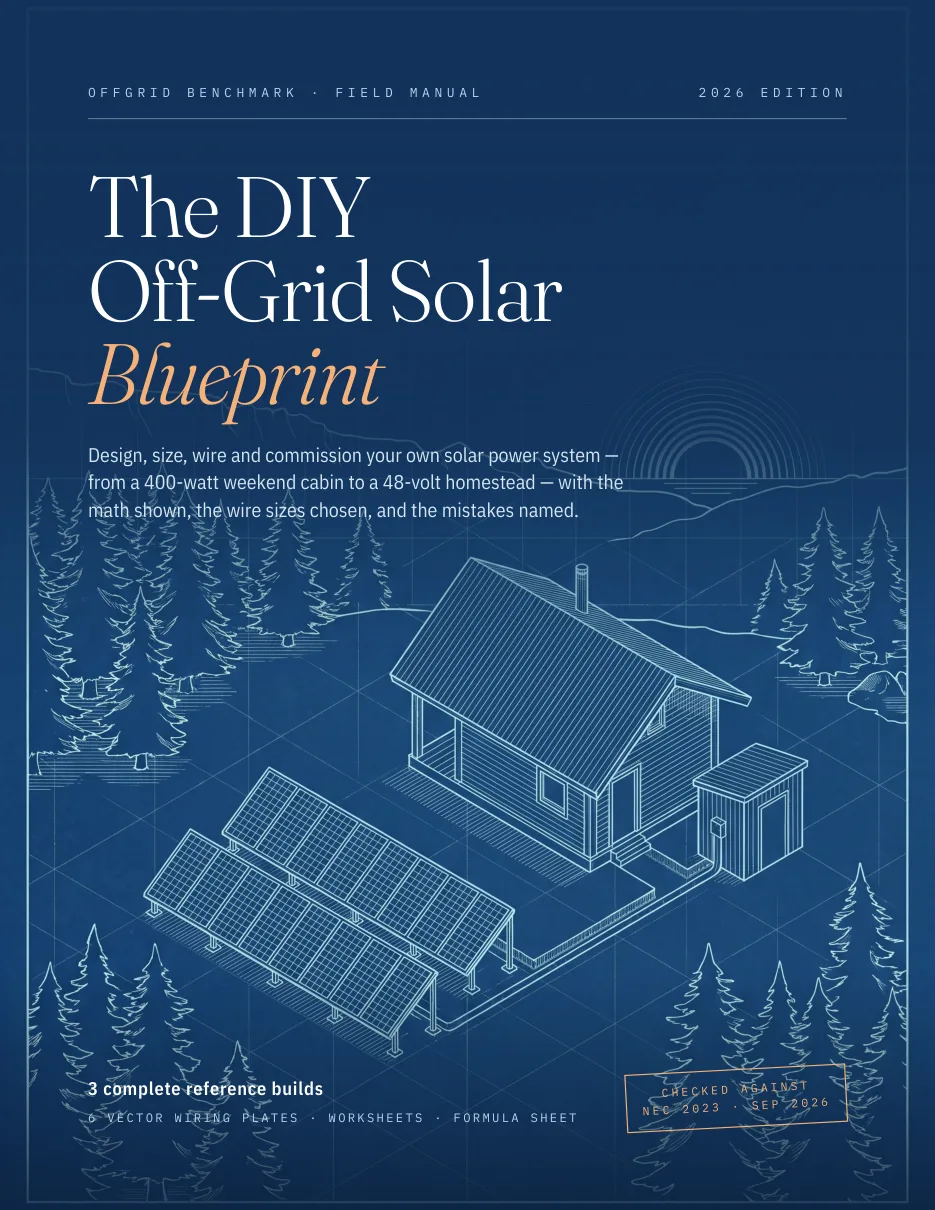
The problem
Most DIY systems fail in the order they were bought: panels on sale, a battery that "seemed big", an inverter sized for a microwave. Then a December week arrives.
The method
Eight phases, in order: loads → voltage → sun → storage → array → electronics → protection → commissioning. Each purchase is decided by the phase before it.
The proof
Three builds worked end-to-end, every fuse and cable size labeled. Code tables, prices and incentive status were verified in September 2026, and every source is listed.
What's inside
Fifteen chapters in four parts (Understand, Design, Build, Operate), plus a formula sheet, printable worksheets, a glossary and a sources appendix.
CH. 01–02
How it works & choosing a voltage
The five components, the energy path, and the current table that settles 12 vs 24 vs 48 V.
CH. 03
The load audit
Measured-not-guessed daily Wh, surge, idle draw, with a real-world appliance reference table.
CH. 04
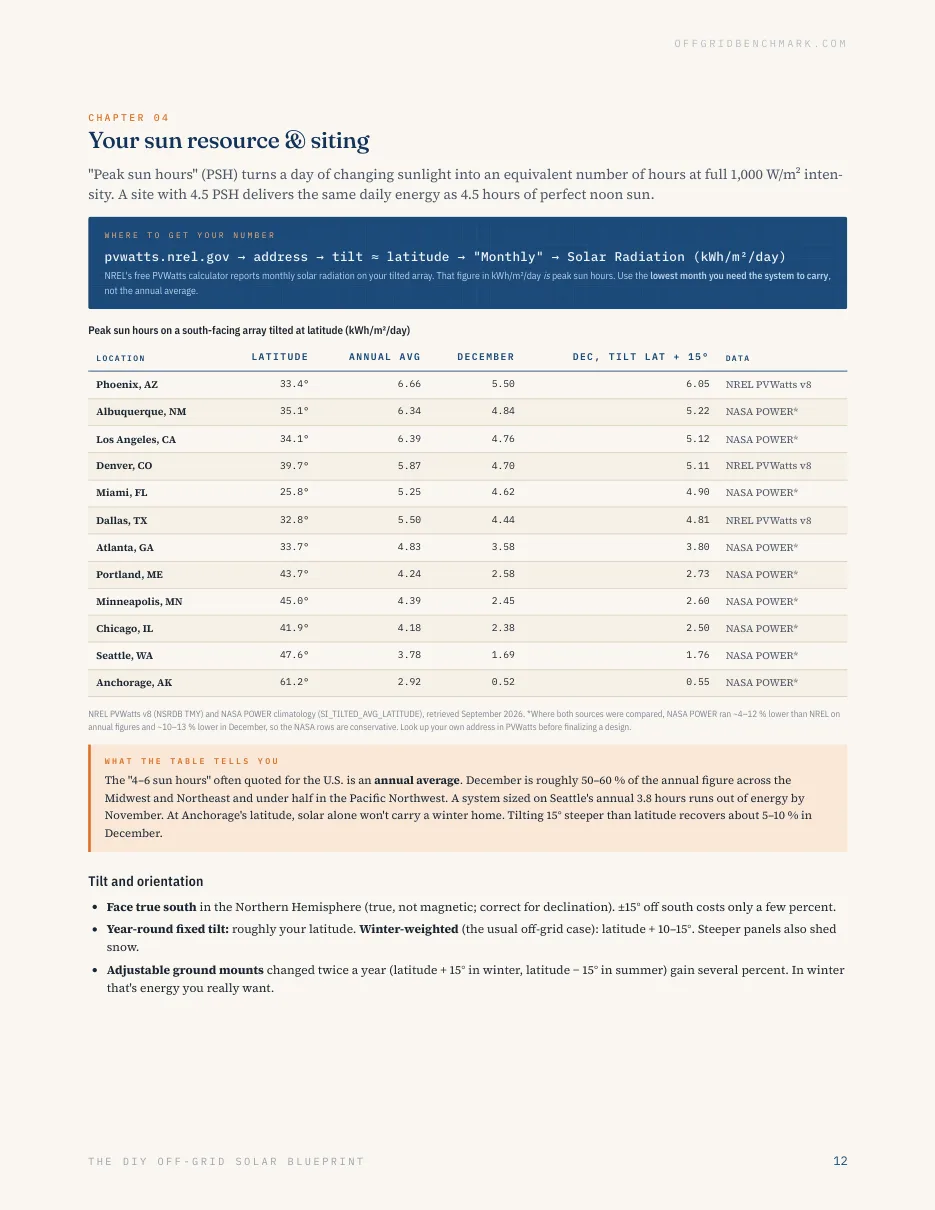
Sun resource & siting
Annual and December peak sun hours for 12 U.S. cities (NREL / NASA), tilt, and the winter shade window.
CH. 05–06
Battery bank & array sizing
Autonomy math, LiFePO4 charge settings, safe paralleling, and the worst-month array formula.
CH. 07–08
Controller, strings & inverter
NEC 690.7 cold-weather Voc check, when strings need fuses, continuous vs surge vs idle.
CH. 09
Wire, fuses & protection
NEC 2023 ampacity table, voltage-drop reach tables for 12/24/48 V, Class T fusing, grounding done right.
CH. 10
Three complete reference builds
12 V Weekender, 24 V Cabin/RV, 48 V Homestead. Each has a wiring plate, protection schedule and priced BOM.
CH. 11–12
Workmanship & commissioning
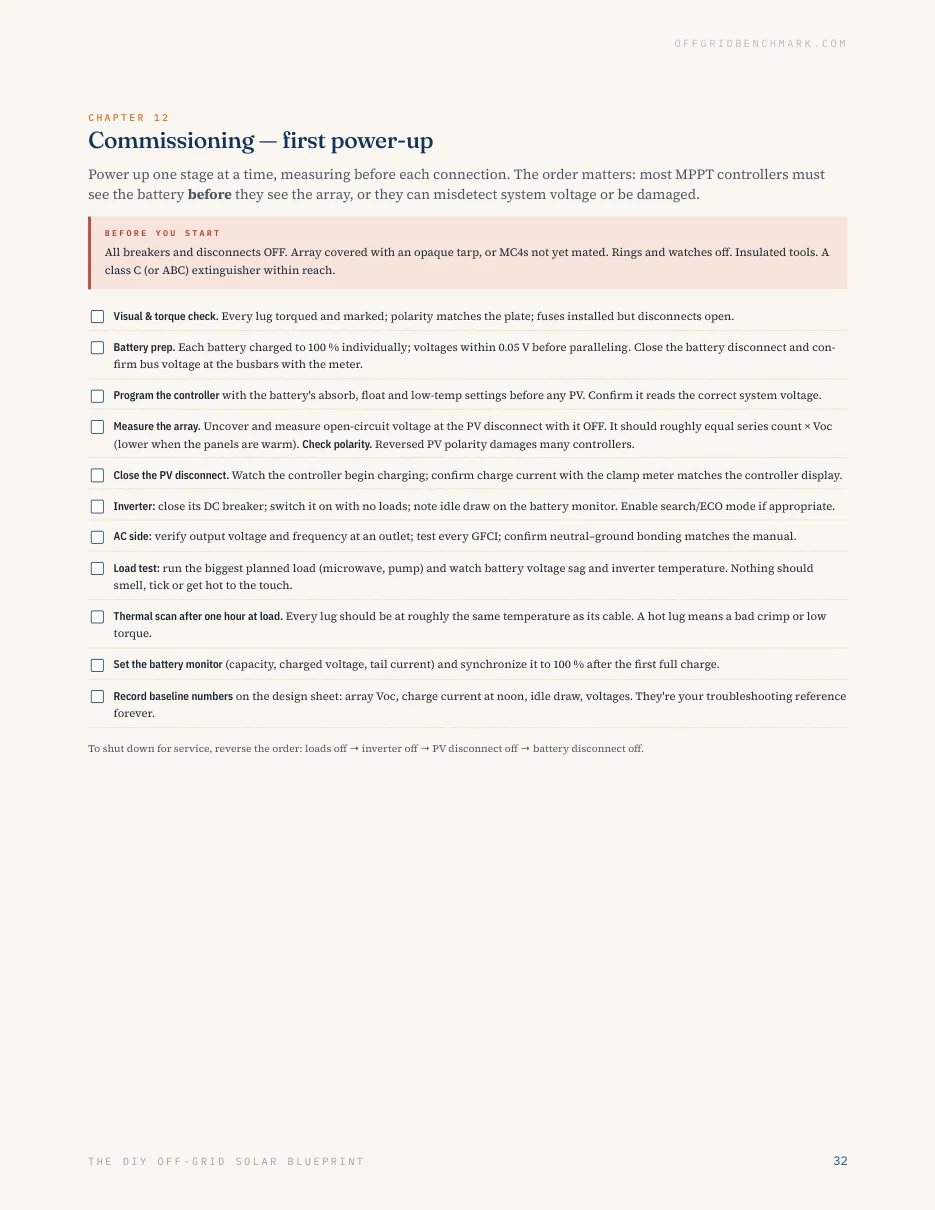
Crimp, torque and label standards, plus an 11-step power-up sequence in the right order.
CH. 13–15
Operate, troubleshoot, permits
Maintenance schedule, symptom→cause→fix table, codes, rapid shutdown, and 2026 incentive status.
Look inside
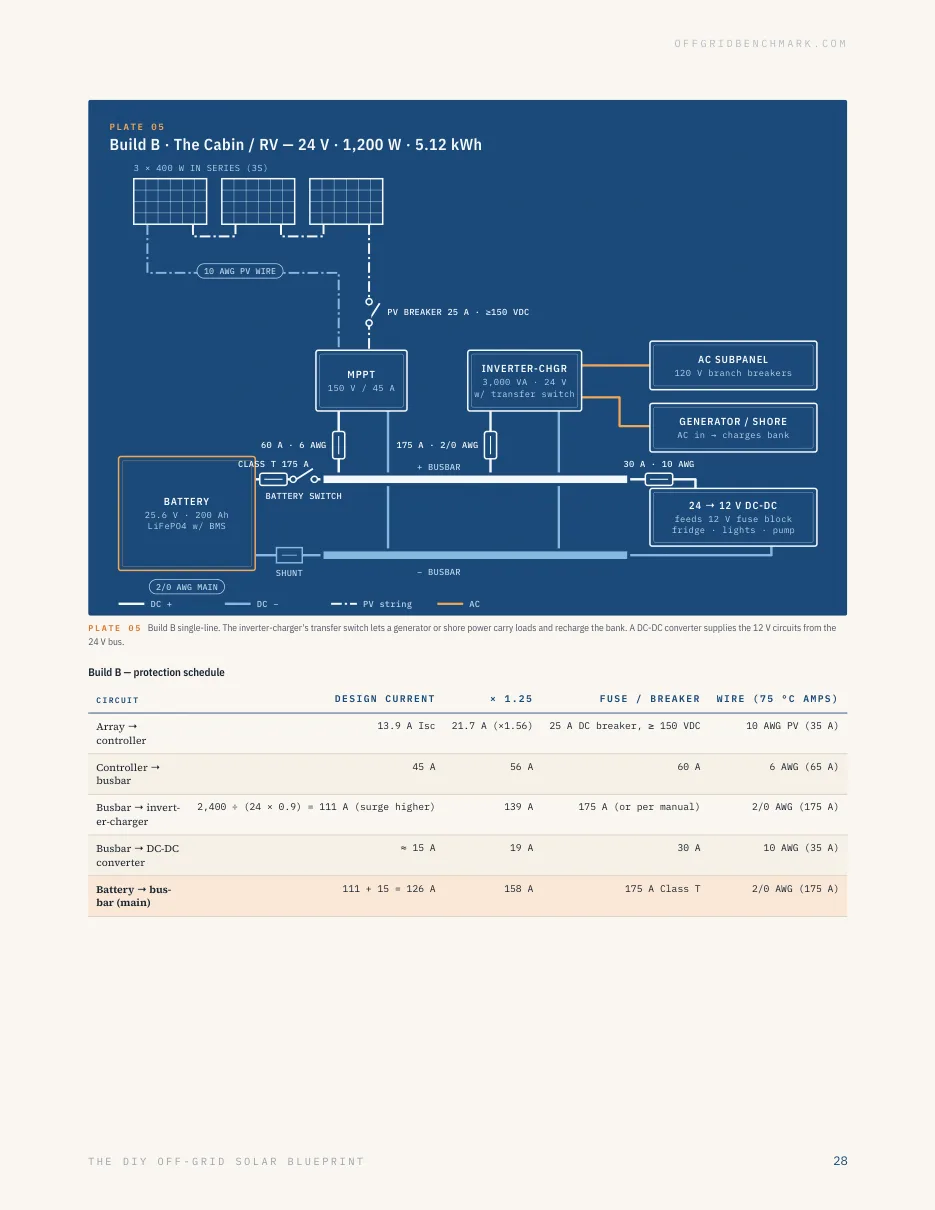
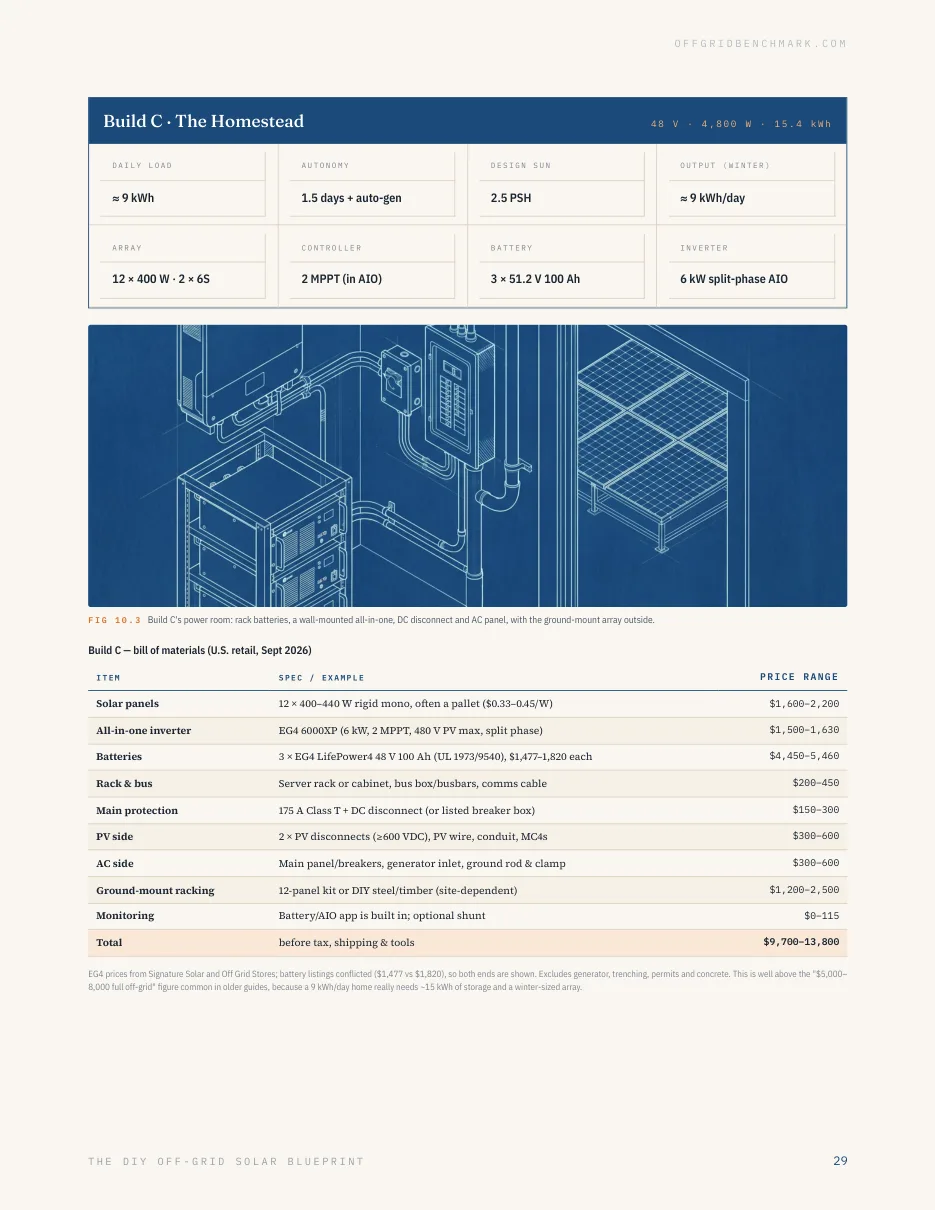
Real pages from the PDF. Wiring plates are vector, so they stay sharp at any zoom and print cleanly for your wall.
Three reference builds, fully specified
Build A · Weekender
12 V · 400 W · 2.56 kWh
Camp cabin, van or backup kit: lights, 12 V fridge, laptop, fan, pump. ≈950 Wh/day.
$1,650–2,450 in parts
Build B · Cabin / RV
24 V · 1,200 W · 5.12 kWh
Part-time living: full-size fridge, microwave, Starlink and a generator-backed inverter-charger. ≈3 kWh/day.
$3,500–5,400 in parts
Build C · Homestead
48 V · 4,800 W · 15.4 kWh
Full-time off-grid: split-phase all-in-one inverter, rack batteries, 240 V well pump. ≈9 kWh/day.
$9,700–13,800 in parts
Part prices are U.S. retail ranges observed September 2026, before tax, shipping and tools.
One-time purchase · instant download
Build it once. Build it right.
42-page PDF, permanent download link, and free corrections in future editions.
Frequently Asked Questions
What exactly do I get?
How is this different from the free guide?
Is it up to date?
Do I need to be an electrician?
Is checkout secure?
Just want the overview? Read the free guide: How to Build a DIY Off-Grid Solar System.