DC to DC Charger Guide: 4 Alternator Chargers Compared
Last updated: 2026-11-10
Quick answer: A DC to DC charger takes power from your vehicle’s alternator and starter battery and charges a second battery the right way while you drive. If you’re charging a 12 V house battery, look at the Victron Orion-Tr Smart or the Renogy DCC50S. If you’re charging a portable power station, look at the EcoFlow 800W Alternator Charger or the BLUETTI Charger 1, and match the charger to your station’s ports first.
Everything below comes from each manufacturer’s datasheet, manual, or product page, and every source is linked. I’m not crowning one winner, because these four solve two different problems. Prices are as of November 10, 2026.

What Does a DC to DC Charger Actually Do?
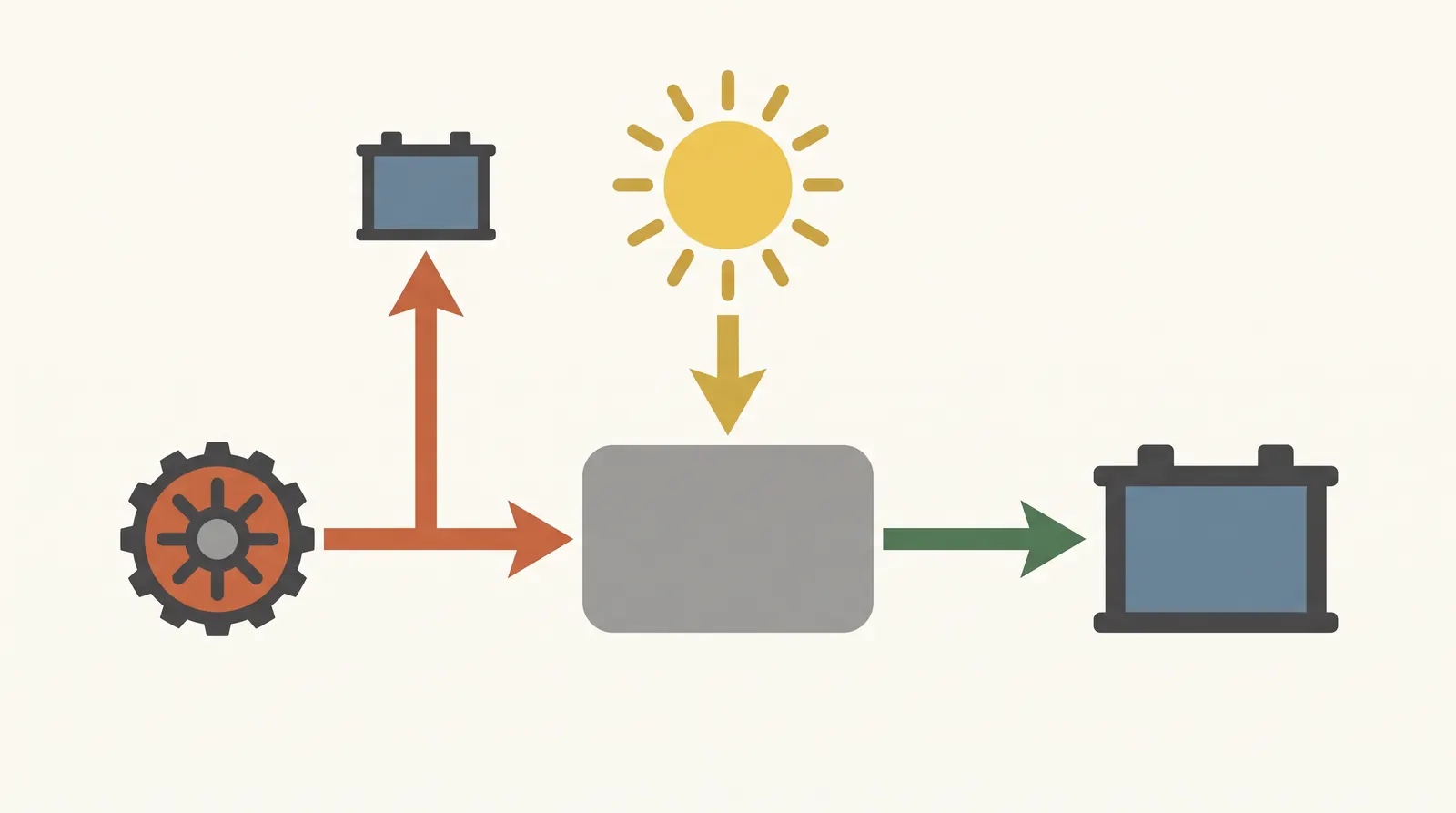
A DC to DC charger (also called a battery-to-battery or B2B charger) is a charger that sits between the starter battery and a second battery. It turns the alternator’s output into a proper multi-stage charge for that second battery. Victron describes its Orion-Tr Smart as designed for dual battery systems “where the starter battery (hence the alternator) is used to charge the service battery.” (Victron Orion-Tr Smart product page)
The chargers in this guide fall into two groups:
- House-battery chargers (Victron Orion-Tr Smart, Renogy DCC50S) wire into a fixed 12 V service battery bank, such as the LiFePO4 bank in a van or RV.
- Power-station alternator chargers (EcoFlow 800W Alternator Charger, BLUETTI Charger 1) take power from a 12 V or 24 V vehicle battery and feed it into a portable power station.
Pick the group first. That decides most of the rest. If you’re still working out how much battery you need, start with how big a battery bank a van or RV needs. For where a DC-DC charger fits in a full system, see the van life electrical guide.
The Four Chargers at a Glance
| Charger | What it charges | Rated output | Vehicle input | Price (as of Nov 10, 2026) |
|---|---|---|---|---|
| Victron Orion-Tr Smart 12/12-30 Isolated | 12 V service battery | 30 A (360 W at 40 °C) | 8 to 17 V | $219.30 at Powerwerx |
| Renogy DCC50S 12V 50A | 12 V auxiliary battery, from alternator or solar | 50 A | 13.2 to 16 V traditional, 12 to 16 V smart (Euro 6) | $307.99 at Renogy (charger only) |
| EcoFlow 800W Alternator Charger | EcoFlow power station or extra battery, via XT150 | 800 W max | 12/24 V (11 to 31 V), 76 A max | $269.00 at EcoFlow |
| BLUETTI Charger 1 | Power station DC/solar input, via MC4 | 560 W, 10 A | 13.8 V, 50 A max (12 V battery) | $219.00 sale at BLUETTI (regular $249.00) |
The BLUETTI price is a dated sale. BLUETTI’s page labels it “Black Friday Early Access, Nov. 5-18.”
How to Choose a DC to DC Charger: Step by Step
- Decide what you’re charging. A fixed 12 V house battery points to the Victron or Renogy. A portable power station points to the EcoFlow or BLUETTI, and only if your station has the right port (see the compatibility notes below).
- Find out what kind of alternator you have. Renogy’s manual gives a simple test. With the engine running and loads off, measure the starter battery voltage, then measure again after 5 to 10 minutes. “If your readings are around 14.4V DC, then you most likely have a traditional alternator. If your readings are around 12.5V to 13.5V, then you most likely have a smart alternator.” It also says to check the vehicle manual or supplier. (Renogy’s current manual (C1))
- Confirm smart-alternator support. Victron’s datasheet lists smart alternator compatibility through an engine-running detection mechanism, and says it is suitable for Euro 5/6 smart alternators. Renogy supports smart alternators, but only with the IGN signal wire connected to the vehicle ignition.
- Match the battery chemistry setting. Renogy supports gel, AGM, flooded, and lithium, but says to “make sure to set the correct battery type once it is installed.” Victron fixes lithium absorption time at a default of 2 hours.
- Size the charger against what your alternator can spare. Compare the charger’s printed input draw (EcoFlow 76 A max, BLUETTI 50 A max at 13.8 V on a 12 V battery) with your vehicle’s alternator rating. Alternator capacity varies by vehicle, so get that number from your vehicle’s documentation.
- Plan fusing and cable from that charger’s own manual. Fuse sizes and wire gauges differ between brands. Don’t borrow one brand’s table for another.
- Check mounting and environment. Victron’s IP43 rating applies only with the screw terminals facing down. Renogy says to mount on a vertical surface indoors, in a ventilated spot.
House-Battery Chargers
Victron Orion-Tr Smart 12/12-30 Isolated
Best fit: a 12 V service battery where you want the input and output grounds separated.
The Orion-Tr Smart datasheet for the 12/12-30 isolated model (ORI121236120) lists:
- Input range: 8 to 17 V
- Output: 30 A continuous at nominal output voltage and 40 °C. That’s 360 W at 40 °C and 430 W at 25 °C, with 40 A for 10 seconds.
- Efficiency: 87%, with a no-load input current under 80 mA
- Charge profile: adaptive three-stage (bulk, absorption, float). For lithium, absorption time is fixed at a default of 2 hours. The algorithm is configurable, or you can set a fixed output voltage.
- Smart alternators: engine-running detection. The datasheet says, “The built-in engine shutdown detection will stop the converter when the engine is not running.”
- Isolation: “This isolated model allows the input and output to have separate chassis grounds.” Galvanic isolation is rated to 200 VDC, and units can be paralleled.
- Environment: -20 to +55 °C, derated 3% per °C above 40 °C. IP43 for the electronics and IP22 for the connection area.
- Wiring: screw terminals, with a maximum cable cross-section of 16 mm² (AWG6). The input fuse is built in and not replaceable.
Victron’s external fuse and cable recommendations aren’t covered in this guide. Use Victron’s own manual for those.
Powerwerx lists this Victron charger at $219.30 (as of November 10, 2026). Victron is not an affiliate partner of this site, so those are plain links.
Renogy DCC50S (and the 30 A DCC30S)
Best fit: a 12 V auxiliary battery where you also want to plug solar panels straight into the charger.
The DCC50S is the same unit as the RBC50D1S. Renogy’s current manual (C1) describes it as a dual-input charger that “can charge the auxiliary battery with a starter battery connected to an alternator or with solar panels connected directly to the battery charger.” From Renogy’s product page:
- Max charge current: 50 A (the DCC30S is 30 A)
- Solar input: 50 V max and 660 W on the 50 A model, or 30 V and 400 W on the 30 A model. Renogy says that if your panel’s open-circuit voltage is 30 V or higher, you should choose the 50 A model.
- Alternator input: 13.2 to 16 VDC for a traditional alternator and 12 to 16 VDC for a smart (Euro 6) alternator. Max alternator input power is 660 W on the 50 A model.
- Battery types: AGM/sealed, gel, flooded, lithium, and a user setting
- Size and weight (50 A): 9.61 x 5.75 x 3.78 in, 4.10 lb, operating from -31 to 149 °F
- Listings: ETL listed to UL 1741 and CSA C22.2. The US page lists a 2-year warranty.
- Efficiency: up to 97%, per Renogy’s current manual (C1).
Smart alternator wiring: the manual’s IGN signal wire section is marked “For smart alternator only.” It adds, “The traditional alternator does not need to be connected to the IGN Signal Wire.”
Fusing (from Renogy’s current manual (C1)): fuse both the input and the output. For the 50A unit, use a 65–80 A fuse on both the starter-battery side and the house-battery side. For the 30A unit, use a 40–50 A fuse on both sides. Install the charger as close to the house battery as possible, and no more than 1.5 m away. Install the starter fuse close to the starter battery positive, ideally within 20 cm. Size the solar fuse at the total panel Isc x 1.56. Renogy’s documents differ, so follow the manual that came with your unit.
Cable (from Renogy’s current manual (C1), Renogy units only): size the cable by fuse rating and total run length, measured as the positive plus the negative. For a 50–80 A fuse (the 50A model’s 65–80 A fuse):
- 6 AWG for 0 to 10 ft
- 4 AWG for 10 to 15 ft
- 3 AWG for 15 to 20 ft
- 2 AWG for 20 to 28 ft
- 1/0 AWG for 28 to 40 ft
- 2/0 AWG for 40 to 50 ft
For a 30–50 A fuse (the 30A model’s 40–50 A fuse): 8 AWG for 0 to 10 ft, 6 AWG for 10 to 15 ft, 4 AWG for 15 to 28 ft, 2 AWG for 28 to 40 ft, and 1 AWG for 40 to 50 ft.
Renogy specifies UL multi-strand copper rated above 105 °C (221 °F) and a fuse strictly smaller than the cable’s max current rating. Renogy says that table allows under 8% voltage drop; that is what the table allows, not a low-drop recommendation.
On the solar input, keep total array current at 20 A or less: 12 AWG for 0–10 A up to 16 ft, and 10 AWG for 10–20 A up to 26 ft.
Safety, in Renogy’s terms: there’s a risk of explosion, so never install the charger in a sealed enclosure with flooded batteries or anywhere battery gases can accumulate. On a boat, Renogy says to have it installed by a qualified electrician. Don’t use the temperature sensor on a LiFePO4 battery that has a BMS.
Price (as of November 10, 2026): $307.99 for the 50 A charger only (RBC50D1S-US), $324.99 with the Bluetooth module (RBC50D1S-BT-US), and $354.99 with Bluetooth and the Renogy ONE Core (RBC50D1S-BT-W02W-US). The 30 A charger only (RBC30D1S-US) is $186.99. The Renogy includes an MPPT solar input, and the Victron is isolated, so the prices aren’t a like-for-like comparison.
If you’re picking the battery on the other end, see LiFePO4 batteries and the best RV house batteries.

Power-Station Alternator Chargers
EcoFlow 800W Alternator Charger
Best fit: an EcoFlow power station that you want to charge fast from the vehicle.
Per EcoFlow’s user manual, the charger connects “to the extra battery port (XT150) of the EcoFlow portable power station or extra battery,” and the vehicle battery’s nominal voltage must be 12 V or 24 V.
- Charge mode: input 12/24 V (11 to 31 V), 76 A max. Output 40 to 60 V, 800 W max.
- Other modes: Reverse Charge (13.8/27.6 V output, 800 W max) and Battery Maintenance (100 W max output)
- Fuse: 125 A rated
- Size and weight: 242 x 194 x 35 mm, 2.3 kg
- Starter protection: “If the measured value is lower than the charger’s start voltage, the charger will stop working.” The start voltage is adjustable in the app. After 48 hours idle in Charge Mode, the charger powers itself off.
- Charge-time claim: EcoFlow’s product page says “Top up 1kWh in only 1.3 hours.” That’s the manufacturer’s claim. EcoFlow’s manual notes that actual output depends on the vehicle.
Compatibility: you need an XT150 port. EcoFlow says a DELTA Pro to Smart Generator Adapter is required to connect the charger to the DELTA 3 Max Plus, DELTA 3 Ultra Plus, DELTA Pro, and DELTA Pro 3. Check EcoFlow’s own compatibility information for your exact station before you buy.
Safety, in EcoFlow’s terms: “It’s recommended that the wiring is performed by a professional.” The fuse cable’s ring terminal goes on the battery positive, torqued to 3 to 4 N·m. Too little torque can melt cables, and over 6 N·m breaks the fuse. The 1 m output cable can’t be extended. Keep the unit away from flammables and heat.
Price: $269.00 at EcoFlow for the charger only (as of November 10, 2026).
BLUETTI Charger 1
Best fit: a BLUETTI station charged through its DC/solar input.
BLUETTI’s manual has the charger output going to the station through MC4 connectors: “Connect the MC4 connectors from both the output cable and the solar charging cable.”
- Input: 13.8 V, 50 A max with a 12 V battery, or 27.6 V, 25 A max with a 24 V battery
- Output: 15 to 56 V (12 V input) or 27 to 56 V (24 V input), adjustable in the app. Rated 10 A and 560 W, with a 27 V default.
- Build: IP20, 145 x 110 x 60 mm, 0.72 kg per the manual
- Auto shutdown: “The CHARGER 1 is designed to automatically shut down 30 minutes after the engine is turned off.”
- Compatible stations (manual table): AC180/AC180P at 12 to 60 V, AC70/AC70P/AC180T at 12 to 60 V, AC200MAX/AC200P/AC200L at 10 to 150 V, AC300/AC500/EP500 at 12 to 150 V, Elite 200 V2 at 12 to 60 V, and EB3A/AC60 at 12 to 28 V. For unlisted products, the manual says to contact BLUETTI support.
- Claim and warranty: BLUETTI’s product page says it can “fully charge a 1kWh power station in just 2.5 hours” and lists a 2-year warranty.
Safety, in BLUETTI’s terms:
- Install a 60 A circuit breaker on the input cable.
- Never connect any port to AC outlets or to batteries above 32 V.
- Connect the input cables to the charger first, then to the car battery.
- Before connecting the station, set the output voltage in the app to within the station’s DC input range.
Price (as of November 10, 2026): $219.00 on sale (regular $249.00).
Install Checklist
- I know whether my alternator is traditional or smart (Renogy’s voltage test or the vehicle manual).
- The charger supports my alternator type, and on a Renogy the IGN wire is planned for a smart alternator.
- The battery type is set correctly after install (lithium vs lead-acid).
- The charger’s input draw fits within what my alternator can spare, per my vehicle’s own documentation.
- Fuses or breakers are sized from this charger’s manual, on both input and output where the manual says so.
- Cable gauge comes from this charger’s manual for my actual run length.
- The mounting position meets the manual (Victron terminals down, Renogy vertical, indoors and ventilated).
- Nothing is mounted in a sealed box with flooded batteries.
- For a power station: the port matches (XT150 for EcoFlow, a DC/solar input in range for BLUETTI), and any required adapter is on the list.
- Professional wiring is booked where the manual recommends it (EcoFlow), or a qualified electrician on a boat (Renogy).

Which DC to DC Charger Should You Buy?
- Choose the Victron Orion-Tr Smart 12/12-30 if you’re charging a 12 V house battery, want separate input and output grounds, and 30 A is enough.
- Choose the Renogy DCC50S if you want 50 A from the alternator plus a built-in MPPT solar input on the same unit, and you’ll follow its 65–80 A fusing and cable table from Renogy’s current manual (C1).
- Choose the EcoFlow 800W Alternator Charger if you own an EcoFlow station with an XT150 port (or the required adapter) and want the higher rated wattage of the two power-station chargers here (800 W vs 560 W).
- Choose the BLUETTI Charger 1 if you own a BLUETTI station from its compatibility table and want to charge through the station’s DC/solar input.
For more on battery hardware, the batteries hub has reviews and comparisons. If your rig is an RV, the RV living use case pulls the rest of the system together.