Growatt SPF 5000ES Hybrid Inverter vs Victron MultiPlus 12/3000/120
Growatt SPF 5000ES Hybrid Inverter (5000W) vs Victron MultiPlus 12/3000/120 (3000W) compared spec-by-spec. Surge, efficiency, pricing, pros, cons, and our verdict on which inverter to buy.
| Specification | ||
|---|---|---|
| AC Output | 5,000W ✓ Winner | 3,000W |
| Surge Output | 10,000W ✓ Winner | 6,000W |
| Input Voltage | 48 | 12 |
| Output Voltage | 120/240V AC split-phase | 120V AC |
| Wave Type | pure sine wave | pure sine wave |
| Efficiency Pct | 93 | 93 |
| Weight | 55 lbs | 53 lbs ✓ Winner |
| Dimensions | 19.9 x 14.6 x 7.5 in | 18.5 x 8.3 x 10.6 in |
| Transfer Switch | Yes | Yes |
| Transfer Time Ms | 10 | 20 |
| Mppt Channels | 2 | — |
| Max Solar Input | 5,000 | — |
| Mppt Voltage Range | 120-450V DC | — |
| Charger Amps | 80 | 120 |
| Operating Temp | 14-122F | 32-122F |
| Warranty | 5 years | 5 years |
| Remote Monitoring | Yes | Yes |
| Programmable | Yes | Yes |
| Parallel Capable | Yes | — |
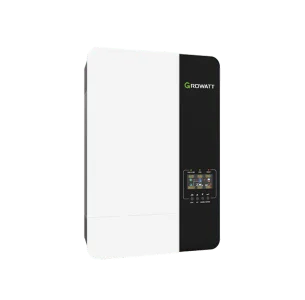
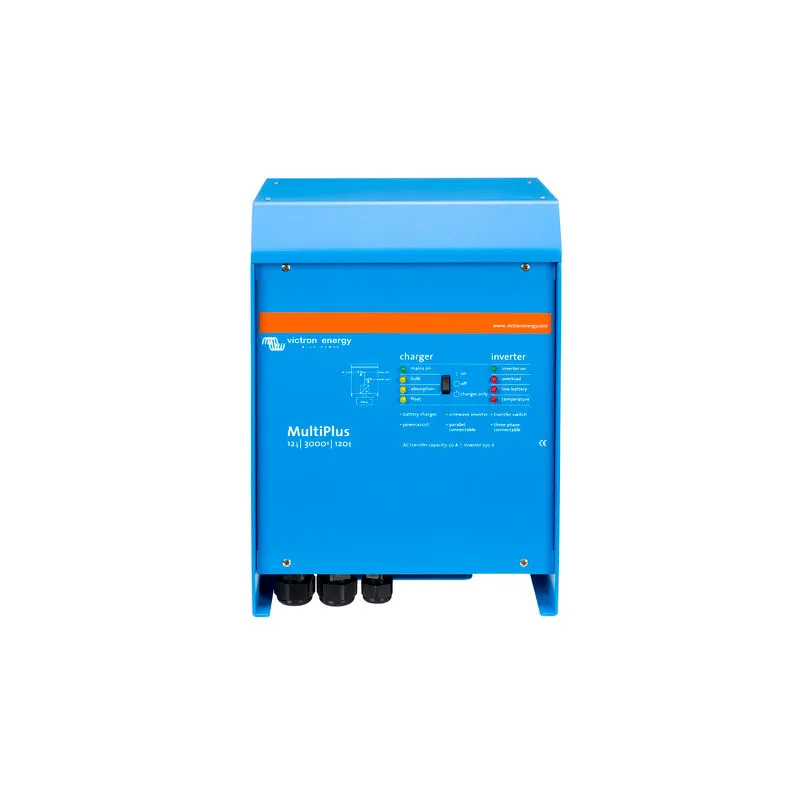
Buy the Growatt SPF 5000ES Hybrid Inverter
Best prices · Updated hourly
Buy the Victron MultiPlus 12/3000/120
Best prices · Updated hourly
Who Should Buy the Growatt SPF 5000ES Hybrid Inverter?
The Growatt SPF 5000ES Hybrid Inverter is built for off grid cabin, whole home solar, diy solar system. At 5,000W continuous with 10,000W surge capacity, it can handle whole-home loads including air conditioners and well pumps.
Key advantages include: all-in-one hybrid: inverter, charger, and dual mppt solar controller; 5,000w continuous with 10,000w surge handles whole-home loads; built-in dual mppt channels accept 5,000w of solar. The pure sine wave output is compatible with all sensitive electronics including CPAP machines, medical devices, and variable-speed motors.
At $900 ($0.18/W), the Growatt SPF 5000ES Hybrid Inverter scores 8.7/10 — a strong performer across all key metrics.
Who Should Buy the Victron MultiPlus 12/3000/120?
The Victron MultiPlus 12/3000/120 is built for off grid cabin, rv full time, marine house system. At 3,000W continuous with 6,000W surge capacity, it can handle whole-home loads including air conditioners and well pumps.
Key advantages include: built-in 120a charger eliminates need for separate charger; automatic transfer switch with 20ms switchover; highly programmable via victron ve.configure software. The pure sine wave output is compatible with all sensitive electronics including CPAP machines, medical devices, and variable-speed motors.
At $1,300 ($0.43/W), the Victron MultiPlus 12/3000/120 scores 9.3/10 — one of the top-rated inverters in our benchmark.
How Do the Specs Compare?
Continuous output: The Growatt SPF 5000ES Hybrid Inverter delivers more sustained power at 5,000W versus 3,000W for the Victron MultiPlus 12/3000/120. Continuous wattage is the number that matters for running loads — not surge. Size your inverter to handle your largest single load with at least 20% overhead.
Surge capacity: The Growatt SPF 5000ES Hybrid Inverter handles larger startup loads at 10,000W peak versus 6,000W for the Victron MultiPlus 12/3000/120. Motors, compressors, and pumps draw 2–3x their running watts at startup — surge rating determines whether your inverter trips during those brief spikes.
Wave type: Both inverters produce pure sine wave output, making them equally compatible with sensitive electronics and motor loads.
Efficiency: The Growatt SPF 5000ES Hybrid Inverter converts power more efficiently at 93% versus 93% for the Victron MultiPlus 12/3000/120. Every percentage point of efficiency loss shows up as heat and wasted battery capacity — on a 12V 200Ah bank, a 5% efficiency gap means roughly 2kWh less usable energy per day.
Price: The Growatt SPF 5000ES Hybrid Inverter costs $900 versus $1,300 for the Victron MultiPlus 12/3000/120 — a $400 difference. Cost per watt: Growatt SPF 5000ES Hybrid Inverter at $0.18/W vs Victron MultiPlus 12/3000/120 at $0.43/W.
🏆 Our Verdict
Choose the Growatt SPF 5000ES Hybrid Inverter if you need maximum power output (5,000W vs 3,000W) and higher surge capacity (10,000W).
Choose the Victron MultiPlus 12/3000/120 if you prioritize premium features and build quality .
Our Take: Growatt SPF 5000ES Hybrid Inverter vs Victron MultiPlus 12/3000/120
Short answer: Choose the Growatt SPF 5000 if you’re building a new off-grid system and want the simplest possible wiring — it has solar MPPT, battery charger, inverter, and transfer switch in one box. Choose the Victron MultiPlus if you want industry-standard monitoring, professional-grade reliability, and you’re pairing it with a separate Victron MPPT charge controller.
These aren’t the same product class
This is the critical thing to understand before you buy either: they solve different problems.
- Growatt SPF 5000 is a hybrid solar inverter — inverter + battery charger + MPPT + transfer switch in one chassis. You connect solar panels directly to it.
- Victron MultiPlus is an inverter-charger — inverter + battery charger + transfer switch, but no MPPT. You connect a separate Victron SmartSolar charge controller to the battery bank.
Searchers asking “Growatt vs Victron” are usually comparing system architectures, not just two inverters. Your choice reshapes your whole build.
Where the Growatt SPF 5000 wins
All-in-one simplicity. One box handles solar input, battery management, AC output, and transfer between grid/generator/battery. For a new ground-up off-grid build, you’re wiring three major connections (PV, battery, AC loads) instead of five or six.
Built-in MPPT with 2,000W capacity. Handles up to 2,000W of solar input at up to 450V open-circuit. For a typical 2–4 panel roof array on a cabin, that’s fine.
Lower upfront cost. Growatt SPF 5000 + a 48V battery bank is typically $2,000–$2,500 for the inverter side. Comparable Victron MultiPlus + SmartSolar 250/85 + battery monitor is $3,500–$4,500 for equivalent capability. That’s a meaningful budget difference.
Split-phase 120/240V output. The SPF 5000 produces split-phase natively, meaning you can run a well pump, electric dryer, or other 240V loads directly. The MultiPlus 48/5000 is single-phase 120V only — you’d need two MultiPlus units in a split-phase configuration (roughly 2× the cost) for 240V.
Where the Victron MultiPlus wins
Monitoring and integration. Victron’s VRM (Victron Remote Management) portal is the industry standard for off-grid monitoring. You get real-time dashboards, historical data, alerts, and remote firmware updates. Growatt’s monitoring exists but is less polished and less reliable.
Modular upgrade path. Because the MultiPlus is separate from the charge controller, you can upgrade one without touching the other. Need more solar? Swap the SmartSolar 250/85 for a 250/100. Growatt is monolithic — you can’t independently upgrade the MPPT.
Professional reliability. Victron has been making off-grid inverter-chargers since 1975. The MultiPlus is used in commercial marine, telecom backup, and industrial off-grid installations. Its reliability is proven over millions of deployed units. Growatt is younger and more consumer-focused.
ESS (Energy Storage System) mode. If you want grid-tie with self-consumption — using excess solar to charge batteries and grid backup during outages — Victron’s ESS firmware is mature and configurable. Growatt has similar features but less flexibility.
Assistant programmability. Victron’s assistants let you program custom logic — e.g., “if battery SOC drops below 30%, auto-start generator; if generator runs more than 4 hours, send alert.” Growatt’s logic is fixed per firmware version.
Real-world winner by scenario
- New off-grid cabin, single-phase, budget-conscious: Growatt SPF 5000. Cheapest path to a working system.
- New off-grid cabin, needs 240V (well pump, dryer): Growatt SPF 5000 (native split-phase). MultiPlus would need two units.
- Existing Victron ecosystem: Victron MultiPlus. Don’t fragment your monitoring.
- Commercial / marine / high-reliability install: Victron. The maturity and support are worth the premium.
- Grid-tie with backup (ESS): Victron. The ESS implementation is more mature.
- Remote monitored installation: Victron. VRM wins.
Output specs that matter
Both produce pure sine wave. Both handle surges above 10,000W briefly for motor startup. Both have automatic transfer switches under 20ms.
Key differences that matter in daily use:
- MultiPlus continuous output: 4,000W (advertised 5,000VA) at 25°C. Derates above 40°C.
- Growatt SPF 5000 continuous output: 5,000W at 25°C. Derates above 45°C.
- MultiPlus peak efficiency: 94%.
- Growatt SPF 5000 peak efficiency: 93% at inverter, 96% at MPPT.
For a typical off-grid load profile (most loads in the 500W–2,500W range), the efficiency difference is under 1% in real-world use.
Our recommendation
For the majority of new off-grid cabin, homestead, and whole-home builds, the Growatt SPF 5000 is the pragmatic choice. Lower cost, simpler wiring, native split-phase for appliances that need 240V, and good-enough monitoring. If your system is under 10kW and you don’t have complex grid-tie requirements, Growatt gets you running faster and cheaper.
Choose the Victron MultiPlus if you value rock-solid VRM monitoring, modular component upgrades, ESS-style grid interaction, or if you’re building a commercial or high-reliability installation where the professional support ecosystem matters more than upfront cost. Pair it with a Victron SmartSolar MPPT controller for a complete Victron system.
Related
Go Deeper
More Comparisons