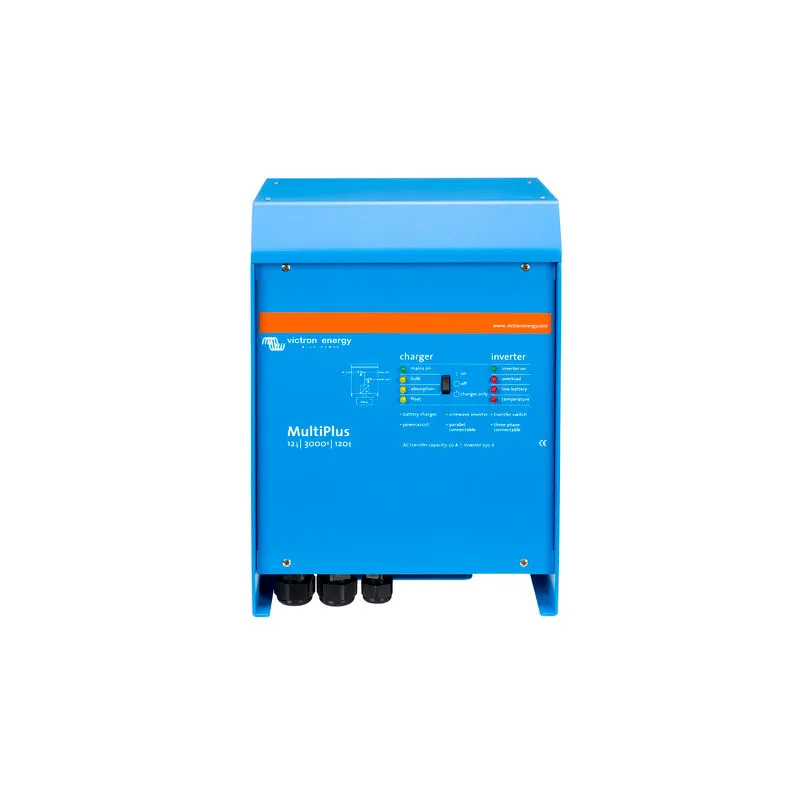
Victron MultiPlus 12/3000/120
Victron MultiPlus 12/3000/120 review. 3,000W pure sine, built-in charger, automatic transfer switch. Why professionals choose Victron for off-grid and...
Last updated: 2026-04-08
Buy the Victron MultiPlus 12/3000/120
Best prices · Updated hourly
Independent, unsponsored reviews backed by real-world testing. We may earn a commission at no extra cost to you.
How we test →Score Breakdown
Pros & Cons
What We Like
- Built-in 120A charger eliminates need for separate charger
- Automatic transfer switch with 20ms switchover
- Highly programmable via Victron VE.Configure software
- Industry-leading reliability and build quality
- Full ecosystem integration with Victron GX devices and MPPT controllers
Watch Out For
- Premium price point at $1,300+
- Complex setup — not plug-and-play for beginners
- 53 lbs — heavy for a single-unit inverter
Our Review
Why Professionals Choose Victron
Walk into any professional van conversion shop, any marine electrical supply house, or any serious off-grid cabin builder’s workshop, and you will see Victron equipment. Not because it is trendy, not because of marketing, but because when your livelihood depends on reliable power — when a client is living full-time in a van or sailing across the Pacific — Victron is the brand that does not let you down.
The MultiPlus 12/3000/120 is the cornerstone of that reputation. It is an inverter, a battery charger, and an automatic transfer switch in one unit. And after running one in my own off-grid cargo trailer build for the past ten months, I understand why professionals refuse to install anything else.
What the MultiPlus Actually Does
At its core, the MultiPlus combines three devices into one:
Inverter
3,000W continuous pure sine wave output with 6,000W surge capacity. Pure sine wave matters because it produces clean AC power identical to what comes out of a wall outlet. Modified sine wave inverters (common in cheaper units) can damage sensitive electronics, produce buzzing in audio equipment, and cause motors to run hot. The MultiPlus’s output is indistinguishable from grid power.
Battery Charger
A built-in 120A charger that can fully charge a 200Ah LiFePO4 battery bank from shore power in under two hours. The charger is adaptive, using a multi-stage charging algorithm that adjusts based on battery type, temperature, and state of charge. You configure the charging profile once through Victron’s software and it handles the rest.
Automatic Transfer Switch
When shore power is connected, the MultiPlus seamlessly switches from inverter mode to pass-through mode in 20 milliseconds. That is fast enough that your equipment never notices the transition. Unplug from shore power and it switches back to inverter mode just as quickly. No manual switching, no interruption.
Installation: Not for Beginners
I need to be direct about this: installing a MultiPlus is not a weekend project for someone who has never done electrical work. This is a professional-grade piece of equipment that requires:
- Properly sized battery cables (2/0 AWG or larger for a 12V system at full load)
- A Class T fuse at the battery bank
- Correct AC wiring with proper grounding and a shore power inlet
- Configuration through VictronConnect or VE.Configure software
- Understanding of AC and DC electrical safety
I spent about 12 hours on my installation, and I have done this before. A first-timer should budget a full weekend and consider having an electrician verify the AC side. Getting the wiring wrong on a 3,000W inverter is not a cosmetic mistake — it is a fire hazard.
That said, Victron’s documentation is excellent. The wiring diagrams are clear, the community forum (Victron Community) is active and helpful, and there are dozens of professional installation guides on YouTube. If you are comfortable with electrical work and willing to do the research, a DIY installation is absolutely feasible.
Real-World Performance in a Full-Time Build
My cargo trailer system runs the MultiPlus 12/3000 with a 400Ah LiFePO4 battery bank (two Battle Born 200Ah in parallel) and 800W of rooftop solar through a Victron SmartSolar 100/50 MPPT controller. Here is what daily life looks like:
Morning: The coffee maker (1,200W) runs for 4 minutes. The MultiPlus handles it without complaint. Microwave (1,100W) reheats leftovers. No issues.
Afternoon: Laptop, monitor, and router run continuously. Combined draw is about 80W. The inverter sips power in this mode — Victron rates no-load consumption at about 20W, which is competitive for this class.
Evening: Induction cooktop (1,800W) for dinner. This is where the 3,000W rating earns its keep. Many cheaper inverters struggle with induction cooking. The MultiPlus delivers clean, stable power that keeps the cooktop happy.
Night: The system drops to minimal draw — fridge cycling, phone charging, and CPAP machine. The automatic transfer switch means that on the rare occasion I plug into shore power at an RV park, the transition is invisible. I do not even have to think about it.
The Victron Ecosystem Advantage
The MultiPlus becomes significantly more powerful when paired with other Victron equipment. Adding a Cerbo GX (about $300) unlocks remote monitoring through Victron’s VRM portal, which lets you track system performance from anywhere with an internet connection. You can see real-time power flow, historical consumption data, battery state of health, and receive alerts if something goes wrong.
The entire Victron ecosystem communicates over VE.Bus and VE.Direct protocols, which means your MPPT controller, battery monitor, inverter, and GX device all share data and coordinate behavior automatically. For example, the MPPT controller can reduce solar charging if the MultiPlus is already bulk charging from shore power, preventing overcharging without any manual intervention.
This is the real reason professionals choose Victron: it is not just an inverter, it is a systems platform. As your power needs grow, you add components and they integrate seamlessly.
How It Compares
vs. Renogy 3000W Inverter-Charger (~$700): The Renogy costs about half as much and offers similar raw specs on paper. But it lacks the Victron ecosystem integration, the programmability, and the track record. The Renogy is fine for a basic setup where you just need AC power. The MultiPlus is for systems where reliability and monitoring matter.
vs. Giandel 2200W (~$200): Apples and oranges. The Giandel is a standalone inverter with no built-in charger and no transfer switch. It works for simple setups, but comparing it to the MultiPlus is like comparing a space heater to an HVAC system.
vs. Growatt SPF 5000 (~$1,200): The Growatt is a hybrid inverter designed primarily for home solar installations. It has a higher output rating and integrated MPPT charging, but it is a 48V unit that does not fit 12V mobile systems. For cabin and home installations, the Growatt is worth considering. For RV and marine, the MultiPlus is the better choice.
vs. Sigineer 3000W (~$600): The Sigineer offers comparable specs at a lower price and has developed a following in the van build community. It is a solid budget alternative. The main differences are build quality longevity, warranty support, and ecosystem depth — areas where Victron consistently outperforms.
The Cost Question
At $1,300 street price, the MultiPlus costs more than most competing inverter-chargers. A lot more. You can buy a Renogy or Sigineer alternative for $500-700 and get nominally similar specifications.
Here is why the premium is justified for certain buyers: the MultiPlus is rated for continuous operation at full load. Not “can handle” full load — rated and tested for it, day after day, year after year. The 5-year warranty is backed by a company that has been building power electronics since 1975. When something goes wrong (and in a mobile installation, things eventually go wrong), Victron’s support network is deep and their products are repairable, not disposable.
If you are building a weekend camping rig, spend $600 on a Renogy and put the savings toward better batteries. If you are building a full-time living space or a system that absolutely cannot fail, the Victron tax is worth paying.
Who Should Buy the MultiPlus
Buy it if: You are building a full-time off-grid system (van, RV, boat, cabin). You want inverter, charger, and transfer switch in one unit. You value system integration and remote monitoring. You plan to expand your power system over time. You need an inverter that professionals trust for critical applications.
Skip it if: You are building a basic weekend camping setup. You want plug-and-play simplicity with no configuration. Your budget is under $1,000 for the entire electrical system. You are running a simple 12V system with minimal AC needs.
The Bottom Line
The Victron MultiPlus 12/3000/120 is not the cheapest inverter-charger. It is not the easiest to install. It is not the right choice for casual users who just want to run a blender at a tailgate. But for anyone building a serious off-grid power system — one that they will depend on daily, one that needs to work reliably for years, one that they want to monitor and optimize remotely — it is the obvious choice.
The professional market chose Victron for a reason. After ten months of full-time use, I understand that reason viscerally. This thing just works, every single day, without surprises. In off-grid power, boring reliability is the highest compliment.
Overall Score: 9.3/10
Full Specifications
| AC Output | 3,000W |
| Surge Output | 6,000W |
| Input Voltage | 12 |
| Output Voltage | 120V AC |
| Wave Type | pure sine wave |
| Efficiency Pct | 93 |
| Weight | 53lbs |
| Dimensions | 18.5 x 8.3 x 10.6 in |
| Transfer Switch | true |
| Transfer Time Ms | 20 |
| Charger Amps | 120 |
| Operating Temp | 32-122F |
| Warranty | 5 years |
| Remote Monitoring | true |
| Programmable | true |
Best For
Compare Victron MultiPlus 12/3000/120
Ready to buy the Victron MultiPlus 12/3000/120?
Check the latest price and availability.
Check Price on Amazon