Solar Powered Air Conditioner: 3 Setups Explained
Last updated: 2026-11-10
Quick answer: A solar powered air conditioner is usually a hybrid mini-split that takes DC straight from solar panels and blends in AC power from the grid or an inverter when the sun can’t keep up. The other two routes are running an AC from a battery and inverter, or using a portable AC with its own battery. Panels alone stop cooling when the sun drops, so every setup that has to cool at night needs a second source.
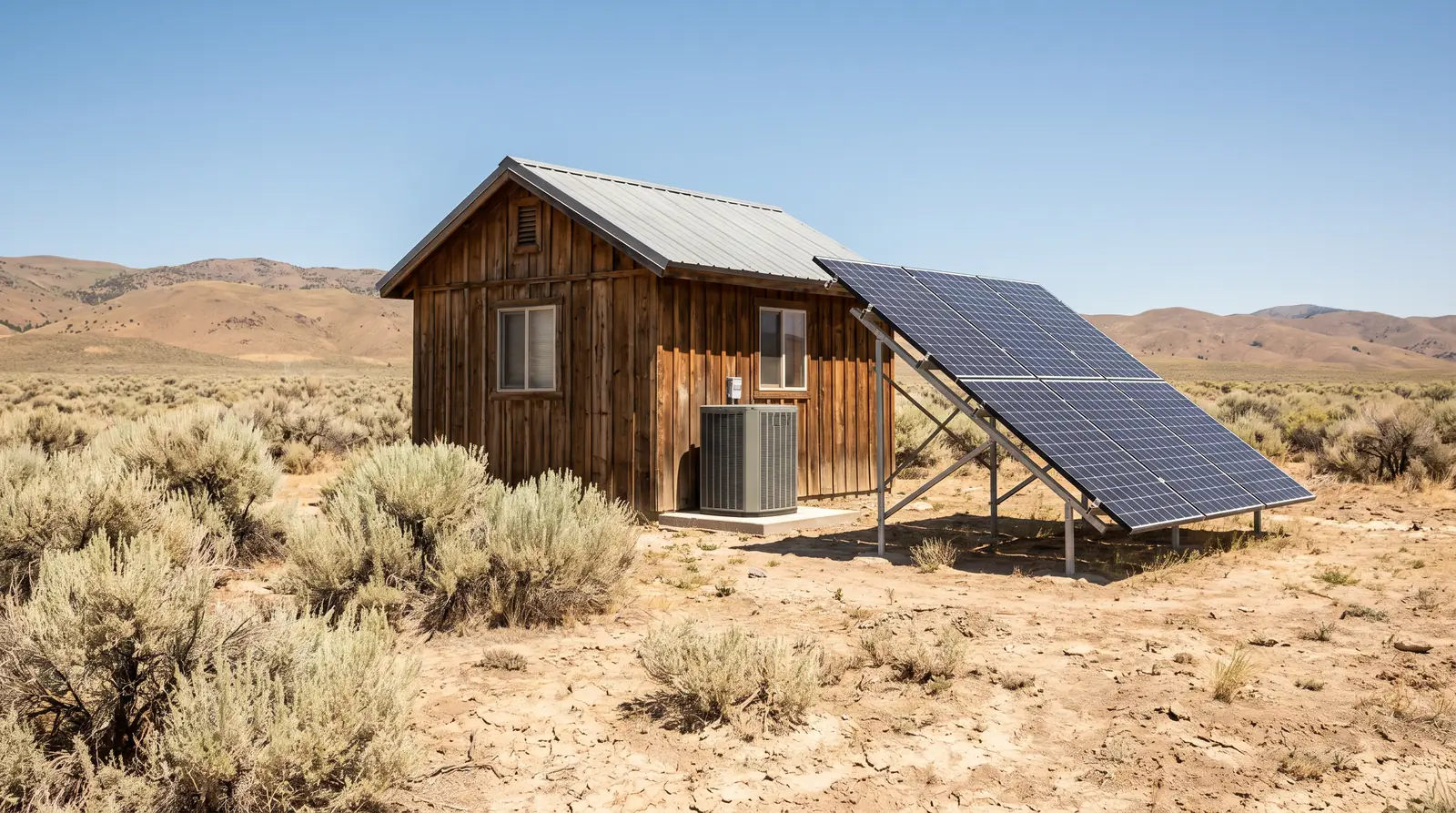
The words “solar air conditioner” get stuck on three very different things, and the difference decides whether your cabin is cool at 9 p.m. This page explains the three setups using manufacturer documents: EG4’s spec sheet and user manual for its 12K and 24K hybrid mini-splits, and EcoFlow’s WAVE 3 spec page for a battery-fed portable. I have not installed or run any of these units, and this is not a wiring plan. It’s a map of the options so you can ask an installer the right questions.
Can solar power run an air conditioner?
Yes, if the AC is built to take solar or you have a battery system big enough to feed it. Start with what the AC draws. EG4 prints a rated cooling power of 950 W for its 12,000 BTU/h unit and 2,050 W for its 24,000 BTU/h unit. EG4 also prints an EER2 (cooling output per watt of electricity, in BTU/W) of 12.6 for the 12K and 11.7 for the 24K. The SEER2 ratings are 22.5 and 21.
Those are the inverter mini-split’s rated numbers. Window and portable units are a different class of machine, and our AC runtime page uses its own figures for them, along with the math on how long a 2,000 Wh power station lasts. I’m not repeating that math here.
The real question is where those watts come from at each hour of the day. That’s what separates the three setups.
The three setups, side by side
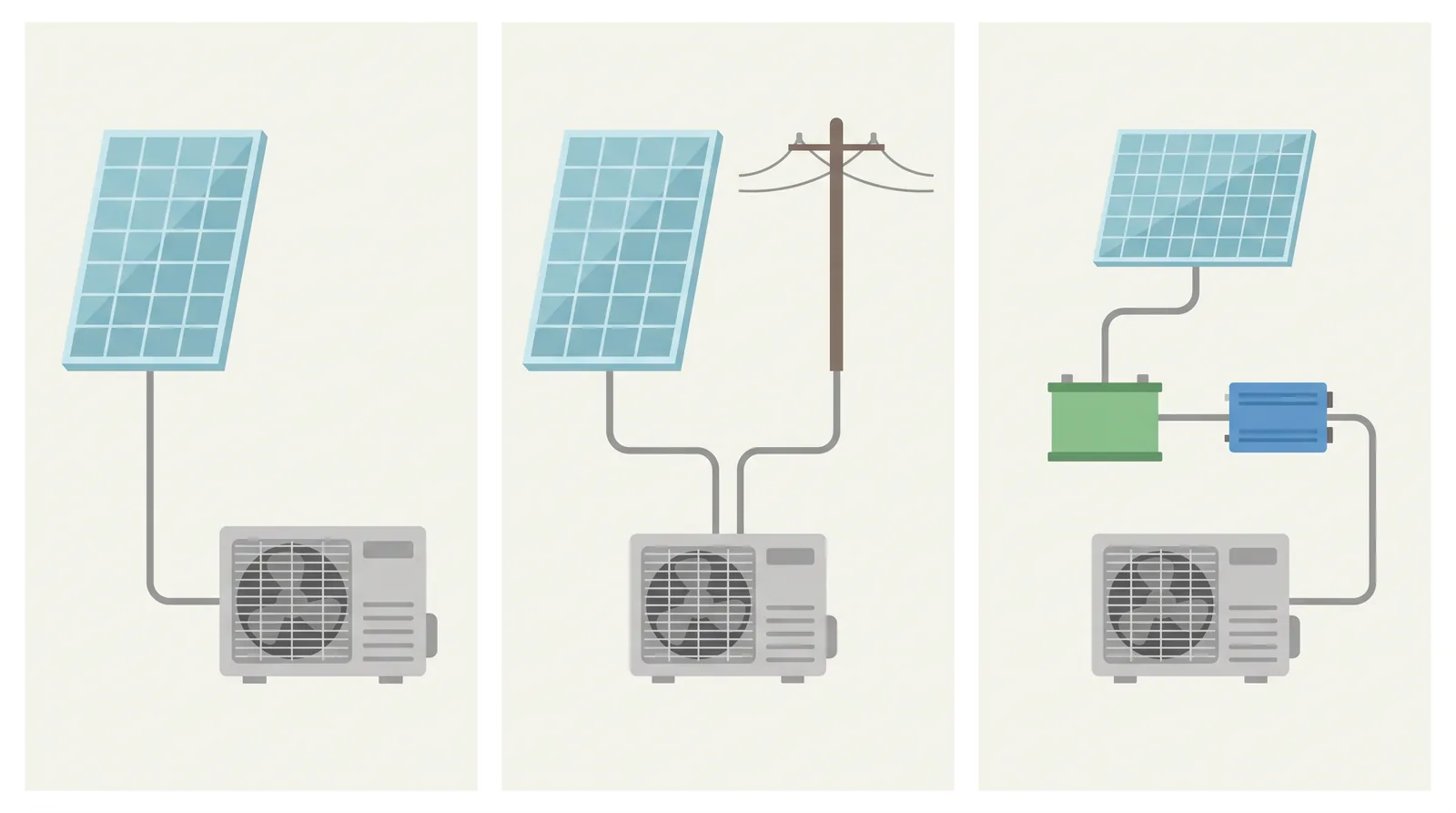
In the illustration, left to right: direct-PV (panels only), hybrid (panels plus grid), and battery-backed (panels, battery and inverter).
| Setup | Where the power comes from | Cools at night? | Documented example | What the maker says |
|---|---|---|---|---|
| Direct-PV (solar only) | Panels wired straight to the outdoor unit | No | EG4 12K/24K with no AC input connected | Can run entirely on solar, but EG4 recommends also connecting AC power |
| Hybrid | Panels plus 115 VAC (12K) or 208 to 240 VAC (24K) from the grid or an inverter | Yes, on the AC input | EG4 12K/24K with both inputs | Prioritizes solar input over AC input automatically |
| Battery-backed | A battery through an inverter, or a battery built for the unit | Yes, until the battery runs low | EG4 in AC-only mode on an existing storage system; EcoFlow WAVE 3 with its add-on battery | EG4: AC input “can be obtained from the grid or an inverter”; EcoFlow: 2 to 8 hours on the add-on battery |
Sources: EG4 spec sheet, EG4 user manual, EcoFlow WAVE 3 specs.
Setup 1: Direct-PV, solar only
A direct-PV air conditioner takes DC from the panels with no battery and no grid in between. EG4’s manual says its hybrid units “can run entirely on solar energy,” then immediately adds: “It’s recommended to connect the unit to AC power to support days with low solar energy or for nighttime use.”
The manual also describes what happens when the sun fades on solar only. The unit may enter sleep mode, and the compressor turns off. It tries to wake three times: “the first attempt 15 minutes after sleep mode begins, the second 45 minutes later, and the last one 1 hour afterward.” If those fail, it goes into a Low Power (“LP”) mode that needs a manual restart.
So a solar-only unit is a daytime cooler. That can be enough for a workshop or a cabin you only use on sunny afternoons. It isn’t enough for a bedroom.
Setup 2: Hybrid, solar plus AC
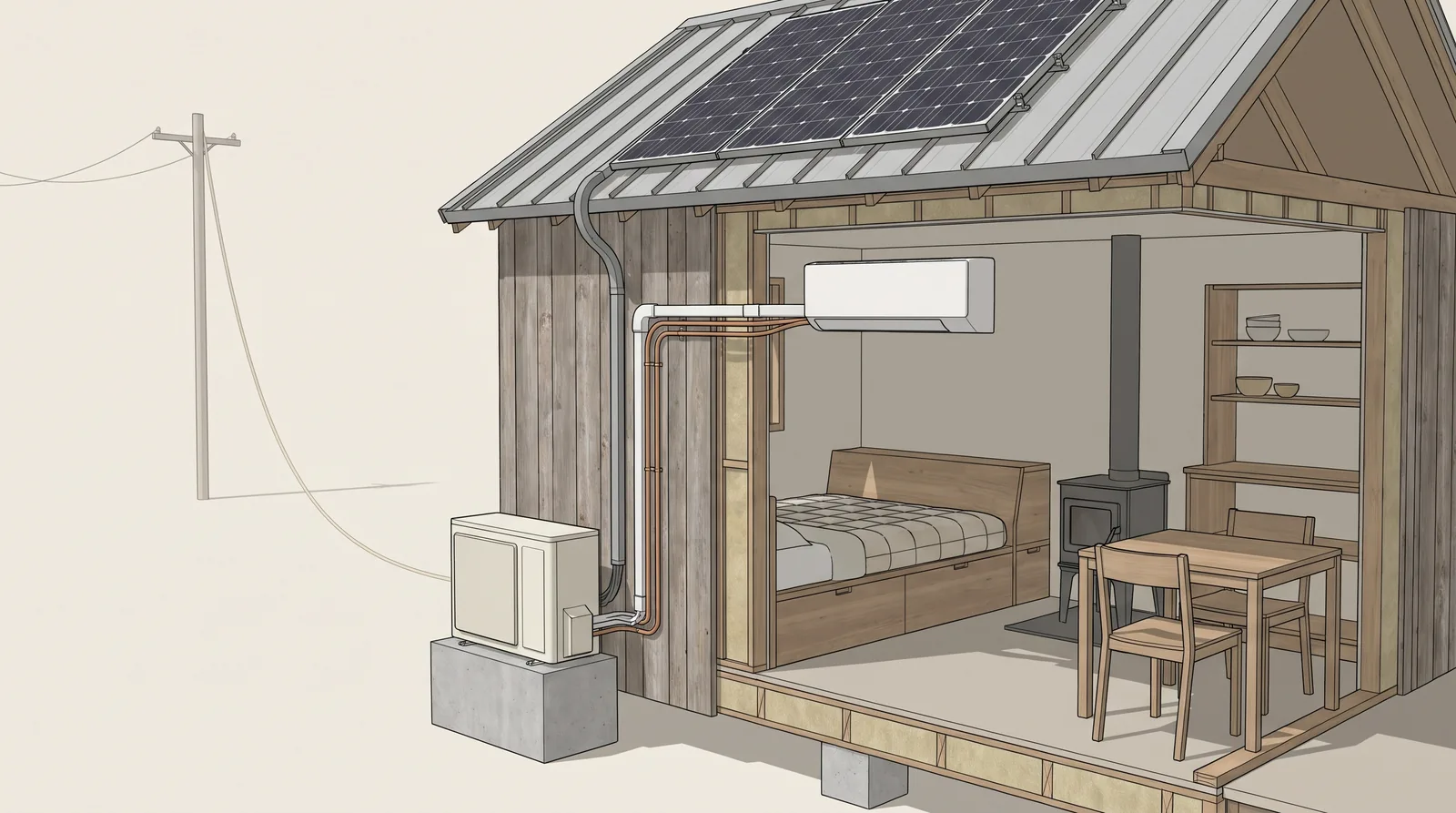
A hybrid solar mini-split has two inputs: a DC input for panels and a normal AC input. EG4’s spec sheet: “Power this hybrid mini-split with solar panels directly attached to the outside unit and/or using 115VAC for the 12K unit or 208-240VAC for the 24K unit.”
The manual says, “The system automatically prioritizes solar input over AC input.” If you want to cap how much it pulls from the grid or your inverter, EG4 has a setting it calls the “AC Power Limiter.”
Here’s what EG4 prints for the two units:
- Cooling capacity: 12,000 BTU/h nominal (3,000 to 12,500 operating range) and 24,000 BTU/h nominal (6,100 to 25,200).
- Designed room size: spaces from 650 to 1,350 square feet across the two units, per EG4.
- PV input: 90 to 380 VDC on the 12K and 150 to 380 VDC on the 24K, with a maximum array open-circuit voltage (Voc) of 380 V.
- Max PV current (Isc): 12 A or less on the 12K, 20 A or less on the 24K.
- Rated PV wattage: 1,100 W on the 12K, 2,200 W on the 24K.
- AC circuit: minimum circuit ampacity of 19.05 A (12K) and 16.33 A (24K), with a 20 A maximum breaker.
- Outdoor operating range, cooling: 32 to 131°F (0 to 55°C).
- Refrigerant: R32, 27.52 oz (12K) and 40.57 oz (24K), with a 16.4 ft pre-charged refrigerant line and a maximum line length of 49.2 ft (12K) or 82 ft (24K).
On price, I could source one number: Ape Solar lists the EG4 12K unit at $1,449.99 each, as of November 10, 2026. That’s the unit only. Panels, the DC disconnect, wire, labor and permits aren’t in it, and I don’t have sourced prices for those, so I won’t total an installed cost.
Setup 3: Battery-backed
A battery-backed solar AC cools from stored energy, so it keeps going after sunset. There are two ways to get there.
An ordinary AC input fed by your battery system. EG4’s manual describes an AC-only mode where “The unit is powered solely by an AC input, which can be obtained from the grid or an inverter.” It says this suits customers who “already have an energy storage system that can run the mini-split.” In other words, your off grid home inverter and battery bank do the work, and the panels charge the batteries instead of feeding the AC directly. Whether your inverter can carry the load is an inverter-sizing question, and the inverter sizing guide is the place to work it out.
A portable AC with its own battery. EcoFlow’s WAVE 3 is the documented example. EcoFlow lists:
- 6,100 BTU (1,800 W) cooling capacity. That 1,800 W is cooling output, not power draw; the rated cooling power (electrical input) is 690 W on AC and 640 W on DC.
- A 1,024 Wh add-on battery (51.2 V, 20 Ah), with an add-on battery input of 700 W max and an AC input of 820 W max.
- “Run Time with EcoFlow Add-On Battery 2-8 hr.”
- About 33.7 lb (15.3 kg), IPX4, 44 to 58 dB, and an operating range of 41 to 122°F (5 to 50°C).
EcoFlow lists the WAVE 3 add-on battery at $649, battery only, as of November 10, 2026. I couldn’t find a current US price for the WAVE 3 unit itself, so I’m not listing one.
If you’re running an AC from a portable power station instead, that’s the AC runtime page’s territory.
How to plan a solar powered air conditioner, step by step
- Decide whether you need night cooling. If yes, direct-PV alone is out. Pick hybrid (grid or inverter as backup) or battery-backed.
- Match the unit to the space using the maker’s own numbers. EG4 rates its two units for 650 to 1,350 square feet. Use the manufacturer’s sizing for whatever unit you’re considering, not a rule of thumb.
- Check the array against the unit’s DC window. The string’s open-circuit voltage is the number of modules in series times each module’s Voc from the panel datasheet, and on the EG4 it must stay at or under 380 V. EG4’s manual warns that Voc rises when temperatures drop below 20°C, and it recommends a qualified solar technician do the array sizing. Browse solar panels for datasheets, and use the solar sizing calculator for the rest of the system.
- Plan the AC circuit. EG4 lists the minimum circuit ampacity and a 20 A maximum breaker. Its manual says the unit must be properly grounded and plugged into a GFCI-rated outlet.
- Plan the DC side the way the manual says. A switch rated for DC disconnect between the array and the outdoor unit (or next to the array), approved for disconnecting solar DC under load; minimum 14 AWG (2.5 mm²) multistrand solar wire; and MC4 connectors of the same type and manufacturer at every joint. For wire beyond that minimum, see what size wire for solar.
- If it’s battery-backed, size the inverter and battery separately. Use the inverter sizing guide, and the runtime page for power stations.
- Hire the licensed work out. See the safety section below. This step isn’t optional on the EG4, by EG4’s own manual.
Safety: what EG4’s manual requires
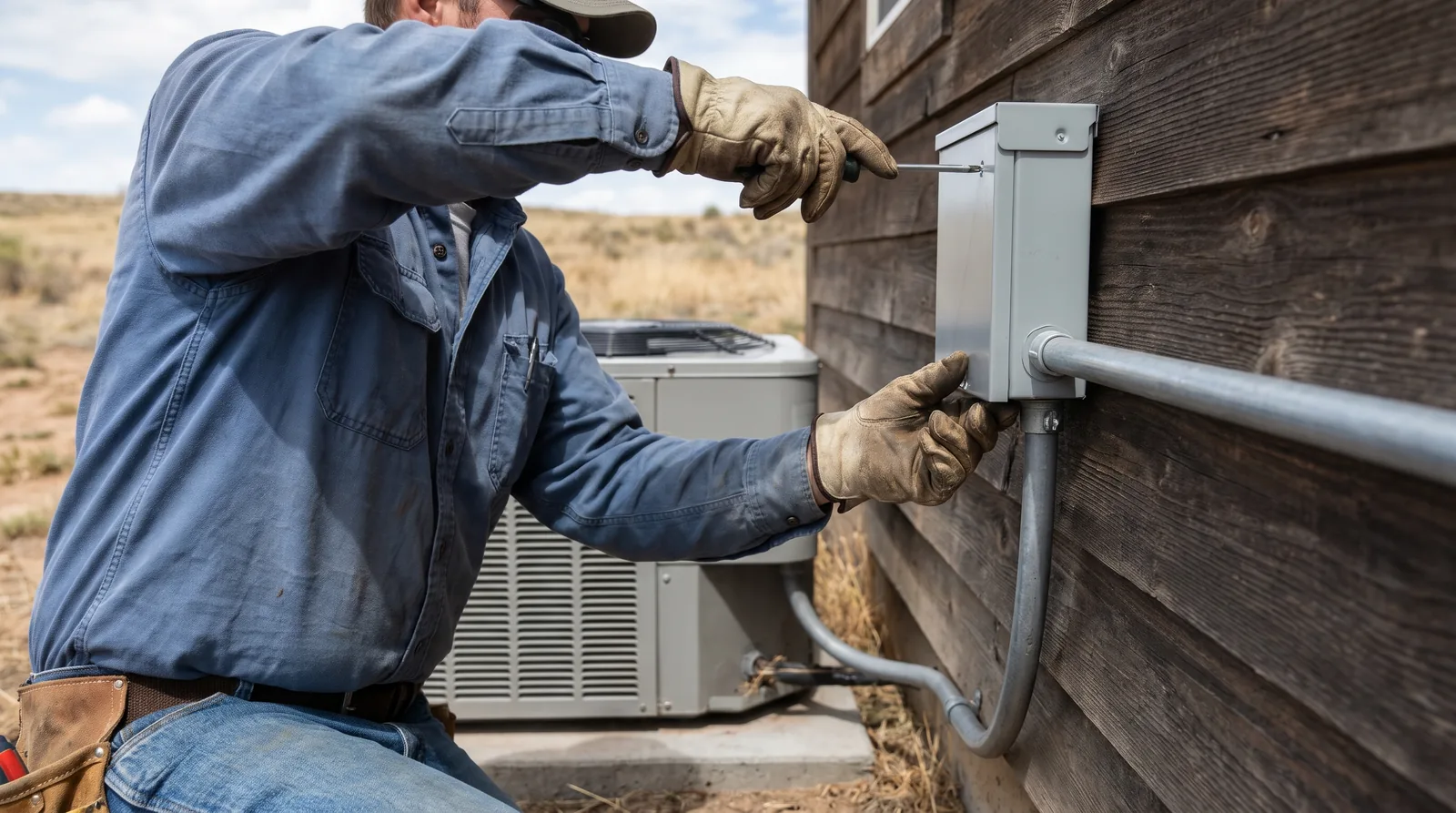
A pre-charged line set can make a mini-split look like a weekend job. EG4’s own manual says otherwise for the electrical side. Everything in this section is EG4’s wording or a close paraphrase of it, from the user manual:
- The equipment involves high-pressure gases and hazardous AC and DC voltages. “All electrical work must be performed by a licensed technician in accordance with local regulations and the instructions provided in this guide.”
- PV modules must be installed to applicable codes (the manual lists “NEC AS/NZS 4777, AS/NZS 5033, CSA C22.1, and others”) by an approved solar technician, and only a qualified technician should install PV modules.
- Total array Voc must not exceed 380 V DC. Many modules exceed 30 V DC in sunlight, and contact with 30 V or more “could be potentially dangerous.”
- Install a switch rated for DC disconnect, approved for disconnecting solar DC under load. Mismatched MC4 connectors can cause fire.
- The unit and solar modules must be grounded per local electrical and building codes, the specified cables fused, and the unit never powered until all wiring and tubing are connected and re-checked.
- If you run it alongside burners or other heating devices, ventilate the room thoroughly to avoid oxygen deficiency.
- The unit contains a fluorinated gas (R32), and only authorized technicians should repair it.
Code requirements vary by jurisdiction. Ask your local permit office and your installer what applies to a PV-direct appliance where you live.
Solar AC checklist
- Decided whether the space needs cooling after sunset.
- Picked a setup: direct-PV, hybrid or battery-backed.
- Checked the unit’s room-size rating against the space.
- Confirmed the array’s cold-weather Voc stays inside the unit’s DC limit, with a qualified solar technician.
- Planned the AC circuit to the manufacturer’s ampacity and breaker numbers.
- Planned a DC disconnect rated for solar DC under load.
- Specified matching connectors and the manual’s minimum wire size.
- For battery-backed: sized the inverter and battery for the AC’s draw.
- Booked a licensed technician for the electrical work and asked about permits.
- Priced the full job, not just the unit.
Which setup fits
- Choose direct-PV if the space only needs cooling while the sun is up and you have no AC source to connect. Expect the compressor to sleep on cloudy afternoons.
- Choose hybrid if you have grid power or an inverter on site and want the panels to cut what you pull from it. If you’re shopping for a solar mini split, this is the setup to look at first.
- Choose battery-backed if you need cooling at night off grid. On a full off grid cabin system, that means feeding a mini-split’s AC input from your inverter. For one room or a small space, a battery-fed portable is the simpler route.
New to the vocabulary? Off grid power 101 covers watts, watt-hours and inverters from the beginning.
What I’m not covering
No pure 12, 24 or 48 V battery-fed DC air conditioners: I didn’t have a datasheet for one, so I left them out rather than guess. No NEC article numbers: the only code references I have are the ones EG4’s manual lists, so ask a licensed installer. No daily solar production or sun-hour figures, and no battery size for overnight cooling. Those depend on your site and your unit, and the battery side is what the solar sizing calculator and runtime page are for.