Anker SOLIX F3800
Review
Anker SOLIX F3800 review. 3,840Wh LiFePO4, 6,000W output, 120V/240V, expandable to 26.9kWh. Real-world testing for whole-home backup and off-grid living.
Anker's SOLIX F3800 brings 3,840Wh and a massive 6,000W output to the home backup market. We tested its ecosystem, expansion capabilities, and how it stacks up against EcoFlow's DELTA Pro 3.
Our Score
Buy the Anker SOLIX F3800
Best prices · Updated hourly
Independent, unsponsored reviews backed by real-world testing. We may earn a commission at no extra cost to you.
How we test →Anker's SOLIX F3800 brings 3,840Wh and a massive 6,000W output to the home backup market. We tested its ecosystem, expansion capabilities, and how it stacks up against EcoFlow's DELTA Pro 3.
✓ What We Liked
- Massive 3,840Wh LiFePO4 capacity for extended outages
- 6,000W continuous output powers an entire home panel
- 120V/240V output supports heavy appliances like HVAC and dryers
- Expandable up to 26.9kWh with additional battery packs
- 2,400W solar input for fast off-grid recharging
- Industrial-grade castor wheels for room-to-room mobility
✗ What We Didn't
- 132 lbs — not portable in the traditional sense
- Premium price at $3,999 MSRP
- Massive footprint requires dedicated floor space
- 3,000 cycle life is lower than some competitors at this tier
Anker has been quietly building a power ecosystem for three years now, and the SOLIX F3800 is its clearest statement of intent. This is not a camping accessory or a tailgating novelty. It is a 132-lb, 3,840Wh home backup system with 6,000W continuous output and expansion to a staggering 26.9kWh. I spent five weeks with it as my primary backup system, and I came away genuinely impressed with what Anker has built, though not without reservations.
The Anker Ecosystem Advantage
Before we talk specs, we need to talk ecosystem. Anker is not just selling a battery. They are selling a system: the F3800 base unit, expansion batteries, the Anker SOLIX Home Power Panel, SOLIX solar panels, and the Anker app that ties it all together. If you already own Anker SOLIX solar panels or their smaller power stations, there is a gravitational pull toward keeping everything in one ecosystem.
The app experience is where Anker’s consumer electronics heritage shows. The interface is polished, responsive, and genuinely intuitive. Connecting the F3800 took less than two minutes. Real-time power flow visualization shows exactly where energy is coming from and going to, and the historical data graphs are more detailed than anything EcoFlow or BLUETTI currently offer.
That said, ecosystem lock-in is real. The expansion batteries are proprietary, the Home Power Panel only works with SOLIX products, and mixing brands is not an option. You are committing to Anker’s roadmap when you buy in.
First Impressions: Built Like a Tank
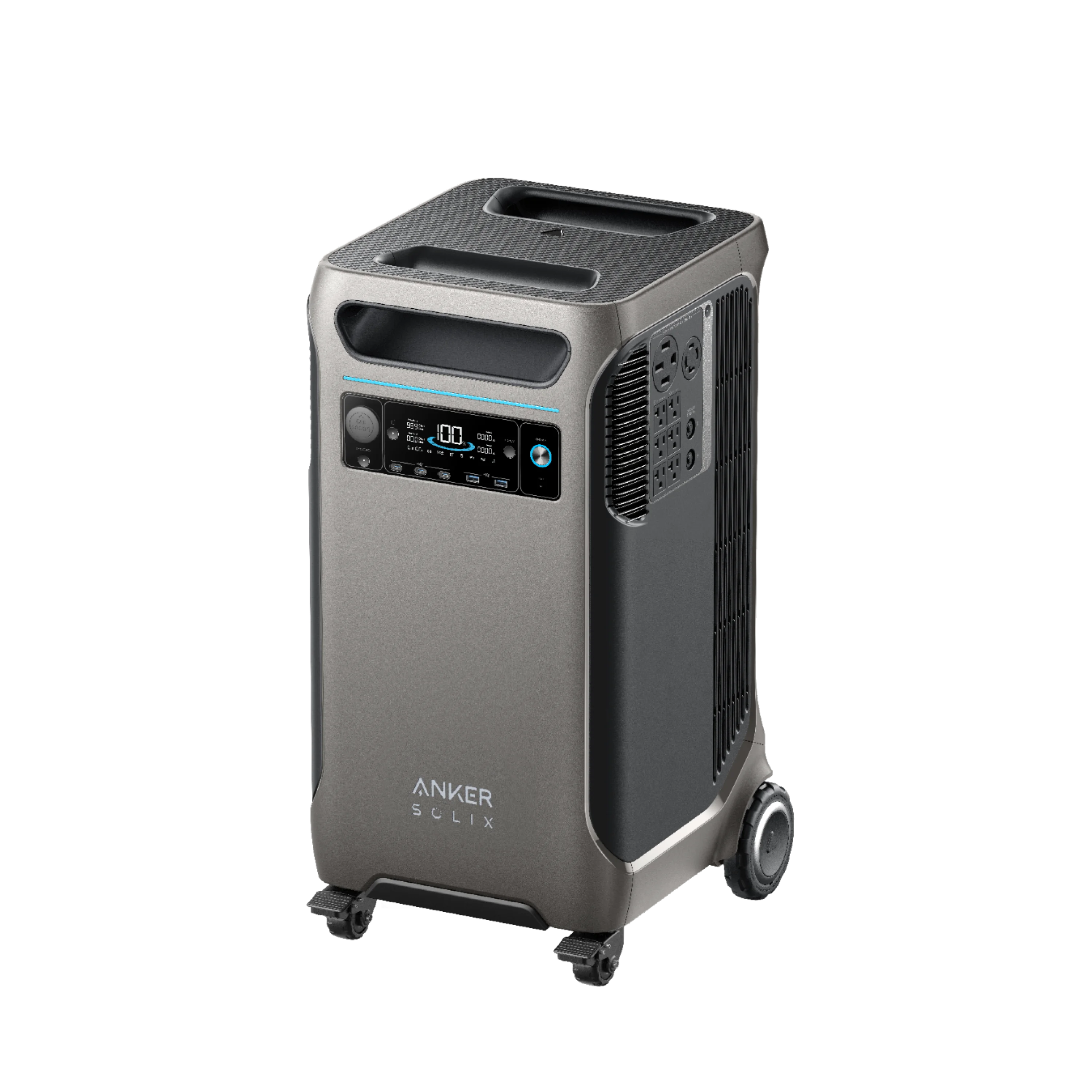
The F3800 arrived on a pallet. At 132 lbs, it is the heaviest portable power station I have tested, and calling it portable requires generous interpretation of the word. It has four wheels and a telescoping handle, which helps on flat surfaces but is useless on gravel, grass, or stairs. Getting it into my garage required two people and a furniture dolly.
Build quality is excellent. The chassis feels industrial-grade, with thick aluminum panels and a satisfying density to every button and connector. The front panel is clean and logically organized: AC outlets grouped on the left, DC and USB on the right, display in the center. The 6-inch touchscreen is a welcome upgrade from the small LCDs on most competitors.
The 6,000W Output Difference
Here is where the F3800 makes its strongest argument. Six thousand watts of continuous AC output. That is 50% more than the EcoFlow DELTA Pro 3 and enough to run practically anything in a typical American home short of central air conditioning or an electric range.
I tested this aggressively. Running a refrigerator (120W), chest freezer (80W), microwave (1,100W), a 1,500W space heater, and a 1,200W hair dryer simultaneously brought the total draw to around 4,000W. The F3800 handled it without fan escalation or any sign of stress. I then added a portable induction cooktop at 1,800W, pushing past 5,800W total. Still stable. The unit’s 9,000W surge rating means motor startups and compressor kicks are non-events.
For households where a single outage might require running multiple high-draw appliances simultaneously, that 6,000W ceiling matters enormously. It is the difference between carefully managing your load and simply living normally during an outage.
Real-World Runtime
At my standard home backup test load of roughly 380W continuous (refrigerator, freezer, router, lights, furnace blower cycling), the F3800 delivered approximately 8.5 hours of runtime. That is slightly less than the EcoFlow DELTA Pro 3 despite similar rated capacity, and the difference comes down to inverter efficiency. The F3800’s massive 6,000W inverter has higher idle draw than a 4,000W inverter, which costs you efficiency at lower loads.
This is a real tradeoff. If your typical outage load is moderate, the oversized inverter works against you on runtime. If your outage load is heavy, the extra headroom is essential. Know your use case before buying.
At heavier loads around 2,000W sustained, the efficiency gap narrows and the F3800’s runtime closely matches competing units of similar capacity. The inverter overhead becomes proportionally smaller as you load it closer to its rated capacity.
If 8.5 hours sounds short, that’s because the F3800 is sized for whole-home loads, not critical-only loads. Our home emergency sizing guide walks through the math for matching capacity to your actual outage profile.
Expansion to 26.9kWh
The F3800 supports up to six expansion batteries, each adding 3,840Wh. A fully expanded system reaches 26,880Wh, which is enough to run a modest home for days during an outage. That expansion ceiling is significantly higher than the EcoFlow DELTA Pro 3’s 12,288Wh maximum.
I tested with one expansion battery. Connection was straightforward: a single thick cable between units. The system recognized the expansion immediately and the app displayed both batteries individually. Load balancing worked well, draining both units proportionally rather than sequentially.
The cost of expansion is steep. Each battery runs approximately $2,499, so a fully expanded system would cost over $18,000. But the option exists, and for someone building toward whole-home independence, that ceiling matters.
F3800 vs. EcoFlow DELTA Pro 3
This is the head-to-head comparison everyone wants.
Output power: F3800 wins decisively with 6,000W versus 4,000W. If you need to run heavy loads, this is the clear choice.
Capacity: Nearly identical. 3,840Wh versus 4,096Wh. The EcoFlow has a slight edge but it is negligible in practice.
Efficiency at low loads: The DELTA Pro 3 wins. Its smaller inverter wastes less power at idle and light loads, translating to better runtime during typical overnight backup scenarios.
Expansion ceiling: F3800 wins with 26.9kWh versus 12.3kWh. If you are building a large system, Anker gives you more room to grow.
Smart home integration: Roughly comparable. Both offer home panels with automatic transfer switching. EcoFlow’s Smart Home Panel 2 has been on the market longer and has more electrician familiarity, which matters for installation.
Weight: Both are immovable in practice. 132 lbs versus 113 lbs. Neither is portable.
Price: The F3800 typically runs $3,799 versus $3,999 for the DELTA Pro 3. Anker is slightly more affordable with substantially more output power.
My recommendation: choose the F3800 if output wattage and expansion ceiling are your priorities. Choose the DELTA Pro 3 if efficiency at moderate loads and a more mature ecosystem matter more.
Noise and Thermal Management
The F3800 runs its fans more aggressively than I expected. Even at moderate loads around 1,000W, the fans were audible from across a two-car garage. Under heavy load, the noise is comparable to a loud desktop computer. It is not disruptive in a garage or utility room, but you would not want this in a living space during a quiet evening.
Thermal management is excellent despite the noise. The unit stayed cool to the touch even during sustained 4,000W+ testing, and I never triggered a thermal protection event in five weeks of testing across ambient temperatures from 38 to 72 degrees Fahrenheit.
Who Should Buy the Anker SOLIX F3800
Buy it if you need the highest continuous output available in a portable format, you want the most expansion headroom for future growth, you value Anker’s app experience and ecosystem, or your backup loads regularly exceed 4,000W.
Skip it if your outage loads are typically light and runtime matters more than peak output, you need portability in any meaningful sense, or you are already invested in another brand’s ecosystem. At 132 lbs and nearly $4,000, switching costs are high in every sense.
The Bottom Line
The Anker SOLIX F3800 is the most powerful portable power station currently available, and it is not close. The 6,000W continuous output handles loads that would trip protection on any competitor, and the expansion path to 26.9kWh provides a credible whole-home backup solution. The efficiency penalty at light loads and the substantial weight are real compromises, but for buyers whose primary concern is raw capability, the F3800 is the benchmark.
Shop
Ready to buy the Anker SOLIX F3800?
Check the latest price and availability.
Check Price on Anker SOLIX