BLUETTI AC180
Review
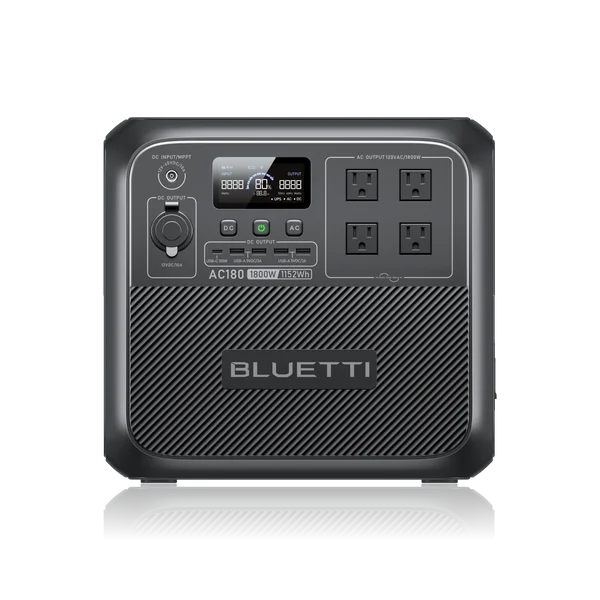
BLUETTI AC180 review. 1,152Wh LiFePO4, 1,800W output, 45-min fast charge to 80%. A top mid-range portable power station for camping, RV, and backup power.
At $699, the AC180 offers 1,152Wh of LiFePO4 power in a 35-lb package. We tested it for weekend car camping and light RV use.
Our Score
Buy the BLUETTI AC180
Best prices · Updated hourly
BLUETTI · Direct
BLUETTI
★ Lowest PriceAmazon · Prime
Amazon
Independent, unsponsored reviews backed by real-world testing. We may earn a commission at no extra cost to you.
How we test →At $699, the AC180 offers 1,152Wh of LiFePO4 power in a 35-lb package. We tested it for weekend car camping and light RV use.
✓ What We Liked
- 1,152Wh capacity at a competitive price point
- 1,800W output with 2,700W power lifting handles most appliances
- 0-80% charge in just 45 minutes via AC
- Built-in 15W wireless charging pad
- LiFePO4 with 3,500+ cycle life for long-term reliability
✗ What We Didn't
- 35 lbs — portable but not ultralight
- Not expandable — locked at 1,152Wh
- 500W max solar input is lower than some competitors
- Only 1 USB-C port
The Case for “Just Enough” Power
There is a specific kind of buyer who does not need a 4,000Wh monster with a price tag to match. They need a power station that runs a CPAP machine overnight, keeps a mini fridge cold through a weekend camping trip, and charges laptops and phones without complaint. The BLUETTI AC180 is built for exactly that person, and after three months of testing it across car camping trips, a home office backup scenario, and one extended RV boondocking weekend in the Utah desert, I think it is one of the best values in the portable power market right now.
What You Get for $699
The AC180 packs 1,152Wh of LiFePO4 battery capacity into a 35-lb box. That is not ultralight territory — you will notice it walking from the car to the campsite — but it is absolutely manageable for one person. The form factor is compact enough to slide behind the passenger seat or tuck into a storage bay without rearranging everything.
Output tops out at 1,800W continuous with 2,700W surge through its power-lifting mode. In practice, that means it runs a coffee maker, a small microwave, a hair dryer, or a portable induction burner without breaking a sweat. I ran a 1,500W space heater from it during a cold spring night in the van and it held steady for about 40 minutes — enough to take the edge off before crawling into the sleeping bag.
Four AC outlets, four USB-A ports, one USB-C port, and one DC outlet cover most charging scenarios. The single USB-C port is my only real complaint about the port layout. In 2026, having just one USB-C feels stingy when most devices have moved to that standard. If you are charging a laptop and a phone simultaneously via USB-C, you will need a hub or adapter.
Charging Speed Is the Killer Feature
The AC180’s party trick is its AC charging speed: 0-80% in 45 minutes. I have tested this multiple times and it consistently hits that mark. Full charge takes about 80 minutes total. This changes the calculus for people who are moving between campsites or running errands in town. Pull into a coffee shop, plug in for an hour, and you are back to nearly full.
Solar input maxes out at 500W, which is lower than some competitors in this price range. With a single 200W panel in direct Colorado sun, I was seeing about 160-170W of actual input, which means a full solar charge takes roughly 7-8 hours in good conditions. Pair it with two panels and you can cut that down to 4 hours, but you will still be capped at 500W even if your panel array can deliver more.
For comparison, the EcoFlow RIVER 3 accepts up to 600W of solar and the Anker SOLIX C1000 takes 600W as well. If solar is your primary charging method, that 500W ceiling is worth considering.
Real-World Testing: Car Camping in Moab
I brought the AC180 on a three-night car camping trip near Moab in early March. Temperatures dropped to the low 30s at night and climbed into the mid-60s during the day. Here is what I ran from it:
- ARB 50-quart fridge/freezer running 24/7 on “fridge” mode (draws about 40W cycling)
- CPAP machine (ResMed AirSense 11) for roughly 7 hours each night
- Phone and tablet charging for two people
- LED camp lights for a few hours each evening
- Laptop for about 2 hours of photo editing on night two
After the first full day and night, the battery sat at 58%. By the end of night two, it was down to 19%. I topped it off with a 200W Renogy panel during day three while we were out hiking and came back to 72%. That was enough to get through the final night comfortably.
The takeaway: for a couple doing moderate-use car camping, the AC180 is a solid two-night unit without solar. Add a panel and you can stretch it indefinitely.
Need to know specifically how long this will run a refrigerator during an outage? See our fridge-focused power station sizing guide for the runtime math by fridge type and brand.
How It Compares
vs. EcoFlow RIVER 3 (~$250): The RIVER 3 is much cheaper but has only 245Wh of capacity. It is a phone-and-laptop charger, not a fridge-and-CPAP unit. Different tools for different jobs.
vs. Anker SOLIX C1000 (~$599): The C1000 offers similar capacity (1,056Wh) at a slightly lower price point. It has a higher solar input ceiling (600W) and more USB-C ports. However, the AC180 edges it out on output wattage (1,800W vs 1,800W with stronger surge) and charging speed. These two are genuinely neck-and-neck, and your choice might come down to brand preference.
vs. BLUETTI AC200L (~$1,399): If you need more than 1,152Wh, the AC200L doubles the capacity and adds expandability. But it also doubles the price and weight. The AC180 is the right call if you can live within its capacity limits.
The Wireless Charging Pad Nobody Asked For
BLUETTI built a 15W wireless charging pad into the top of the unit. I used it exactly twice. It works fine, but when I am camping, my phone is usually in my pocket or on a table — not balanced on top of a power station. It is a nice-to-have that adds zero weight, so I am not complaining. Just do not let it be a deciding factor.
App Control: Useful but Not Essential
The BLUETTI app connects via Bluetooth and lets you monitor input/output wattage, battery percentage, and remaining runtime. You can also toggle outlets on and off, set charging limits to extend battery longevity, and update firmware. The app is functional and stable on both iOS and Android. I appreciated being able to set a charge limit to 80% for daily use — LiFePO4 batteries last longer when you avoid constant full charges.
Who Should Buy the AC180
Buy it if: You are a weekend car camper, RV weekender, or someone who wants reliable backup power for outages. You run a CPAP machine, a portable fridge, and basic electronics. You value fast AC charging for quick turnarounds between trips. You want LiFePO4 longevity without spending over $1,000.
Skip it if: You need to run high-draw appliances for extended periods. You depend heavily on solar charging and want maximum solar input. You need expandability for growing your system over time. You camp for more than two nights without access to shore power or solar.
The Bottom Line
The BLUETTI AC180 does not try to be everything. It is a mid-range power station that delivers excellent value for people whose needs fit within its 1,152Wh capacity. The fast charging alone sets it apart — being able to go from dead to 80% in under an hour means you spend less time tethered to an outlet and more time actually using the thing.
At $699 on sale, it undercuts most competitors in the 1,000-1,200Wh class while matching or exceeding them on output and charging speed. The LiFePO4 chemistry with 3,500+ rated cycles means this unit should last the better part of a decade with regular use. For the money, it is genuinely hard to beat.
Overall Score: 8.7/10
Shop
Ready to buy the BLUETTI AC180?
Check the latest price and availability.
Check Price on BLUETTI