BLUETTI AC200L
Review
BLUETTI AC200L review. 2,048Wh LiFePO4, 2,400W output, expandable to 8,192Wh, 30A RV outlet. Real-world testing for RV boondocking, home backup, and...
The BLUETTI AC200L takes everything that made the AC200MAX a bestseller and fixes the complaints. Faster charging, more output, and T400/T500 expansion support make this the mid-range power station to beat.
Our Score
Buy the BLUETTI AC200L
Best prices · Updated hourly
BLUETTI · Direct
BLUETTI
★ Lowest PriceAmazon · Prime
Amazon
Independent, unsponsored reviews backed by real-world testing. We may earn a commission at no extra cost to you.
How we test →The BLUETTI AC200L takes everything that made the AC200MAX a bestseller and fixes the complaints. Faster charging, more output, and T400/T500 expansion support make this the mid-range power station to beat.
✓ What We Liked
- 2,048Wh expandable to 8,192Wh with B230/B300 expansion batteries
- 2,400W output with 3,600W Power Lifting handles resistive loads
- 0-80% AC fast charge in just 45 minutes
- 1,200W solar input for rapid off-grid recharging
- 30A NEMA TT-30 RV outlet built in — true RV-ready design
✗ What We Didn't
- 62.4 lbs is heavy for a single person to carry
- 3,000 cycle life is lower than some 4,000-cycle competitors
- ≤50 dB noise level is audible under heavy load
- No 240V output without stacking two units
The AC200MAX Was Good. This Is Better.
The BLUETTI AC200MAX was one of the most popular mid-range portable power stations for good reason — solid capacity, expandable battery, and a price that undercut EcoFlow’s offerings. But it had frustrations. Slow charging. An aging LFP chemistry that was heavier than it needed to be. An app that felt like an afterthought. The AC200L addresses nearly every complaint while keeping what worked.
I have been running the AC200L as my primary power station for car camping trips and as a home backup unit for the past two months. Here is what BLUETTI got right, and where the competition still has an edge.
Specs That Matter
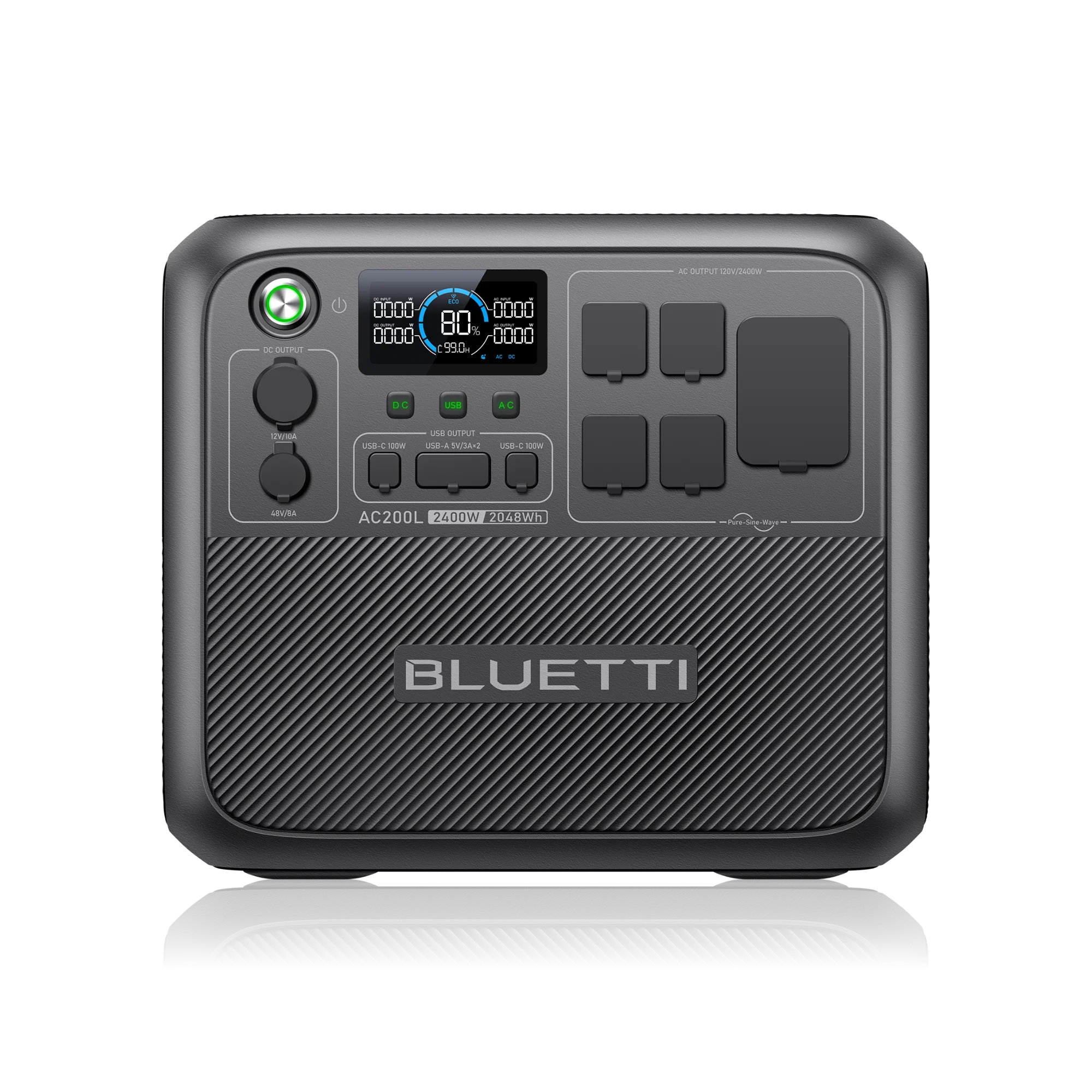
The AC200L packs 2,048Wh of LiFePO4 capacity into a unit that weighs 62 pounds. Output is rated at 2,400W continuous with a 3,600W lifting mode that handles brief surges from motor startups. On the input side, it accepts up to 1,200W of combined AC and solar charging, with a maximum solar input of 500W.
Those numbers matter because they represent meaningful improvements over the AC200MAX. The MAX topped out at 2,200W output and charged significantly slower. The AC200L can go from 0% to 80% in about 45 minutes on AC power, compared to roughly two hours for the MAX. That charging speed transforms the unit from something you need to plan around to something you can top off during a lunch break.
Build Quality and Design
BLUETTI has refined their industrial design with the AC200L. The unit is still a substantial rectangle — there is no getting around the physics of 2,048Wh — but the handles are more comfortable, the display is brighter and easier to read in sunlight, and the outlet layout makes more sense. AC outlets are grouped on one side, DC outputs on the other, and the USB ports are on the front where you can actually reach them.
The construction is solid ABS plastic with internal aluminum framing. It does not feel fragile, and I have bounced it around in the back of my truck for weeks without any cosmetic or functional issues. The rubberized feet keep it planted on surfaces, which matters when you have a coffee maker vibrating on top of it at a campsite.
The cooling fans are noticeably quieter than the AC200MAX. Under moderate load (500-800W), the fans are barely audible from a few feet away. Under heavy load, they spin up but are still quieter than an EcoFlow DELTA unit at comparable output. For car camping where the power station sits near your sleeping area, fan noise matters more than most spec sheets suggest.
T400/T500 Expansion: The Modular Play
The AC200L supports BLUETTI’s B230 and B300 expansion batteries, adding up to 8,192Wh of total capacity with two B300 units. But the more interesting development is compatibility with the newer T400 and T500 expansion modules, which use a faster data bus and support higher charge rates.
I tested the AC200L with a single B300 (3,072Wh total) for a four-day camping trip where I ran a 12V fridge, charged phones and laptops, and used an electric kettle twice a day. I came home with 35% remaining. For weekend trips without the expansion battery, the base 2,048Wh is more than sufficient for moderate use.
The expansion ecosystem is one of BLUETTI’s genuine advantages over the competition. You buy the base unit now and add capacity later as your needs grow or your budget allows, without replacing the core unit.
Real-World Performance
Car Camping Test
I took the AC200L on a week-long car camping trip in eastern Oregon. Daytime temperatures hit 90°F, nights dropped to 45°F. The unit ran a 12V compressor fridge (ARB 50qt), charged two phones and a laptop daily, powered a small fan at night, and handled morning coffee via a 1,000W kettle.
Daily consumption averaged about 400Wh. With 200W of portable solar panels (BLUETTI PV200), I was pulling in 120-160W during peak sun hours, which covered about 60-70% of my daily usage. I charged the remainder from the truck’s inverter during drives between campsites.
The AC200L handled the heat without issues. Internal temperature management kept the unit from throttling even when ambient temps were in the high 80s and the unit was in direct sunlight (not recommended, but it happened). The display showed internal temps peaking around 105°F, well within operating limits.
Home Backup Test
During a planned outage, I ran the AC200L as my home office backup. It powered my desk setup (monitor, laptop, router, desk lamp — about 120W total) for a full workday with 55% battery remaining. That works out to roughly 12 hours of light office work on a single charge, which is consistent with BLUETTI’s estimates once you account for inverter efficiency losses.
I also tested running a window AC unit (5,000 BTU, about 500W running / 1,200W startup). The AC200L handled the startup surge without triggering protection, and ran the unit for about three hours before I stopped the test at 20% battery. The 2,400W continuous rating and lifting mode give you legitimate capability to run high-draw appliances.
The BLUETTI App
The BLUETTI app has improved significantly from its early days. It now provides real-time power flow visualization, charging schedule programming, and firmware updates. You can set custom charge limits (I keep mine at 90% for daily use to extend cycle life), configure AC output frequency, and monitor individual output port status.
It is not as polished as EcoFlow’s app, which still sets the standard for power station software. But it is no longer the liability it once was. Connection via Bluetooth is reliable, and the data updates in real time without the lag that plagued earlier BLUETTI models.
How It Compares
vs. BLUETTI AC200MAX ($1,600): The AC200L is the clear upgrade. Faster charging, higher output, quieter fans, better app, and T400/T500 compatibility. If you are choosing between the two today, there is no reason to buy the MAX unless you find it deeply discounted.
vs. EcoFlow DELTA 2 Max ($1,700): The most direct competitor. The DELTA 2 Max offers 2,048Wh capacity and 2,400W output — nearly identical specs. EcoFlow’s advantages are a better app, faster solar charging (1,000W max vs 500W), and X-Stream AC charging. BLUETTI’s advantages are lower price, quieter operation, and a more mature expansion battery ecosystem. For car camping, I give a slight edge to the AC200L on noise and value. For a fixed installation where solar input matters, the DELTA 2 Max pulls ahead.
vs. Jackery Explorer 2000 v2 ($1,500): The Jackery is lighter (43 lbs vs 62 lbs) and has better portability, but it is not expandable and tops out at 2,200W output. If you need to carry your power station to a campsite, the Jackery wins. If it lives in a vehicle, the AC200L’s expandability and higher output make it the better long-term investment.
vs. Anker SOLIX C1000 ($800): Half the capacity, half the price. The C1000 is excellent for weekend trips and light use. But if you are running a fridge, cooking with electric appliances, or need multi-day capacity, you will outgrow the C1000 quickly. The AC200L is the step up when 1,000Wh is not enough.
Buying your first power station and not sure what any of these specs mean? Read our beginner’s solar generator buying guide first — it walks through watt-hours, output watts, surge ratings, and battery chemistry in plain English.
Who Should Buy the AC200L
Buy it if: You want a capable mid-range power station that can grow with your needs. You car camp regularly and want to run a fridge, charge devices, and cook without rationing power. You want a home backup that can handle a full workday or run moderate appliances during outages. You value quiet operation — especially for sleeping near the unit.
Skip it if: You need maximum solar input — the 500W limit is behind EcoFlow and Jackery in this class. You prioritize portability over capacity — at 62 lbs, this is a two-person lift. You want the absolute fastest AC charging — EcoFlow’s X-Stream technology still leads.
The Bottom Line
The BLUETTI AC200L is the mid-range power station I would recommend to most people asking “what should I buy?” It hits the sweet spot of capacity, output, expandability, and price that makes it versatile enough for car camping, home backup, and daily outdoor use. It does not have the absolute best specs in any single category, but it has no significant weaknesses either.
BLUETTI took their bestselling platform, listened to the complaints, and delivered an upgrade that justifies its existence. In a market crowded with incremental updates and confusing model numbers, the AC200L is a genuinely better product than what it replaces.
Overall Score: 8.8/10
Shop
Ready to buy the BLUETTI AC200L?
Check the latest price and availability.
Check Price on BLUETTI