BLUETTI AC200MAX
Review
BLUETTI AC200MAX review — 2,048Wh LiFePO4 expandable power station at $1,599. Compared against EcoFlow, Jackery, and Anker for RV, cabin, and backup use.
The AC200MAX hits a sweet spot: 2,048Wh of LiFePO4 capacity, expandable to 8kWh, at a price that undercuts the competition.
Our Score
Buy the BLUETTI AC200MAX
Best prices · Updated hourly
BLUETTI · Direct
BLUETTI
★ Lowest PriceAmazon · Prime
Amazon
Independent, unsponsored reviews backed by real-world testing. We may earn a commission at no extra cost to you.
How we test →The AC200MAX hits a sweet spot: 2,048Wh of LiFePO4 capacity, expandable to 8kWh, at a price that undercuts the competition.
✓ What We Liked
- Excellent value at under $2,000
- LiFePO4 with 3,500+ cycle life
- Expandable up to 8,192Wh with B230/B300 packs
- 2,200W output handles most appliances
- Proven reliability with huge user community
✗ What We Didn't
- 62 lbs is still heavy for one person
- Slower AC charging than EcoFlow (2.5 hours)
- Lower solar input than competitors (900W max)
The BLUETTI AC200MAX occupies the space in the portable power market where ambition meets pragmatism. At 2,048Wh with 2,200W output, it handles real appliances. At $1,599 on sale, it does not require a second mortgage. And with expansion capability up to 8,192Wh, it grows with you instead of forcing a full replacement when your needs change.
I tested the AC200MAX for five weeks on an RV boondocking trip through the Southwest, running it as the sole power source for everything from the coffee maker to the router. Here is how it held up.
RV Boondocking: The Real Test
My test rig was a 24-foot travel trailer parked on BLM land outside Quartzsite, Arizona for two weeks, followed by three weeks of mixed boondocking and campground stays across Utah. The AC200MAX sat on the floor next to the dinette and powered the following daily loads:
- 12V compressor fridge (65W average)
- Laptop and two phones (50W)
- LED lighting (20W)
- Starlink router (40W average)
- Coffee maker (900W, 10 min/day)
- Instant Pot (700W, 30 min every other day)
The continuous baseline of 175W gave me roughly 10 hours of runtime on a full charge. With the coffee maker and Instant Pot adding periodic spikes, my actual daily consumption averaged about 1,400Wh. That meant I needed nearly a full recharge every day.
Solar Charging: Honest Numbers
I paired the AC200MAX with two 200W portable panels, arranged on a tilt mount to face the Arizona sun. Peak solar input consistently hit 340-380W around midday, with a daily total of roughly 1,600-1,900Wh harvested over 6-7 hours of useful sunlight.
That was enough to fully recharge the AC200MAX each day with a small surplus. On cloudy days, which were rare in Quartzsite, input dropped to 200-250W and I had to reduce my evening loads to avoid running dry before sunrise.
The 900W maximum solar input on the AC200MAX is adequate for the base unit but becomes a bottleneck if you add expansion batteries. Charging 8,192Wh of total capacity through 900W of solar would take the better part of two full days. EcoFlow’s DELTA 3 Ultra accepts 2,400W of solar, which is a meaningful advantage for large solar arrays.
The Expansion Ecosystem
The AC200MAX connects to BLUETTI B230 (2,048Wh) or B300 (3,072Wh) expansion batteries via a simple cable. I tested it with a single B230, bringing total capacity to 4,096Wh. The connection is plug-and-play: attach the cable, and the AC200MAX automatically integrates the extra capacity into its display and management.
With the B230 attached, my daily 1,400Wh consumption left enough reserve for a comfortable cushion. I stopped worrying about power budgets entirely, which is the whole point of expansion.
This modular approach is the AC200MAX’s defining advantage. You can start with the base unit at $1,599 and add a B230 ($1,299) a year later when your budget allows. By contrast, fixed-capacity units force you to either overbuy from the start or replace the entire unit when you need more.
Build Quality and Port Layout
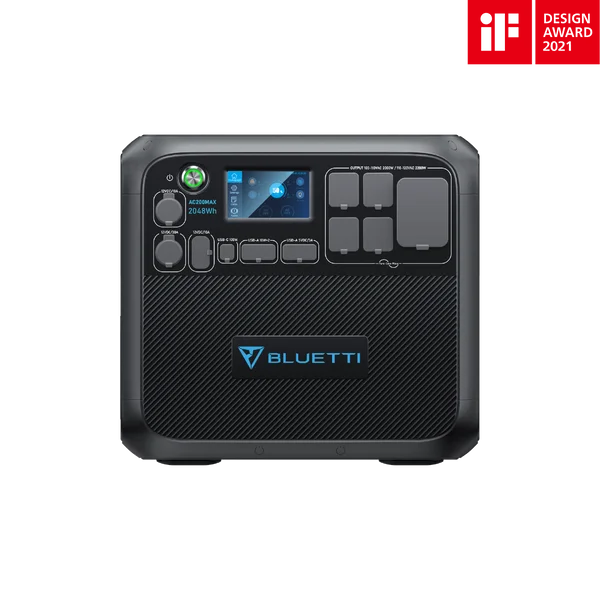
The AC200MAX is built like a tank. The rubberized exterior panels absorb minor impacts, and the unit survived three weeks of RV travel over rough roads without any rattles or loose components. The carrying handles on each side are comfortable, though at 62 lbs, you will want two hands or two people for any distance beyond 20 feet.
The port layout is functional but not elegant. The four AC outlets are grouped on one side, USB ports on the front face, and the DC output and solar input on another panel. I found myself rotating the unit depending on what I needed to access, which is mildly annoying in tight RV spaces but not a dealbreaker.
One notable omission: only one USB-C port. In 2026, when every phone, laptop, and accessory charges via USB-C, a single port creates conflicts. I kept a USB-C hub plugged in permanently, which is an inelegant workaround for a $2,000 device.
AC200MAX vs. EcoFlow DELTA 3 Plus
The DELTA 3 Plus is the most direct competitor to the AC200MAX, and the comparison is instructive. The DELTA 3 Plus offers faster AC charging, higher solar input, and a more modern app experience. It also costs about $500 more at typical sale prices.
The AC200MAX wins on two fronts: expansion capability and value. The DELTA 3 Plus is not expandable, so its capacity is fixed at purchase. And dollar-for-dollar, the AC200MAX delivers more watt-hours per dollar spent.
If you want the best standalone mid-capacity unit and do not plan to expand, the DELTA 3 Plus is the better device. If you want a system that can grow from 2kWh to 8kWh over time, the AC200MAX is the only sensible choice in this price range.
The Weight Reality
At 62 lbs, the AC200MAX is firmly in the two-person-carry category. I could shuffle it around inside the RV by myself, but loading it into a truck or carrying it across a campsite required help. For comparison, the Anker SOLIX C1000 weighs 28 lbs and is a true one-handed carry.
This weight is the cost of 2,048Wh of LiFePO4 cells. Physics does not negotiate. If you need this much capacity in a portable format, 60+ lbs is where you land. The EcoFlow DELTA 3 Ultra is even heavier at 75 lbs for 4,096Wh.
For RV and cabin use where the unit stays mostly stationary, the weight is a non-issue after initial placement. For car camping where you are setting up and breaking down frequently, the weight becomes a genuine consideration.
App and Firmware
The BLUETTI app works but lacks the polish of EcoFlow’s interface. Connection was reliable over Bluetooth, and I could monitor input/output, battery percentage, and estimated runtime. Firmware updates were stable if infrequent.
What the BLUETTI app lacks is granular control. I could not schedule outlet groups independently or set charging limits to preserve battery longevity. EcoFlow allows both. For most users this will not matter, but power users who want to optimize every charging cycle will notice the gap.
Reliability Over Five Weeks
The AC200MAX ran continuously for 35 days with no failures, no error codes, and no unexpected shutdowns. The LiFePO4 cells showed no measurable capacity degradation over this period, which is expected at 3,500 rated cycles but reassuring to confirm.
Fan noise was moderate under heavy load and inaudible at baseline draw. The unit ran warm in the Arizona heat but never triggered thermal throttling, even with ambient temperatures above 100F.
Who Should Buy the BLUETTI AC200MAX
Buy it if you are building an RV or cabin power system that may need to grow over time, you want the best value per watt-hour in the mid-capacity segment, or you need 2,000W+ output at under $2,000. The expansion ecosystem is this unit’s strongest argument.
Skip it if you prioritize fast AC charging, you need more than one USB-C port without adapters, or you want the most polished app experience. The EcoFlow DELTA 3 Plus outperforms the AC200MAX on convenience features, and the Anker SOLIX C1000 offers far better portability at a lower price point if you can live with less capacity.
The Bottom Line
The BLUETTI AC200MAX is not the most exciting power station on the market. It is the most practical. The expandable architecture means your investment grows with your needs instead of becoming obsolete. The LiFePO4 chemistry means it will still be performing in 2035. And the price means you do not have to choose between a power station and the rest of your gear budget. In a market chasing bigger numbers and faster specs, the AC200MAX quietly delivers the best long-term value.
Ready to buy the BLUETTI AC200MAX?
Check the latest price and availability.
Check Price on BLUETTI