EcoFlow DELTA 3 Plus
Review
EcoFlow DELTA 3 Plus review. 1,024Wh LiFePO4, 1,800W output, 56-min full charge, expandable to 5kWh. Real-world testing for camping, RV, and backup use.
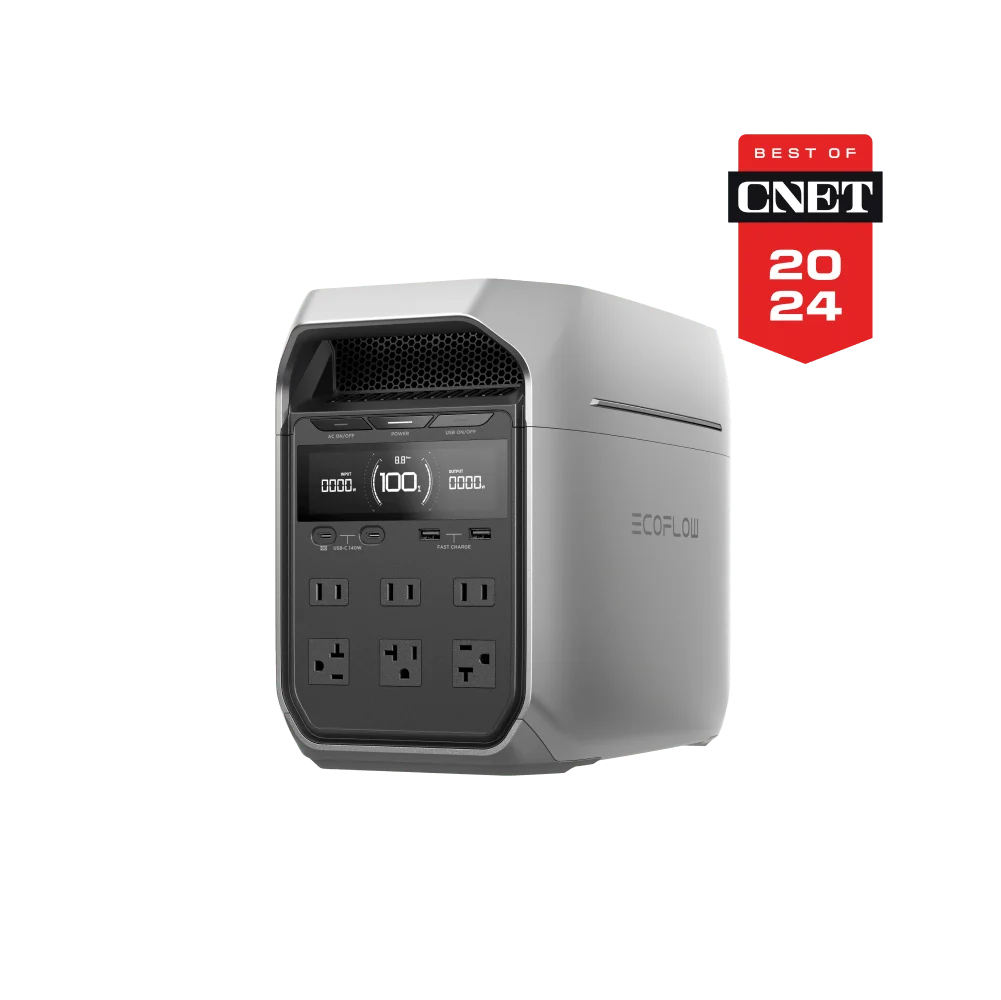
The EcoFlow DELTA 3 Plus hits the sweet spot between portability and power at 1,024Wh and 27.6 lbs. We tested it for car camping, light RV use, and weekend cabin trips.
Our Score
Buy the EcoFlow DELTA 3 Plus
Best prices · Updated hourly
Independent, unsponsored reviews backed by real-world testing. We may earn a commission at no extra cost to you.
How we test →The EcoFlow DELTA 3 Plus hits the sweet spot between portability and power at 1,024Wh and 27.6 lbs. We tested it for car camping, light RV use, and weekend cabin trips.
✓ What We Liked
- 1,024Wh capacity in a 27.6 lb package — excellent power-to-weight ratio
- 56-minute full charge via 1,500W AC input
- 4,000 cycle LiFePO4 for decade-long lifespan
- Expandable up to 5kWh with compatible EcoFlow batteries
- 6 AC outlets — most in its class
- Smart app control with real-time monitoring
✗ What We Didn't
- 500W max solar input limits off-grid charging speed
- 1,800W output may not handle largest appliances
- Expansion batteries sold separately at premium prices
Every product category has a sweet spot. Not the biggest, not the cheapest, but the one that covers the most real-world use cases without forcing painful compromises. In portable power stations, the EcoFlow DELTA 3 Plus is that product. At 1,024Wh, 1,800W output, and 27.6 lbs, it threads the needle between “too small to be useful” and “too heavy to move” better than anything else I have tested this year.
I spent four weeks with the DELTA 3 Plus as my primary power source for car camping weekends, a light RV trip down the Oregon coast, and as a general-purpose backup at home. Here is why it earned a permanent spot in my gear rotation.
The Portability Threshold
There is a weight threshold in portable power stations where the device transitions from something one person grabs with one hand to something that requires planning, a second person, or a hand truck. That threshold, based on my experience, is around 35 lbs. Above it, you think twice before moving the unit. Below it, you just pick it up and go.
At 27.6 lbs, the DELTA 3 Plus lives comfortably below that line. I carried it from my garage to my truck with one hand, set it up on a picnic table at a campsite without assistance, and moved it between the cab and the truck bed without grunting. That sounds trivial, but after testing 75-lb and 113-lb units that require two people and careful logistics, the DELTA 3 Plus felt like liberation.
The form factor is compact enough to fit on the floor behind the passenger seat of a midsize truck. It does not dominate a campsite table. It slides under an RV dinette. These are small ergonomic victories that compound over a weekend of use.
Car Camping: The Primary Use Case
My standard car camping setup includes a 12V fridge/freezer (50W average), LED string lights (15W), phone and laptop charging (30W combined), and occasionally a small electric kettle (800W) for morning coffee. Total continuous draw without the kettle is about 95W.
The DELTA 3 Plus ran this setup for two full nights and most of a third before hitting 10% battery. That is roughly 28 hours of real-world runtime at light loads, closely matching the theoretical calculation of 1,024Wh at 85% inverter efficiency divided by 95W draw.
The electric kettle was an interesting test. At 800W, it is well within the DELTA 3 Plus’s 1,800W continuous limit but represents a significant spike in draw. Boiling 500ml of water took about 4 minutes and consumed approximately 55Wh, or about 5% of the battery. A worthwhile trade for hot coffee at a campsite where fire restrictions prohibited a camp stove.
I also ran a small portable projector (60W) for a movie night. The DELTA 3 Plus powered the projector and a Bluetooth speaker for three hours with minimal battery impact. This is the kind of quality-of-life use case where a mid-capacity power station truly shines.
Light RV Use: The Oregon Coast Trip
I borrowed a friend’s Class B camper van for a four-day trip down the Oregon coast. The van had a small 12V fridge, cabin lights, USB charging, and a roof-mounted exhaust fan. It did not have shore power hookups at every stop, which made the DELTA 3 Plus essential.
Over four days of boondocking at dispersed sites and state park overflow areas without hookups, I ran the van’s fridge continuously and used the DELTA 3 Plus for supplemental power: charging devices, running the exhaust fan at night, and powering a small induction hotplate for dinner.
I recharged once during the trip using the van’s 12V outlet while driving. The DELTA 3 Plus supports 12V car charging at up to 240W, which meant a three-hour drive from Gold Beach to Coos Bay brought it from 15% to roughly 75%. Not a full charge, but enough to get through another two nights comfortably.
For a full-time RV setup or a Class A motorhome, the DELTA 3 Plus is undersized. But for weekend van trips and light RV use where you are supplementing existing 12V systems rather than powering everything, it is right-sized.
Expandability: Growing Into Your Needs
The DELTA 3 Plus supports EcoFlow’s expansion batteries, scaling up to approximately 5,120Wh total. I did not test with expansion packs, but the option matters for a specific buying pattern: start with the base unit for camping, then add capacity if you later get an RV, build a cabin, or want more home backup runway.
This expansion path is a meaningful advantage over competitors in the same weight class. The BLUETTI AC180, for example, does not support external expansion batteries. Once you outgrow its 1,152Wh capacity, you buy a new unit. With the DELTA 3 Plus, you buy a battery pack.
Charging Speed
EcoFlow’s X-Stream charging technology remains best in class. The DELTA 3 Plus charges from 0 to 80% in approximately 50 minutes on AC power. A full charge takes about 70 minutes. For the car camping use case, this means you can plug in at home after work on Friday, and by the time you have packed the truck, the battery is full.
Solar charging with a single 220W EcoFlow panel delivered between 150 and 190W in direct spring sunlight, putting a full recharge at around 6 to 7 hours. Pair two panels and you cut that in half. For a weekend trip with decent sun, a single panel can replenish what you used overnight by mid-afternoon.
DELTA 3 Plus vs. BLUETTI AC180
The BLUETTI AC180 is the DELTA 3 Plus’s most direct competitor, and this comparison comes down to priorities.
Capacity: AC180 has a slight edge at 1,152Wh versus 1,024Wh. In practice, this translates to roughly an hour of additional runtime at typical camping loads. Noticeable but not dramatic.
Output power: The AC180 delivers 1,800W continuous, identical to the DELTA 3 Plus. Both handle the same appliances.
Weight: The AC180 weighs 35.3 lbs versus the DELTA 3 Plus at 27.6 lbs. That 7.7-lb difference sounds small on paper but is significant in practice. The AC180 sits right at my one-person portability threshold, while the DELTA 3 Plus is comfortably below it.
Expandability: The DELTA 3 Plus supports expansion batteries up to 5kWh total. The AC180 does not support external expansion. If you anticipate growing needs, this alone justifies the EcoFlow.
Charging speed: The DELTA 3 Plus charges roughly twice as fast as the AC180 on AC power. EcoFlow’s fast-charging technology is a genuine competitive advantage.
Price: The AC180 typically sells for $100 to $200 less than the DELTA 3 Plus. If budget is the primary constraint and you do not need expansion capability, the AC180 is a solid value.
My recommendation: The DELTA 3 Plus wins on weight, charging speed, and expandability. The AC180 wins on price and offers slightly more base capacity. For most buyers in this category, the DELTA 3 Plus’s advantages are worth the premium.
What It Cannot Do
Honesty time. The DELTA 3 Plus will not run a full-size refrigerator for more than about 7 hours. It cannot sustain a 1,500W space heater through a cold night. It does not have enough capacity for whole-home backup beyond keeping the Wi-Fi and a few lights on for a partial day. And its 1,800W output means window AC units and large power tools are out of reach.
If any of those are your primary use case, look at the DELTA 3 Ultra or the DELTA Pro 3. The DELTA 3 Plus is purpose-built for the car camping, weekend RV, and light backup segment, and trying to stretch it beyond that leads to disappointment.
If you’re new to portable power stations entirely, our beginner’s solar generator buying guide covers what every spec means and how to size a unit to your actual loads — useful before you commit at any price point.
Who Should Buy the EcoFlow DELTA 3 Plus
Buy it if you car camp regularly and want reliable power for a fridge, lights, and devices, you do light RV or van camping and need supplemental power, you want a home backup unit for essentials during short outages, or you want a starting point in EcoFlow’s ecosystem with room to expand later. The weight, capacity, and output balance is the best in its class.
Skip it if your power needs regularly exceed 1,500Wh per day, you need to run high-draw appliances like space heaters or window AC units, or you want whole-home backup for extended outages. Step up to the DELTA 3 Ultra for those use cases.
The Bottom Line
The EcoFlow DELTA 3 Plus is the power station I recommend most often, because it fits the use case most people actually have. Not the theoretical maximum scenario, but the real one: a weekend of camping, a few nights in a van, a short power outage at home. It is light enough to grab, powerful enough to be useful, and expandable enough to grow with you. At 27.6 lbs and 1,024Wh, it is the Goldilocks unit. Not too big, not too small, and priced right for what it delivers.
Shop
Ready to buy the EcoFlow DELTA 3 Plus?
Check the latest price and availability.
Check Price on EcoFlow