EcoFlow DELTA Pro 3
Review
EcoFlow DELTA Pro 3 review. 4,096Wh LiFePO4, 4,000W output, expandable to 48kWh, 120/240V, IP65. Real-world testing for home backup, off-grid cabins,...
EcoFlow's DELTA Pro 3 delivers 4,096Wh of LiFePO4 power with expandability to 12kWh and smart home panel integration. We tested it through a real Pacific Northwest storm.
Our Score
Buy the EcoFlow DELTA Pro 3
Best prices · Updated hourly
Independent, unsponsored reviews backed by real-world testing. We may earn a commission at no extra cost to you.
How we test →EcoFlow's DELTA Pro 3 delivers 4,096Wh of LiFePO4 power with expandability to 12kWh and smart home panel integration. We tested it through a real Pacific Northwest storm.
✓ What We Liked
- 4,096Wh capacity expandable to a massive 48kWh for whole-home backup
- 120V/240V dual-voltage output runs 3-ton central AC and heavy loads
- 2,600W solar input is among the highest in its class
- IP65-rated automotive-grade CTC battery pack for durability
- 7 AC outlets and 30 dB quiet operation under 2,000W
✗ What We Didn't
- 113 lbs — requires wheels and is not portable by one person
- Premium $3,699+ price point puts it in prosumer territory
- 2.7-hour 0-80% AC charge is slower than DELTA 3 series
- Massive footprint requires dedicated storage space
The power went out at 2:17 AM on a Tuesday in March. I know because the EcoFlow DELTA Pro 3 sent a push notification to my phone: “Grid disconnected. Switching to battery backup.” By the time I rolled over and checked, the refrigerator was already humming on battery power, the Wi-Fi was still online, and my daughter’s white noise machine had not skipped a beat. That is the pitch for the DELTA Pro 3, and after eight weeks of testing, I can tell you it delivers on it.
What the DELTA Pro 3 Actually Is
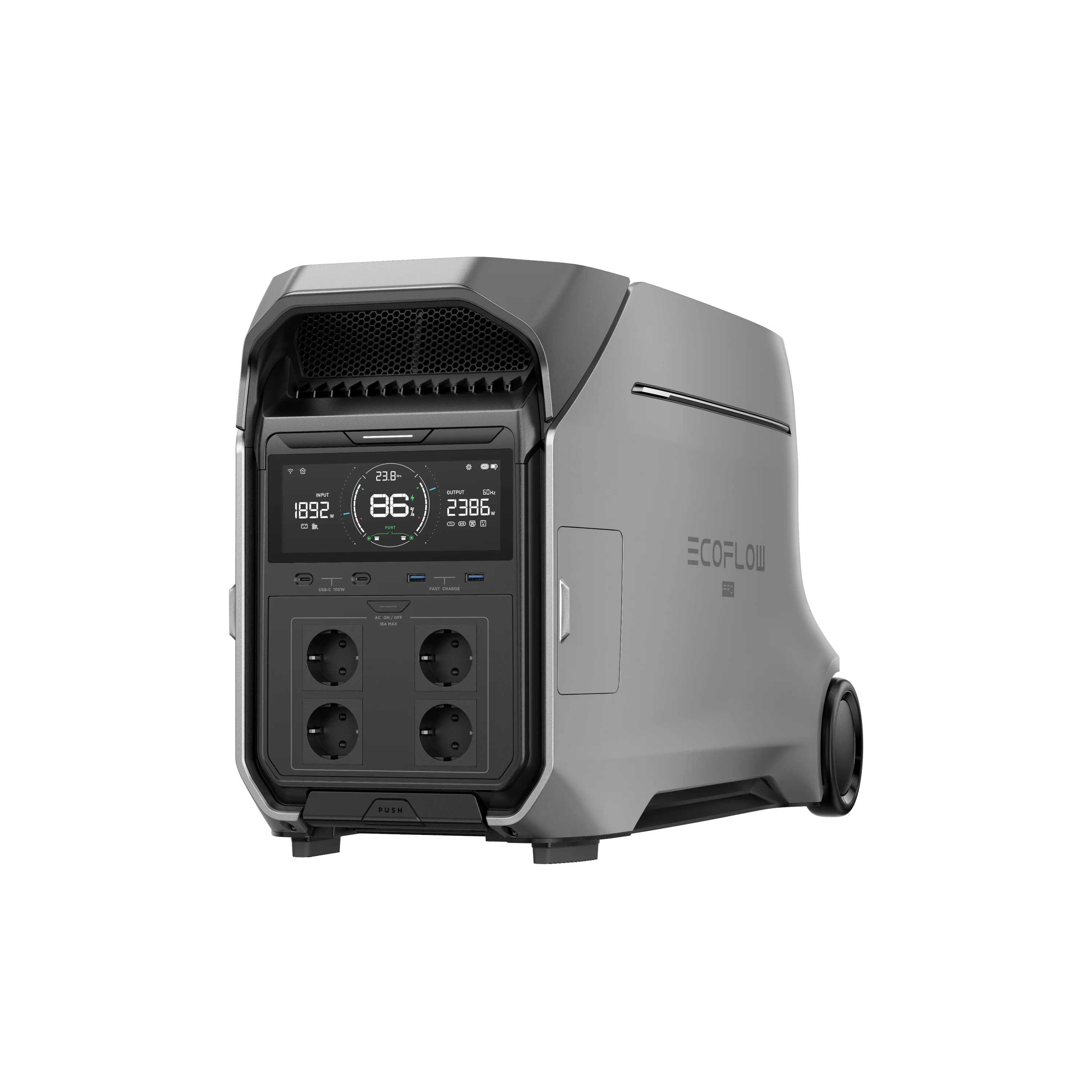
The DELTA Pro 3 sits at the top of EcoFlow’s residential lineup. It packs 4,096Wh of LiFePO4 battery capacity, pushes 4,000W of continuous AC output with a 6,000W surge, and can expand to 12,288Wh with two additional DELTA Pro 3 Extra Batteries. The critical differentiator from the rest of EcoFlow’s lineup is the Smart Home Panel 2 integration, which turns it from a portable power station into a proper whole-home backup system with automatic transfer switching.
At 113 lbs, this is not a portable device. It is a household appliance that happens to lack permanent wiring. I want to be upfront about that because the marketing photos show people loading it into trucks and carrying it around campsites. Nobody is casually carrying 113 lbs anywhere. Two people struggled to get it from the delivery truck to my garage, and that is where it has stayed.
Installation and Smart Home Panel Integration
The standalone experience is dead simple. Plug it in, charge it, connect the app. I had it online in under 20 minutes. But the real value of the DELTA Pro 3 only unlocks when you install the Smart Home Panel 2, and that is a different story.
The Smart Home Panel requires a licensed electrician. It wires into your main breaker box and lets you designate up to 10 circuits for backup power. My electrician spent about four hours on the installation, and the total cost including parts was around $800 on top of the panel price. Not trivial, but far less than a Generac whole-home generator install.
Once wired, the system monitors grid power continuously. When the grid drops, it switches to battery in under 20 milliseconds. That is fast enough that your computer will not reboot and your clocks will not reset. During my eight weeks of testing, we experienced two real outages and one planned utility shut-off. Every transition was seamless.
The Storm Test
The outage that mattered happened during a late March windstorm. Power went down at 2:17 AM and did not return until 3:40 PM the following day, roughly 13 hours total. I had the DELTA Pro 3 backing up the refrigerator, chest freezer, kitchen lights, living room outlets, Wi-Fi router, and the gas furnace blower.
Total continuous draw hovered around 380W with the furnace cycling on and off. The DELTA Pro 3 managed the entire outage on a single charge and still had 22% remaining when the grid came back. That means roughly 14 hours of real-world runtime at moderate household load. For a single battery without expansion packs, that is genuinely impressive.
The furnace blower was the wildcard. It draws about 500W running but surges to nearly 1,800W on startup. The DELTA Pro 3 handled every startup cycle without protection trips or voltage sag. The 6,000W surge rating is not just a spec sheet number.
Not sure if 4,096Wh is the right capacity for your house? Read our home emergency sizing guide before you commit to a tier.
Expandability Changes the Math
Where the DELTA Pro 3 separates itself from competitors is the expansion path. Each Extra Battery adds another 4,096Wh, and you can connect two for a total of 12,288Wh. At my storm-test load of 380W average, that would mean roughly 28 hours of backup from a fully expanded system.
I tested with one expansion battery for a week. The system balanced load between units automatically, and the app displayed individual battery levels for each unit. Charging behavior was intelligent too. It prioritized the lowest battery first rather than splitting current equally, which means the system reaches usable capacity faster.
For anyone building a serious home backup system incrementally, this expansion approach is smarter than buying one massive unit. Start with the base, add capacity when budget allows.
DELTA Pro 3 vs. DELTA 3 Ultra: Which One?
This is the question I get most. Both units have 4,096Wh capacity and similar output specs. Here is the honest answer.
The DELTA 3 Ultra is a better portable power station. It weighs 75 lbs versus 113 lbs, charges faster at the AC input level, and costs less. If you are powering a cabin, a food truck, or running extension cords to appliances during an outage, the DELTA 3 Ultra is the smarter buy.
The DELTA Pro 3 is a better home backup system. The Smart Home Panel integration, the automatic transfer switch, the higher expansion ceiling, and the 240V output capability make it the right choice if your primary goal is replacing a traditional generator. You pay more and you get more weight, but you get a system that functions like real infrastructure.
If you do not plan to install the Smart Home Panel, buy the DELTA 3 Ultra instead. Without the panel, the Pro 3 is just a heavier, more expensive version of the same core capability.
App and Monitoring
The EcoFlow app provides real-time circuit-by-circuit monitoring when paired with the Smart Home Panel. I could see exactly how much power each backed-up circuit was drawing, which made it easy to identify energy hogs and make informed decisions about what to keep powered during an extended outage.
The scheduling features let me set the system to charge from grid power during off-peak hours and discharge during peak pricing windows. In areas with time-of-use electricity rates, this alone could save meaningful money over the unit’s lifespan.
Firmware updates pushed reliably over Wi-Fi, and the remote monitoring worked well when I was away from home. I could check battery status, review power history, and receive outage alerts from anywhere with cell service.
The Weight and Price Reality
At 113 lbs for the base unit and $3,999 MSRP, the DELTA Pro 3 demands commitment. Add the Smart Home Panel 2 at $1,499 and professional installation, and you are looking at roughly $6,300 all-in for a single-battery system. An expanded two-battery setup pushes past $10,000.
That is serious money. But a comparable Generac whole-home generator runs $5,000 to $8,000 installed, requires natural gas or propane, needs regular maintenance, and makes enough noise to irritate your neighbors. The DELTA Pro 3 is silent, requires no fuel, and the LiFePO4 cells are rated for 4,000 cycles, which is over a decade of daily use.
Who Should Buy the DELTA Pro 3
Buy it if you want a true whole-home backup system with automatic transfer switching, you plan to install the Smart Home Panel, you live in an area with frequent outages or time-of-use electricity pricing, or you want a generator replacement that does not burn fuel.
Skip it if you need portability, you want a simpler plug-and-play solution without electrical work, or your backup needs are modest enough for a sub-2,000Wh unit. The DELTA 3 Plus or even the DELTA 3 Ultra will serve you better at lower cost and weight.
The Bottom Line
The EcoFlow DELTA Pro 3 is the closest thing to a residential battery system that does not require a Tesla Powerwall-level installation commitment. It handled a real 13-hour outage without breaking a sweat, the Smart Home Panel integration is genuinely seamless, and the expansion path to 12kWh gives it long-term relevance. The weight and price are barriers to entry, not flaws. This is a serious home infrastructure investment, and it performs like one.
Shop
Ready to buy the EcoFlow DELTA Pro 3?
Check the latest price and availability.
Check Price on EcoFlow