Goal Zero Yeti 1000X
Review
Goal Zero Yeti 1000X review. 983Wh Li-NMC, 1,500W output, expandable. Premium build with limited cycle life and high price. Honest pros and cons.
Goal Zero commands premium prices and brand loyalty. The Yeti 1000X delivers 983Wh with excellent build quality — but its Li-NMC chemistry and 500-cycle lifespan raise questions in a LiFePO4 world.
Our Score
Buy the Goal Zero Yeti 1000X
Best prices · Updated hourly
Independent, unsponsored reviews backed by real-world testing. We may earn a commission at no extra cost to you.
How we test →Goal Zero commands premium prices and brand loyalty. The Yeti 1000X delivers 983Wh with excellent build quality — but its Li-NMC chemistry and 500-cycle lifespan raise questions in a LiFePO4 world.
✓ What We Liked
- Premium build quality with rugged design
- Expandable with Yeti Tank expansion batteries
- 1,500W output handles most mid-size appliances
- Trusted brand with strong retail presence (REI, Best Buy)
- 600W max solar input with Goal Zero ecosystem
✗ What We Didn't
- Li-NMC battery with only 500 cycles — far behind LiFePO4 competitors
- Slow AC charging without optional 600W supply ($200 extra)
- Only 2 AC outlets — fewer than competitors
- Premium pricing for the capacity and specs offered
- 2-year warranty is shortest in class
Quick answer: The Goal Zero Yeti 1000X is a 983Wh / 1,500W portable power station with premium build quality and U.S. retail availability through REI. Its main weakness is the Li-NMC battery chemistry rated for roughly 500 cycles — where most 2026 competitors use LiFePO4 rated for 3,000+ cycles at a lower price. It’s worth the premium if you value the brand, in-person REI support, and warranty service; skip it if cycle life and price-per-watt-hour are what matter most.
Goal Zero has been in the portable power game longer than most of the brands you see dominating Amazon search results today. The Yeti line built a reputation in the overlanding and emergency preparedness communities when portable power stations were still a niche product. That reputation comes with a price premium, and the Yeti 1000X is a perfect example of the tension between brand trust and raw value.
The Yeti 1000X delivers 983Wh of capacity and 1,500W of continuous output. It weighs 31.68 pounds, costs around $1,200 at retail, and is available at REI — a distribution channel that no Chinese-direct brand can match. I used it for six weeks as a home office backup and on two weekend camping trips. Here is whether the premium pencils out.
The Battery Chemistry Question
This is the elephant in the room. The Yeti 1000X uses lithium nickel manganese cobalt (Li-NMC) cells, not lithium iron phosphate (LiFePO4). In 2024 and beyond, nearly every competitor in this capacity class has moved to LiFePO4. The difference matters.
Li-NMC cells offer higher energy density, which is why the Yeti 1000X packs 983Wh into a relatively compact form factor. But they come with a significant tradeoff: cycle life. Goal Zero rates the Yeti 1000X at 500 cycles to 80% capacity. Compare that to the Anker SOLIX C1000 at 3,000 cycles with LiFePO4, or the BLUETTI AC200MAX at 3,500 cycles. At one cycle per day, the Yeti 1000X reaches 80% capacity in about a year and a half. The Anker lasts over eight years at the same rate.
For weekend warriors who cycle the battery 50 times a year, the 500-cycle rating translates to roughly 10 years. That is acceptable. For full-time or heavy users, it is a dealbreaker.
Build Quality and Design
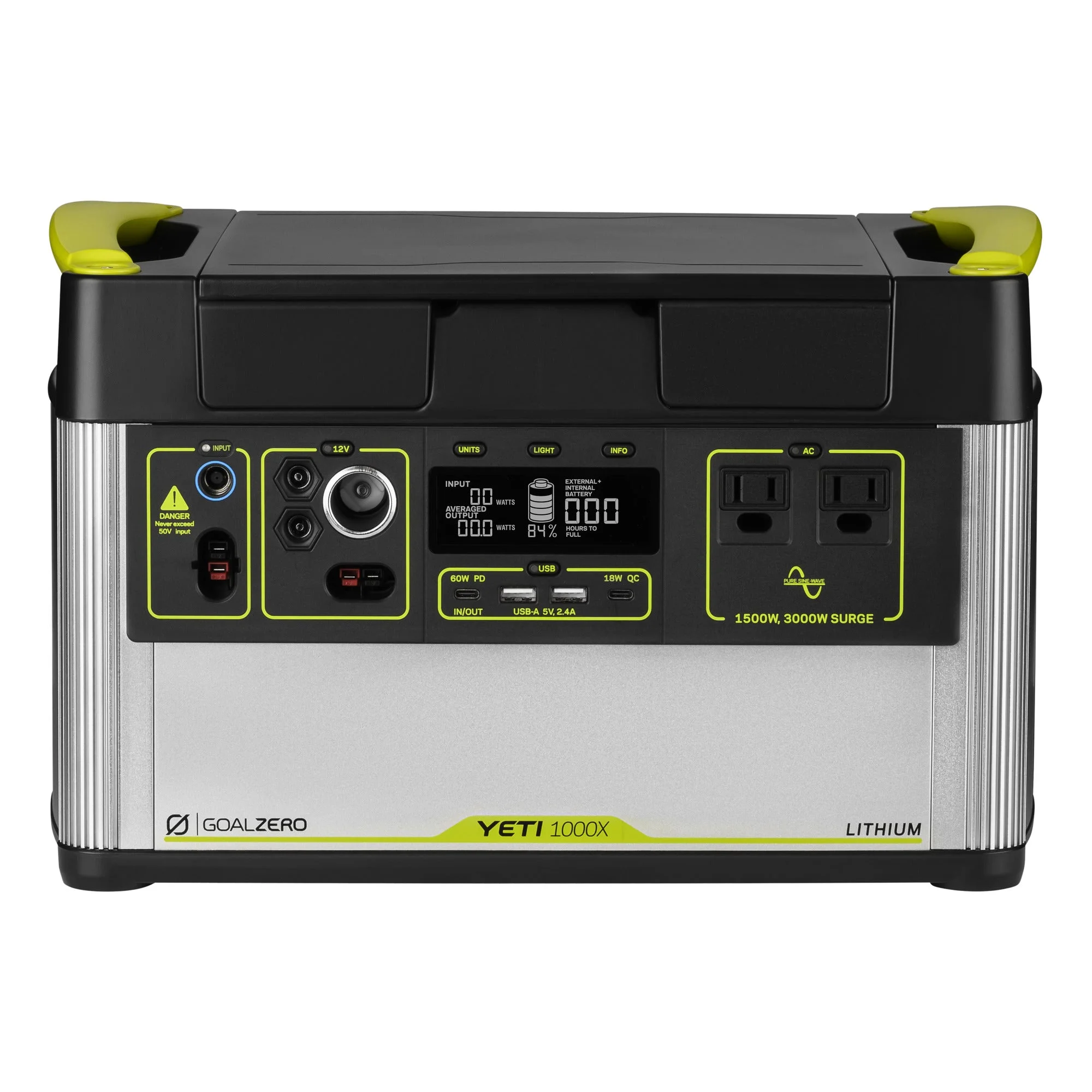
Where Goal Zero genuinely earns its premium is build quality. The Yeti 1000X feels like a piece of professional equipment. The aluminum and high-grade polymer chassis is rigid and dense. The control panel is clean, with a backlit LCD display that shows input/output wattage, battery percentage, and estimated runtime. The buttons have a satisfying tactile click.
The integrated folding handle locks into position and distributes the 31.68-pound weight evenly. Every port is clearly labeled. The overall fit and finish is a step above anything from BLUETTI, EcoFlow, or Anker. If you care about industrial design and build feel, Goal Zero delivers.
The fan noise is moderate under load. It is not silent, but it is less intrusive than the EcoFlow DELTA series, which tends to run fans aggressively. At light loads below 200W, the fan rarely kicks on.
Output and Charging
The Yeti 1000X provides 1,500W continuous with a 3,000W surge through its two AC outlets. This handles a microwave, a small space heater, a blender, and most common household appliances without issue. I ran a 1,200W microwave for five minutes with no warnings and stable voltage.
There are two USB-C ports (one at 60W, one at 18W), two USB-A ports, a 12V car port, and a 6mm DC port. The 60W USB-C is sufficient for most laptops but falls short of the 100W delivery that newer competitors offer.
Charging from a wall outlet takes approximately 9 hours with the included 120W charger, which is painfully slow by modern standards. You can purchase a higher-wattage charger separately to bring this down, but that is an additional $100-plus expense. The Anker SOLIX C1000 charges from 0 to 100% in 58 minutes using its built-in 1,800W input. This is not a close comparison.
Solar input maxes at 300W through the MPPT charge controller. With two Goal Zero Boulder 100 panels, I achieved roughly 160W of real-world input on a clear day, translating to a full charge in about 7 hours. The MPPT controller is efficient and well-implemented.
The REI Factor
One of Goal Zero’s genuine advantages is retail availability. You can walk into an REI, handle the product, and buy it with REI’s generous return policy. If something goes wrong, you drive to a store. You do not navigate a Chinese brand’s email support system or wait three weeks for a warranty replacement to ship from Shenzhen.
This matters more than spec sheet comparisons might suggest. For buyers who are not comfortable purchasing a $1,000 product from an Amazon listing with a brand name they cannot pronounce, Goal Zero and REI remove friction entirely. The 2-year warranty is backed by a US company with a physical presence.
Goal Zero Yeti 1000X vs. Anker SOLIX C1000
The Anker SOLIX C1000 is the most direct competitor and the one that makes the Yeti 1000X hardest to recommend on specs alone.
| Spec | Goal Zero Yeti 1000X | Anker SOLIX C1000 |
|---|---|---|
| Capacity | 983Wh | 1,056Wh |
| Output | 1,500W | 1,800W |
| Battery | Li-NMC | LiFePO4 |
| Cycle Life | 500 | 3,000 |
| Weight | 31.68 lbs | 27.6 lbs |
| Charge Time (AC) | ~9 hrs (120W) | 58 min |
| Price | ~$1,200 | ~$900 |
The Anker wins on every measurable specification: more capacity, more power, longer lifespan, lighter weight, dramatically faster charging, and a lower price. The Yeti 1000X’s advantages are qualitative: build feel, brand reputation, retail availability, and customer service infrastructure.
The Ecosystem
Goal Zero offers a mature ecosystem of solar panels, cables, and accessories designed to work together. The Boulder and Nomad panel lines connect without adapters, and the Yeti App provides monitoring and firmware updates via Bluetooth. The app is functional, though the interface feels dated compared to EcoFlow and BLUETTI’s offerings.
If you are already invested in Goal Zero panels, the Yeti 1000X integrates seamlessly. Switching brands means replacing panels or buying adapters, which adds cost and complexity.
Long-Term Reliability
I have spoken with multiple full-time RVers who have used Yeti products for 3-plus years. The consensus is consistent: Goal Zero products last. They do not develop mysterious faults, the BMS does not glitch, and the output remains stable over time. This anecdotal reliability data is worth something, especially when newer brands have limited long-term track records.
Who Should Buy the Goal Zero Yeti 1000X
Buy it if you value build quality and brand trust over raw specifications, you want the convenience of buying and returning through REI, you are a weekend user who will not approach 500 cycles for years, or you are already invested in the Goal Zero solar panel ecosystem.
Skip it if you cycle your battery daily or near-daily, you want the best specs per dollar, fast AC charging matters to you, or you are comfortable buying from newer brands online. The Anker SOLIX C1000 delivers objectively more for less money. So do the BLUETTI AC200MAX and EcoFlow DELTA 2 Max.
The Bottom Line
The Goal Zero Yeti 1000X is a well-built, reliable power station from a brand with a proven track record. It is also overpriced relative to its specifications, held back by Li-NMC chemistry in a market that has moved to LiFePO4, and saddled with slow stock charging. The premium buys you peace of mind, REI’s return policy, and build quality that feels a cut above the competition. Whether that is worth $300 to $400 more than objectively superior alternatives depends on how much you value the intangibles. For most buyers in this market, the numbers do not lie: the competition has passed the Yeti 1000X by.
Goal Zero Yeti 1000X is discontinued
Anker no longer sells this model. The closest current alternative is the Goal Zero Yeti 1000 (6th Gen).
Read the Goal Zero Yeti 1000 (6th Gen) Review →