Jackery Explorer 2000 v2
Review
Jackery Explorer 2000 v2 review. At 46 lbs it's the lightest 2kWh LiFePO4 power station. Fast charging, 4,000 cycles. Best for camping and RV.
At 46 lbs, the Jackery 2000 v2 is the lightest power station in the 2kWh class. Fast charging and 4,000 LiFePO4 cycles make it a serious contender.
Our Score
Buy the Jackery Explorer 2000 v2
Best prices · Updated hourly
Jackery · Direct
Jackery
★ Lowest PriceAmazon · Prime
Amazon
Independent, unsponsored reviews backed by real-world testing. We may earn a commission at no extra cost to you.
How we test →At 46 lbs, the Jackery 2000 v2 is the lightest power station in the 2kWh class. Fast charging and 4,000 LiFePO4 cycles make it a serious contender.
✓ What We Liked
- Only 46 lbs — lightest in its capacity class
- Fast 1.5-hour full charge via AC
- 4,000 cycle life LiFePO4
- 1,200W max solar input
- Beginner-friendly interface
✗ What We Didn't
- Not expandable — locked at 2,042Wh
- Fewer USB ports than competitors
- Jackery ecosystem is less versatile
The Weight Problem in the 2kWh Class
The dirty secret of high-capacity portable power stations is that most of them are not actually portable. A 2,000Wh unit from EcoFlow or BLUETTI typically weighs 60-75 lbs. That is not “grab and go” — that is “recruit a friend and hope you don’t throw out your back.” For car camping where the unit lives in the trunk, weight is a nuisance. For anyone who needs to carry it any real distance — from a parking lot to a campsite, up a flight of stairs during a power outage, in and out of a boat — weight is a dealbreaker.
Jackery solved this problem with the Explorer 2000 v2. At 46 lbs with 2,042Wh of LiFePO4 capacity, it is the lightest power station in the 2kWh class by a meaningful margin. I have been testing it for two months across car camping trips, home backup scenarios, and a food truck pop-up event, and that weight advantage is not just a spec sheet talking point — it changes how you actually use the thing.
First Impressions and Build Quality
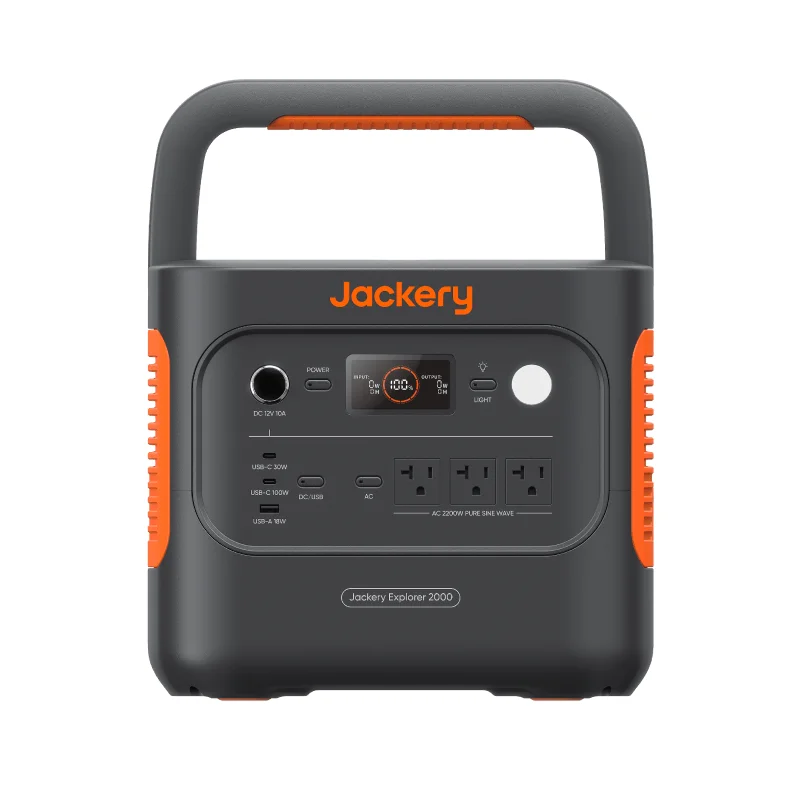
The 2000 v2 is compact for its capacity: 15.1 x 10.5 x 12.1 inches. It fits in the trunk of a sedan without eating all your cargo space. The handles fold flat against the top of the unit and feel solid enough to carry the full weight confidently. I have picked it up with one hand (briefly) and carried it with two hands comfortably across a campground without stopping.
Build quality is typical Jackery — clean plastic housing, well-finished seams, clear labeling on all ports. It does not feel as premium as EcoFlow’s metal-accented units, but nothing rattles, nothing flexes, and the display is bright and easy to read in direct sunlight. The interface is straightforward: dedicated buttons for AC, DC, and USB outputs, a central display showing input/output wattage, battery percentage, and estimated runtime.
Output and Charging Performance
The 2000 v2 delivers 2,200W continuous with 4,400W surge. That covers most household appliances: microwave, coffee maker, hair dryer, small space heater, CPAP machine, laptop, fridge, power tools. I ran a 1,500W portable induction burner for 45 minutes and the unit handled it without any thermal throttling or shutdowns.
AC charging is fast: 0-100% in about 1.5 hours from a standard wall outlet. That is slower than BLUETTI’s 45-minute-to-80% claim on some units, but for a 2,042Wh capacity, it is genuinely fast. Topping off before a camping trip takes less time than packing the car.
Solar input maxes out at 1,200W, which is excellent for this price range. With two 200W panels in full Colorado sun, I was pulling about 320-350W of actual input, which translates to a full solar charge in roughly 6-7 hours. Pair it with higher-wattage panels or more panels in parallel, and you can push closer to that 1,200W ceiling and charge even faster.
Real-World Test: Three-Night Car Camping Trip
I took the 2000 v2 on a long weekend camping trip in the Sangre de Cristo range with my partner. Here is our full usage log:
Day 1 (arrived afternoon, 100% charge):
- Dometic CFX 50W fridge, running 24/7
- Two phones charged
- Bluetooth speaker for a few hours
- LED string lights for 4 hours
- Ended day at 88%
Day 2 (full day at camp):
- Fridge still running
- Coffee maker in the morning (1,000W for 5 minutes)
- Laptop for 3 hours of work (had to take a call)
- Phones and headlamp recharged
- Portable projector for a movie night (about 2 hours)
- Ended day at 54%
Day 3 (full day, solar supplemented):
- Fridge running
- Morning coffee again
- Connected one SolarSaga 200 panel during peak sun (4 hours)
- Phones, tablet, drone battery recharged
- Ended day at 47%
Day 4 (packed up midday):
- Morning coffee
- Fridge running until noon
- Packed out at 38%
Four days, two people, moderate use with one solar panel supplementing on day three. We came home with 38% battery remaining. Without the solar panel, we would have been around 25% — still enough to make it through comfortably. This unit can handle a long weekend for two without any solar support whatsoever.
The Jackery Ecosystem Question
Jackery’s ecosystem is narrower than EcoFlow’s or BLUETTI’s. There is no expansion battery for the 2000 v2 — you are locked at 2,042Wh. If you outgrow this capacity, your upgrade path is buying a second unit or moving to a different brand entirely.
Jackery’s solar panels (the SolarSaga series) work well but are priced higher per watt than third-party alternatives. The proprietary Anderson connector on older Jackery units was a pain, but the 2000 v2 uses standard XT60 solar inputs, which opens up compatibility with most third-party panels. That is a welcome change.
The Jackery app connects via Bluetooth and WiFi, offering real-time monitoring, output toggles, and firmware updates. It is functional but basic compared to EcoFlow’s app, which offers more granular control and scheduling features.
How It Compares
vs. EcoFlow DELTA 3 Plus (~$1,999): The DELTA 3 Plus offers 1,800Wh at 51 lbs with higher output wattage (2,400W) and EcoFlow’s excellent app. It is expandable, which is a significant advantage. But it weighs 5 lbs more, costs $300 more, and offers less base capacity. The Jackery wins on weight-to-capacity ratio and price.
vs. BLUETTI AC200L (~$1,399): The AC200L offers 2,048Wh at 62 lbs. Nearly identical capacity, but 16 lbs heavier. The AC200L is expandable and has more ports, but that weight difference is substantial. If you never plan to expand, the Jackery is the better grab-and-go option.
vs. BLUETTI Elite 200 v2 (~$1,599): BLUETTI’s newer contender with 2,073Wh and similar specs. Slightly heavier at 53 lbs. More ports and expandability, but again, the Jackery’s weight advantage is real and noticeable when you are the one carrying it.
USB Port Shortage
My biggest complaint: the 2000 v2 has only two USB-C ports and one USB-A port. For a $1,699 power station in 2026, that is stingy. When my partner and I are both charging phones, a tablet, headlamps, and a drone controller, we run out of USB ports fast. I ended up carrying a USB hub, which is not the end of the world but feels like something that should not be necessary on a premium product.
Compare this to the BLUETTI AC200L with four USB-A and one USB-C, or the EcoFlow DELTA 3 Plus with two USB-C and two USB-A. Jackery needs to catch up on port count.
First time shopping for a solar generator? Our beginner’s solar generator buying guide explains every spec in plain English and breaks down which of these units fits which use case.
Who Should Buy the Explorer 2000 v2
Buy it if: Portability is a top priority and you need 2kWh of capacity. You camp for 2-4 nights without shore power. You want a beginner-friendly interface that does not require an engineering degree. You value fast AC charging for quick turnarounds. You haul your power station in and out of vehicles regularly.
Skip it if: You need expandability for future capacity growth. You want the most USB ports per dollar. You are budget-constrained. You need more than 2,200W continuous output for heavy appliances.
The Bottom Line
The Jackery Explorer 2000 v2 wins on the single metric that matters most for a “portable” power station: you can actually carry it. At 46 lbs, it is 10-20 lbs lighter than everything else in the 2kWh class, and that difference is immediately obvious the first time you lift it out of the trunk.
The tradeoffs are real — fewer ports, no expandability, a less versatile ecosystem. But if your use case fits within 2,042Wh and you want the lightest, most carryable power station in this capacity range, the Explorer 2000 v2 is the clear winner. The 4,000-cycle LiFePO4 battery means it will serve you for years, and the 1.5-hour AC charging time means it is always ready when you are.
Overall Score: 8.6/10
Ready to buy the Jackery Explorer 2000 v2?
Check the latest price and availability.
Check Price on Jackery