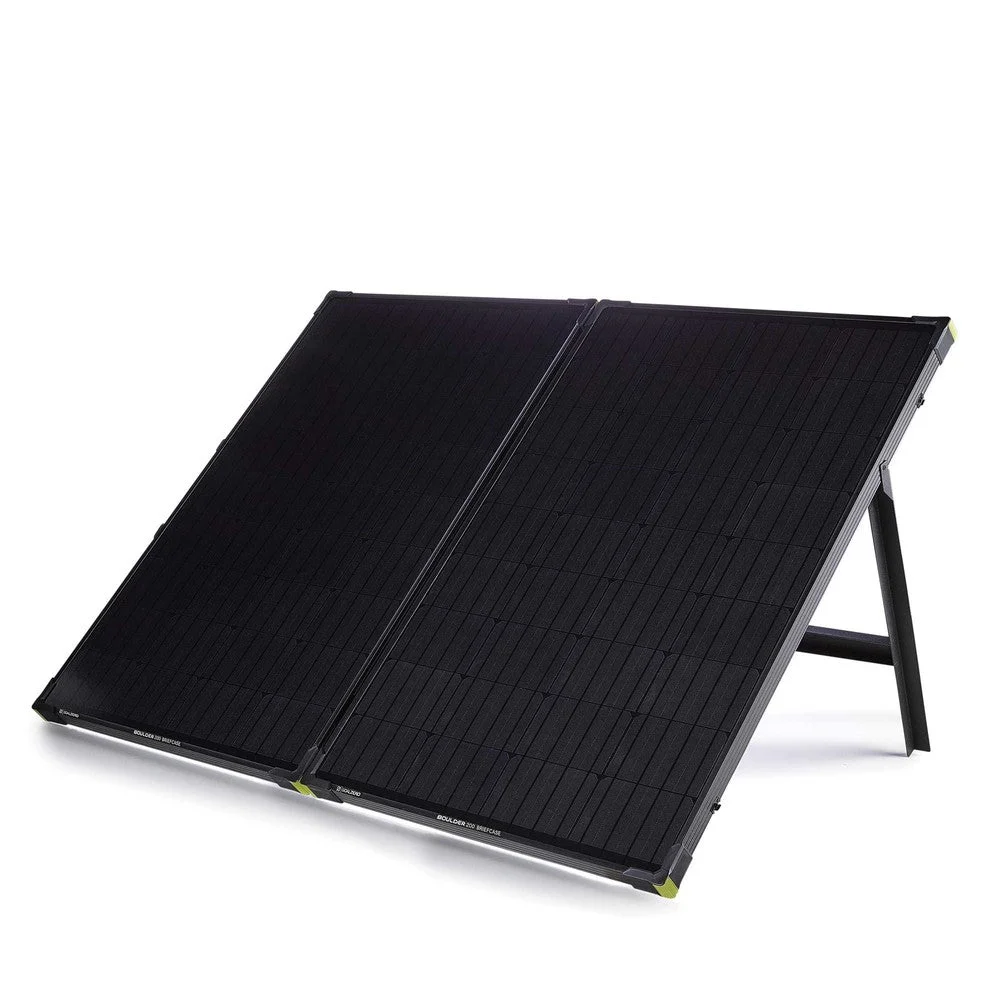
Goal Zero Boulder 200 Briefcase Solar Panel
Goal Zero Boulder 200 Briefcase solar panel review. 200W monocrystalline, 42 lbs, briefcase design. Premium build quality but is it worth $400 when...
Last updated: 2026-04-08
Buy the Goal Zero Boulder 200 Briefcase Solar Panel
Typical prices · Check the retailer for today's price
Independent, unsponsored reviews built from specs, manuals, and owner reports. We may earn a commission at no extra cost to you.
How we score →Score Breakdown
Pros & Cons
What We Like
- Premium build quality with tempered glass and aluminum frame
- Briefcase design folds in half for transport
- Protective canvas carry bag included
- Seamless integration with Goal Zero Yeti power stations
Watch Out For
- 42 lbs — very heavy for a portable panel
- Significantly overpriced vs competitors at $2/watt
- No published IP rating for weather protection
- 2-year warranty is short for a $400 panel
Our Review
I have not tested this unit. This review is built from manufacturer specs and published manuals.
Goal Zero charges a premium for everything they make, and the Boulder 200 is no exception. At roughly $400 for a 200W rigid monocrystalline panel, you are paying about $2 per watt. The Renogy 200W monocrystalline rigid panel delivers the same wattage for about $1 per watt. That is a 100% price premium. The question is whether the Boulder 200 earns it.
What the Premium Buys You
Materials and format are the honest answer. The Boulder 200 is two 100W panels joined by a hinge, built with tempered glass and an aluminum frame with added corner protection. The briefcase design folds in half for transport, and a protective canvas bag is included.
The current Boulder 200 BC connects through Goal Zero’s High Power Port (HPP), rated 14-22V at up to 14A, which plugs straight into a Yeti power station. If you are already in the Goal Zero ecosystem, there is no adapter hunting or compatibility guessing. Non-Goal Zero stations need an adapter, though at this price you probably already own a Yeti.
Goal Zero lists 21.8V open-circuit and 18.1V at maximum power, and does not publish a cell efficiency figure.
Why It Is Hard to Recommend
Forty-two pounds. That is how much this panel weighs. A Renogy 200W rigid panel comes in around 26 pounds. The weight makes the Boulder 200 a two-person lift for most setups, and it essentially eliminates any claim to portability. This is a panel you install semi-permanently on an RV roof or prop up at a base camp — not something you hike with.
Goal Zero does not publish an IP rating, so do not count on it in heavy rain. The 2-year warranty is short for a product at this price point. Renogy offers 10 years of material and workmanship coverage on its 200W rigid panel. BLUETTI offers 2 years on its foldables.
Who Should Buy It
Buy the Boulder 200 if you are already invested in the Goal Zero ecosystem and want a glass-and-aluminum briefcase panel for a semi-permanent installation. The ecosystem integration is seamless.
Skip it if value matters to you at all. The Renogy 200W monocrystalline delivers equivalent output at half the price with a longer warranty and lighter weight. The Goal Zero brand tax is real, and unless you are specifically buying into their ecosystem, you are paying double for a format most people do not need. Your money goes further elsewhere.
Full Specifications
| Wattage | 200 |
| Panel Type | monocrystalline |
| Weight | 42lbs |
| Dimensions | 40 x 53.5 x 1.75 in (unfolded) |
| Folded Dimensions | 40 x 26.75 x 3.5 in |
| Connector Type | High Power Port (HPP), 14-22V, up to 14A |
| Warranty | 2 years |
| Foldable | false |
| Voc | 21.8 |
| Vmp | 18.1 |
| Operating Temp | 32-113F |
| Cells | monocrystalline silicon |
| Frame | anodized aluminum |
Best For
Compare Goal Zero Boulder 200 Briefcase Solar Panel
Shop
Ready to buy the Goal Zero Boulder 200 Briefcase Solar Panel?
Check the latest price and availability.
Check Price on Amazon