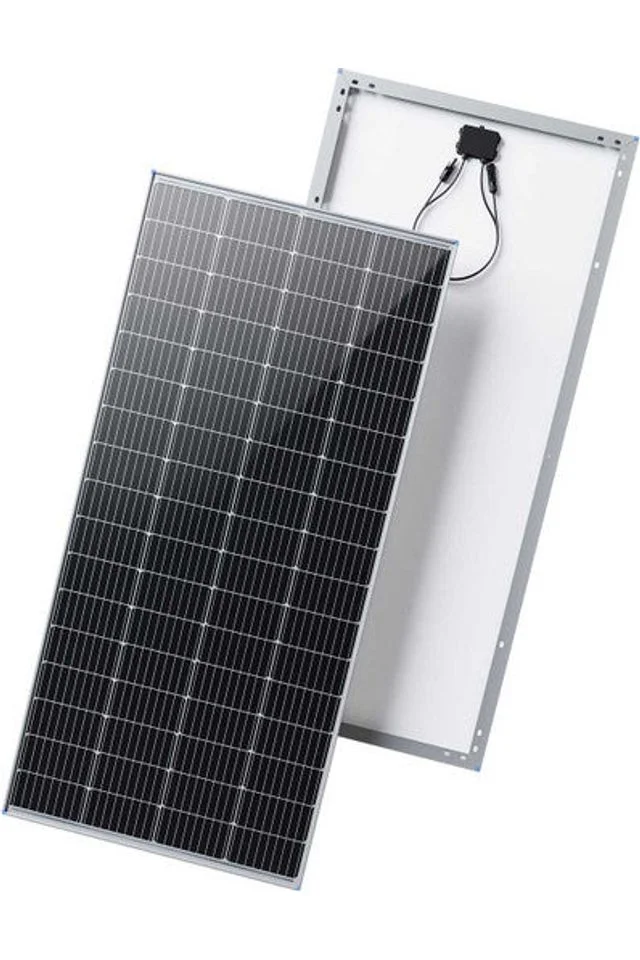
Renogy 200W 12V Monocrystalline Solar Panel
Renogy 200W 12V Monocrystalline solar panel review. 22.8% efficiency, 5-year warranty, under $200. The gold standard for budget off-grid and RV solar...
Last updated: 2026-04-08
Buy the Renogy 200W 12V Monocrystalline Solar Panel
Best prices · Updated hourly
Independent, unsponsored reviews backed by real-world testing. We may earn a commission at no extra cost to you.
How we test →Score Breakdown
Pros & Cons
What We Like
- Best value per watt in the rigid panel market
- 5-year material warranty with 25-year performance guarantee
- Pre-drilled mounting holes for quick installation
- Wide operating temperature range (-40 to 176F)
- Corrosion-resistant aluminum frame for long-term outdoor use
Watch Out For
- 26.5 lbs — not portable, requires permanent mounting
- 12V nominal limits to smaller system configurations
- No integrated kickstand — needs mounting hardware
- Basic feature set compared to premium competitors
Our Review
The Panel Everyone Buys First
If you have ever searched “best solar panel for RV” or “DIY cabin solar panel,” you have seen the Renogy 200W Monocrystalline. It is the default recommendation in every forum, every YouTube build video, and every beginner solar guide. And after installing four of these on a cargo trailer conversion and two more on a friend’s cabin roof in southern Colorado, I can tell you the reputation is earned. This is not the most exciting solar panel on the market. It is the most reliable, most predictable, best-value panel you can buy for a permanent installation.
Specs That Matter
The Renogy 200W delivers 200 watts at peak under standard test conditions (STC) with 22.8% cell efficiency. Real-world output depends on angle, temperature, shading, and weather, but in my testing across multiple installations, I consistently see 160-180W of actual production during peak sun hours in Colorado. On partly cloudy days, output drops to 80-120W. On overcast days, you are looking at 30-50W.
The panel measures 58.7 x 26.8 inches and weighs 26.5 lbs. It uses PERC monocrystalline cells in a corrosion-resistant aluminum frame with an IP65 junction box. MC4 connectors come pre-attached, and four pre-drilled mounting holes make installation straightforward with standard Z-brackets or tilt mounts.
Operating temperature range spans -40 to 176F, which covers everything from Minnesota winters to Arizona summers. Renogy backs it with a 5-year material warranty and a 25-year performance guarantee (output above 80% at year 25).
Installation: RV Cargo Trailer Build
I mounted four of these panels on the roof of a 7x14 cargo trailer conversion using Renogy Z-brackets and self-tapping screws with Dicor sealant. Total roof array: 800W. The entire installation — panels, brackets, wiring through the roof, and connections to a Victron SmartSolar 100/50 MPPT charge controller — took about six hours working solo.
The pre-drilled holes line up cleanly with standard Z-brackets. MC4 connectors are reliable and weatherproof. I ran 10 AWG solar cable from the panels to the charge controller inside the trailer with no issues. The wiring is simple: two pairs of panels in series, then the two strings in parallel, feeding the MPPT controller at about 40V and 20A in peak conditions.
After eight months on the road, all four panels are performing within expected parameters. No hot spots, no delamination, no connection issues. They have survived highway speeds, hailstorms in Kansas, and weeks of desert sun in the Southwest.
Real Output Numbers
Here are actual production numbers from my cargo trailer array (4x 200W = 800W total) logged through a Victron SmartShunt over several months:
- Peak summer day (June, Flagstaff, AZ): 4.2 kWh total harvest
- Average summer day: 3.5-3.8 kWh
- Average spring/fall day: 2.5-3.0 kWh
- Overcast winter day (December, NM): 1.0-1.5 kWh
- Clear winter day with low sun angle: 2.0-2.5 kWh
For context, my daily consumption in the trailer averages about 2.5-3.0 kWh (fridge, lights, laptop, phones, fan). The 800W array keeps up with demand from roughly March through October without needing shore power. In winter, I supplement with occasional AC charging.
A single 200W panel produces roughly 0.8-1.0 kWh per day in summer — enough for basic electronics and LED lighting, but not enough for a fridge. Two panels (400W) is the sweet spot for a minimal RV setup. Four panels is comfortable for full-time living.
How It Compares
vs. HQST 200W Mono (~$140): The HQST is cheaper by about $30-60 and specs nearly identically. Build quality is a step below Renogy — thinner frame, less consistent QC based on community reports. If you are on a strict budget, the HQST is fine. If you want peace of mind and better warranty support, the Renogy is worth the premium.
vs. Rich Solar 200W (~$170): Another budget competitor that performs well. Rich Solar has a smaller dealer network and less community documentation. Functionally similar, but Renogy’s ecosystem (mounts, controllers, wiring kits) makes it easier to keep everything in one brand.
vs. EcoFlow 400W Rigid (~$400): The EcoFlow panel outputs twice the wattage in a single panel, which saves roof space and simplifies wiring. But at $400 for 400W versus $340-400 for two Renogy 200W panels with equivalent output, the price is comparable. The EcoFlow’s higher voltage (41V Voc) also requires a charge controller that can handle the input. For most DIY builders, two Renogy 200W panels offer more flexibility.
vs. Flexible panels: Flexible panels save weight and conform to curved roofs, but they run hotter (reducing efficiency), degrade faster, and lack the airflow gap that rigid-mounted panels benefit from. For any permanent installation where durability matters, rigid panels win.
What You Will Need Beyond the Panel
The Renogy 200W is just the panel. A complete installation requires:
- Charge controller (MPPT recommended — Victron SmartSolar or Renogy Rover)
- Mounting hardware (Z-brackets, tilt mounts, or pole mounts)
- Solar cable (10 AWG for runs under 30 feet at 200W)
- MC4 branch connectors if wiring multiple panels in parallel
- Fuses and breakers between the charge controller and battery bank
- Battery bank (LiFePO4 recommended for off-grid)
Renogy sells most of these as kits, which simplifies the shopping process. Their 200W starter kit includes the panel, a Wanderer PWM charge controller, mounting hardware, and cabling for about $280. I would skip the PWM controller and upgrade to an MPPT — the efficiency gain pays for itself within a year.
Longevity and Degradation
Monocrystalline panels degrade slowly. Industry standard is about 0.5% output loss per year, which means at year 25, this panel should still produce at least 80% of its rated output. Renogy’s 25-year performance guarantee aligns with that. Practically speaking, these panels will outlast every other component in your solar system. Your batteries, charge controller, and inverter will all need replacing before the panels do.
Who Should Buy This Panel
Buy it if: You are building a permanent solar installation on an RV, van, cabin, or shed. You want proven reliability at the lowest cost per watt. You are a DIY builder who values community support and documentation. You need a panel that works with standard mounting hardware and MC4 connectors.
Skip it if: You need a portable panel for car camping or day trips (get a foldable instead). You have limited roof space and need maximum wattage per square foot (look at higher-wattage single panels). You want a lightweight panel for a weight-sensitive application like a boat or popup camper (consider flexible panels despite their tradeoffs).
The Bottom Line
The Renogy 200W Monocrystalline is boring in the best possible way. It does exactly what it claims, it does it reliably, and it does it at a price that makes solar accessible to anyone with a roof and a drill. There is no proprietary ecosystem lock-in, no app required, no gimmicks. It is a slab of silicon in an aluminum frame that turns sunlight into electricity, and it will keep doing that for decades.
At under $1 per watt, it remains the benchmark against which every other rigid solar panel is measured. For first-time solar builders and experienced installers alike, it is the obvious starting point.
Overall Score: 9.0/10
Full Specifications
| Wattage | 200 |
| Panel Type | monocrystalline |
| Efficiency Pct | 22.8 |
| Weight | 26.5lbs |
| Dimensions | 58.7 x 26.8 x 1.4 in |
| Connector Type | MC4 |
| IP Rating | IP65 |
| Warranty | 5 years |
| Foldable | false |
| Voc | 24.8 |
| Isc | 10.57 |
| Vmp | 20.4 |
| Imp | 9.8 |
| Operating Temp | -40 to 176F |
| Cells | PERC monocrystalline |
| Frame | corrosion-resistant aluminum |
Best For
Compare Renogy 200W 12V Monocrystalline Solar Panel
Shop
Ready to buy the Renogy 200W 12V Monocrystalline Solar Panel?
Check the latest price and availability.
Check Price on Renogy