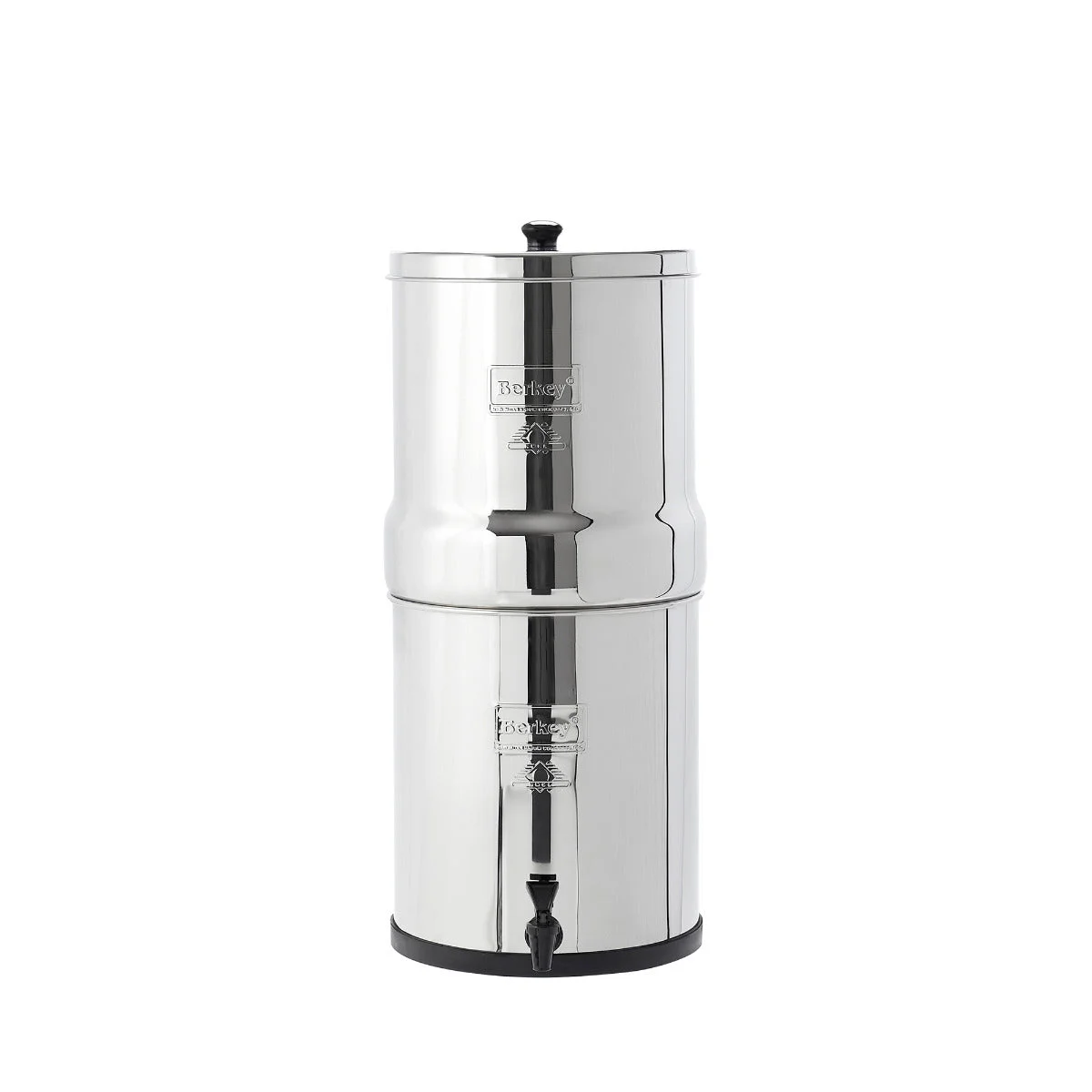
Big Berkey Gravity Water Filter
Big Berkey gravity water filter review. 2.25-gallon capacity, 6,000-gallon filter life, removes 200+ contaminants. Real-world testing for off-grid...
Last updated: 2026-04-08
Buy the Big Berkey Gravity Water Filter
Best prices · Updated hourly
Independent, unsponsored reviews backed by real-world testing. We may earn a commission at no extra cost to you.
How we test →Score Breakdown
Pros & Cons
What We Like
- Removes 200+ contaminants including viruses without electricity
- 6,000-gallon filter life per pair — extremely low cost per gallon
- Stainless steel construction lasts decades
- No plumbing, no power — just fill and pour
- Optional fluoride/arsenic filters available
Watch Out For
- Slow filtration — 3.5 gallons per hour with 2 elements
- Not portable — designed as a countertop unit
- $298 upfront investment is significant
- Requires regular cleaning of Black Berkey elements
- FDA classification controversy — sold as water purifier, not NSF certified
Our Review
The Big Berkey has been sitting on kitchen counters in off-grid cabins, homesteads, and prepper pantries for longer than most of its competitors have existed. It is a gravity-fed water filtration system with no moving parts, no electricity, no plumbing connection, and a devout following that borders on religious. After three months of daily use at a cabin in southern Oregon, I understand both the devotion and the skepticism.
How the Big Berkey Works
The concept is as simple as water filtration gets. Two stainless steel chambers stacked vertically. You pour unfiltered water into the top chamber, gravity pulls it through Black Berkey purification elements, and clean water collects in the lower chamber with a spigot. No pumps, no power, no pressure. Fill it and wait.
The Big Berkey model holds 2.25 gallons in the upper chamber and the same in the lower, for 4.5 gallons total capacity. It ships with two Black Berkey elements, and you can add two more for a total of four, which significantly increases flow rate. Each element is rated for 3,000 gallons, so a pair provides 6,000 gallons of filtration life. At 3 gallons per day of household use, that is over five years before replacement.
I tested with the standard two-element configuration for the first six weeks, then added a second pair for comparison.
Flow Rate: Expectations vs. Reality
Berkey’s marketing suggests the Big Berkey with two elements filters up to 3.5 gallons per hour. In my testing, reality was more nuanced.
With fresh, properly primed elements and clean source water from a well, I measured approximately 2.8 gallons per hour during the first week. That is close enough to the rated spec that I will not quibble. However, after six weeks of daily use with moderately hard well water, flow rate had decreased to roughly 1.8 gallons per hour. Re-scrubbing the elements with a Scotch-Brite pad restored flow to about 2.4 gallons per hour.
This maintenance cycle is normal and expected. The Black Berkey elements work by adsorption and micro-pore filtration, and mineral buildup gradually reduces flow. Plan on scrubbing the elements every 4 to 6 weeks depending on your source water quality.
Adding the second pair of elements brought flow rate to approximately 4.5 gallons per hour with fresh elements. For a household of three or more, I consider four elements the practical minimum. The two-element configuration works for a solo user or couple, but you will find yourself waiting for water if you are filling multiple bottles or cooking a large meal.
The Testing Controversy
I would be doing you a disservice if I did not address the elephant in the room. In 2023, Berkey faced significant scrutiny when the EPA issued a stop-sale order related to unregistered pesticide claims. The core issue was that Berkey marketed the Black Berkey elements as removing certain pesticides and other contaminants without completing the EPA registration process required for products making those specific claims.
To be clear about what this does and does not mean. It does not mean the filters do not work. Independent lab tests have consistently shown effective reduction of bacteria, parasites, chlorine, heavy metals, and various organic compounds. What it means is that Berkey made specific marketing claims about contaminant removal that had not gone through the EPA’s formal registration and verification process.
Berkey has since worked to address the regulatory issues, and the filters remain available. But if third-party verified certifications like NSF 42, 53, or P231 are important to you, and for many people they should be, the Big Berkey does not currently carry those certifications. Competitors like ProOne and Alexapure have pursued independent NSF testing for their elements. That difference matters for informed decision-making.
I use the Big Berkey daily and trust it for my well water based on years of community track record and independent lab results. But I want you to make that decision with full information.
Daily Life with the Big Berkey
The day-to-day experience of living with a Big Berkey is remarkably simple once you get past the initial priming process. Priming the elements requires running water through them under pressure using the included priming button, which is mildly annoying but only takes about ten minutes per element.
Once set up, the routine is: wake up, pour two pitchers of well water into the top chamber, let it filter throughout the morning, and draw clean water from the spigot as needed. I refilled the upper chamber two to three times per day for a household of two. The stainless steel construction keeps the water cool, and the spigot flow is adequate if not impressive.
The Big Berkey does take up counter space. At 19.25 inches tall and 8.5 inches in diameter, it has a significant footprint. In a small cabin kitchen, this is a real consideration. I ended up building a small shelf for it to free up counter space, which worked well but should not be necessary for a $350+ filtration system.
Big Berkey vs. ProOne Big+
The ProOne Big+ is the Big Berkey’s most direct competitor, and it deserves serious consideration.
Filtration capacity: The ProOne G2.0 elements carry NSF 42 and 53 certifications, which the Black Berkey elements currently lack. For buyers who prioritize independently verified performance claims, ProOne has the edge.
Flow rate: Comparable. Both systems filter at roughly similar rates with two elements, though individual results vary by source water.
Element life: Black Berkey elements are rated for 3,000 gallons each. ProOne G2.0 elements are rated for 2,250 gallons each. Berkey wins on longevity per element.
Build quality: Both use stainless steel chambers. The ProOne has slightly better fit and finish in my experience, with a more stable base and a marginally better spigot design. Neither feels cheap.
Price: Nearly identical for comparable configurations. The ProOne Big+ with two elements runs about $300 to $350. The Big Berkey with two elements runs $330 to $380 depending on current pricing.
My take: If NSF certification matters to you, buy the ProOne. If element longevity and the broader community knowledge base matter more, the Big Berkey remains a solid choice. Both are excellent gravity filters.
Who the Big Berkey Is Actually For
The Big Berkey occupies a specific niche, and understanding that niche prevents disappointment.
It is ideal for off-grid cabins, homesteads, and rural properties where the primary water source is a well, spring, or rain catchment. It provides daily drinking water without electricity, plumbing pressure, or consumable cartridges that need frequent replacement. Pour, wait, drink. For years.
It is also well-suited for urban emergency preparedness. If municipal water treatment fails during a natural disaster, a Big Berkey with stored water or access to any freshwater source provides safe drinking water indefinitely.
It is not ideal for backpacking, car camping, or any application requiring portability. It is not a quick solution. If you need filtered water in 30 seconds, buy a GRAYL GeoPress. The Big Berkey is a slow, steady, daily-use system.
It is also not a substitute for professional water testing. If you are on well water, get your water tested annually regardless of what filtration system you use. The Big Berkey reduces many contaminants, but knowing what is in your source water is fundamental to making informed treatment decisions.
Long-Term Cost Analysis
The Big Berkey’s economics are compelling over time. Initial cost for the unit with two elements is approximately $350. Replacement elements cost about $110 per pair and last 6,000 gallons. At 3 gallons per day, you are replacing elements roughly every 5.5 years.
Over 10 years, total cost of ownership is approximately $570: the initial unit plus one set of replacement elements. That works out to about 5 cents per gallon of filtered water. Compare that to bottled water at roughly $1 per gallon or even a Brita pitcher at 15 to 20 cents per gallon when you factor in filter replacements.
For off-grid use where hauling water or buying bottled water is inconvenient or expensive, the Big Berkey pays for itself within the first year or two.
Who Should Buy the Big Berkey
Buy it if you need a reliable, electricity-free water filtration system for daily household use, you are setting up an off-grid cabin or homestead, or you want a long-term emergency preparedness solution with minimal ongoing costs. The simplicity, durability, and element longevity make it a genuine long-term investment.
Skip it if you need portability, you require NSF-certified filtration claims, you want instant filtered water on demand, or you have limited counter space in a small living area. Consider the ProOne Big+ for certified performance or a GRAYL GeoPress for portable use.
The Bottom Line
The Big Berkey is not exciting. It is a stainless steel cylinder that slowly filters water using gravity. But that simplicity is the product. No electricity, no plumbing, no moving parts, no consumable cartridges that expire every few months. For the specific use case of daily off-grid water filtration, it has earned its reputation over decades of real-world use. Address the testing controversy with your own research, understand the flow rate limitations, and you will find a water system that quietly does its job for years. Sometimes boring is exactly what you need.
Full Specifications
| Filter Type | gravity |
| Capacity Gallons | 2.25 |
| Flow Rate Gph | 3.5 |
| Filter Life Gallons | 6000 |
| Filter Elements Included | 2 |
| Max Filter Elements | 4 |
| Contaminants Removed | bacteria, protozoa, chlorine, pesticides, pharmaceuticals, heavy metals, VOCs |
| Requires Power | false |
| Virus Removal | true |
| Material | 304 stainless steel |
| Height Inches | 19.25 |
| Diameter Inches | 8.5 |
| Weight | 7lbs |
| Serves People | 1-4 |
| Pf2 Fluoride Compatible | true |
Best For
Compare Big Berkey Gravity Water Filter
Ready to buy the Big Berkey Gravity Water Filter?
Check the latest price and availability.
Check Price on Amazon