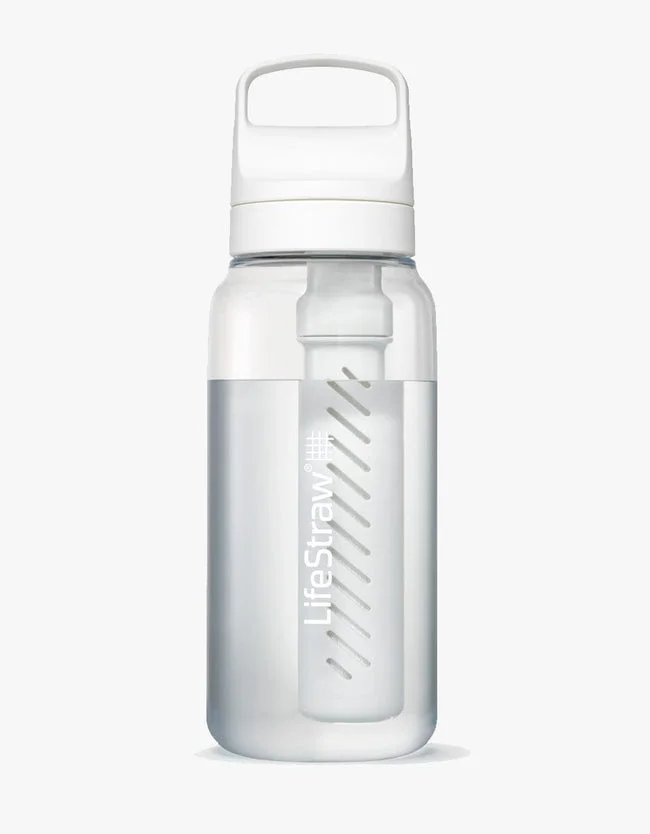
LifeStraw Go Water Filter Bottle
LifeStraw Go Series review. 22 oz bottle with two-stage filtration, removes bacteria and improves taste. Real-world testing for hiking, travel, and...
Last updated: 2026-04-08
Buy the LifeStraw Go Water Filter Bottle
Best prices · Updated hourly
Independent, unsponsored reviews backed by real-world testing. We may earn a commission at no extra cost to you.
How we test →Score Breakdown
Pros & Cons
What We Like
- Integrated bottle + filter means no separate container needed
- Two-stage filtration with carbon improves taste by removing chlorine
- 4,000-liter membrane life is excellent for daily or trail use
- Leak-proof design with secure carry handle
- Available in multiple colors and stainless steel options
Watch Out For
- Activated carbon filter only lasts 100 liters — frequent replacement needed
- 5.9 oz is heavier than standalone squeeze filters
- 22 oz capacity is small for long stretches between water sources
- Does not remove viruses — not suitable for international travel
- Straw mechanism requires more suction effort than gravity or squeeze systems
Our Review
The LifeStraw Go takes the LifeStraw concept and puts it where it always should have been: inside a water bottle. At $40, you get a 22-ounce BPA-free Tritan bottle with an integrated hollow fiber membrane filter and an activated carbon capsule. Fill from a stream, sip through the mouthpiece, and the filter handles the rest. No squeezing, no pumping, no waiting. It is the simplest filtered water experience I have used.
The Everyday Filter Bottle
The hollow fiber membrane removes 99.9999% of bacteria and 99.9% of protozoa, which covers every biological threat you would encounter in North American backcountry water. The membrane filter is rated for 1,000 gallons — at a gallon a day, that is nearly three years of use before you need a replacement. The activated carbon capsule handles chlorine, taste, and odor for the first 25 gallons, making it useful for both backcountry and municipal water that tastes off.
Flow rate is the LifeStraw Go’s strongest practical feature. You drink through the straw naturally, and the resistance is minimal. There is no squeezing, no biting a valve, no waiting for gravity to do its work. You sip like you would from any water bottle. This sounds trivial, but it is the difference between a filter you actually use and one that sits in your pack because it is annoying to drink from.
The bottle itself is lightweight, durable, and fits in standard cup holders and pack pockets. The lid seals well enough to prevent leaks in a bag. The mouthpiece folds down for transport. The overall design is polished — this looks and feels like a normal water bottle, not a survival tool you tolerate.
What It Does Not Do
The LifeStraw Go does not remove viruses. For backcountry use in the US and Canada, that is fine. For international travel where viral contamination is a concern, the Grayl GeoPress at $90 is the better choice — it handles viruses, bacteria, and protozoa in a similar bottle format, though at more than double the price and with a more laborious press-and-drink mechanic.
The 22-ounce capacity is small. On a hot day on the trail, you are stopping to refill frequently. This is a sipping bottle, not a hydration workhorse. If you need volume, a Sawyer Squeeze with a 1-liter SmartWater bottle or a gravity system is more practical.
The activated carbon capsule is a consumable that depletes fast at 25 gallons. Once it is gone, the membrane still filters pathogens, but chlorine and taste compounds pass through. Replacement carbon capsules are about $10, which is reasonable but adds to the ongoing cost.
The bottle is plastic. If you prefer stainless steel for durability or temperature retention, the LifeStraw Go is not available in a metal version. It is a warm-weather, lightweight-use bottle.
Who Should Buy It
Buy the LifeStraw Go if you want a single bottle for day hikes, gym use with iffy fountain water, and light travel. It is the best combination of filtration quality, flow rate, and everyday usability at $40. It is the filter bottle I reach for most often.
Skip it if you need virus removal, high volume, or a stainless steel build. The Grayl GeoPress handles viruses, and the Sawyer Squeeze handles volume. The LifeStraw Go handles convenience.
Full Specifications
| Filter Type | hollow fiber membrane + activated carbon |
| Weight Oz | 5.9 |
| Capacity Oz | 22 |
| Flow Rate | bite-and-sip (integrated straw) |
| Filter Life Gallons | 1057 |
| Filter Life Liters | 4000 |
| Carbon Filter Life Liters | 100 |
| Pore Size | 0.2 micron |
| Contaminants Removed | bacteria, protozoa, microplastics, chlorine, organic chemical matter |
| Requires Power | false |
| Virus Removal | false |
| Bpa Free | true |
| Two Stage Filtration | true |
| Leak Proof | true |
| Operating Temp | above freezing |
Best For
Compare LifeStraw Go Water Filter Bottle
Ready to buy the LifeStraw Go Water Filter Bottle?
Check the latest price and availability.
Check Price on Amazon