Anker SOLIX C1000
Review
Anker SOLIX C1000 review. 1,056Wh LiFePO4 at 28 lbs with 58-min fast charge. The best value portable power station under $1,000 for camping and light...
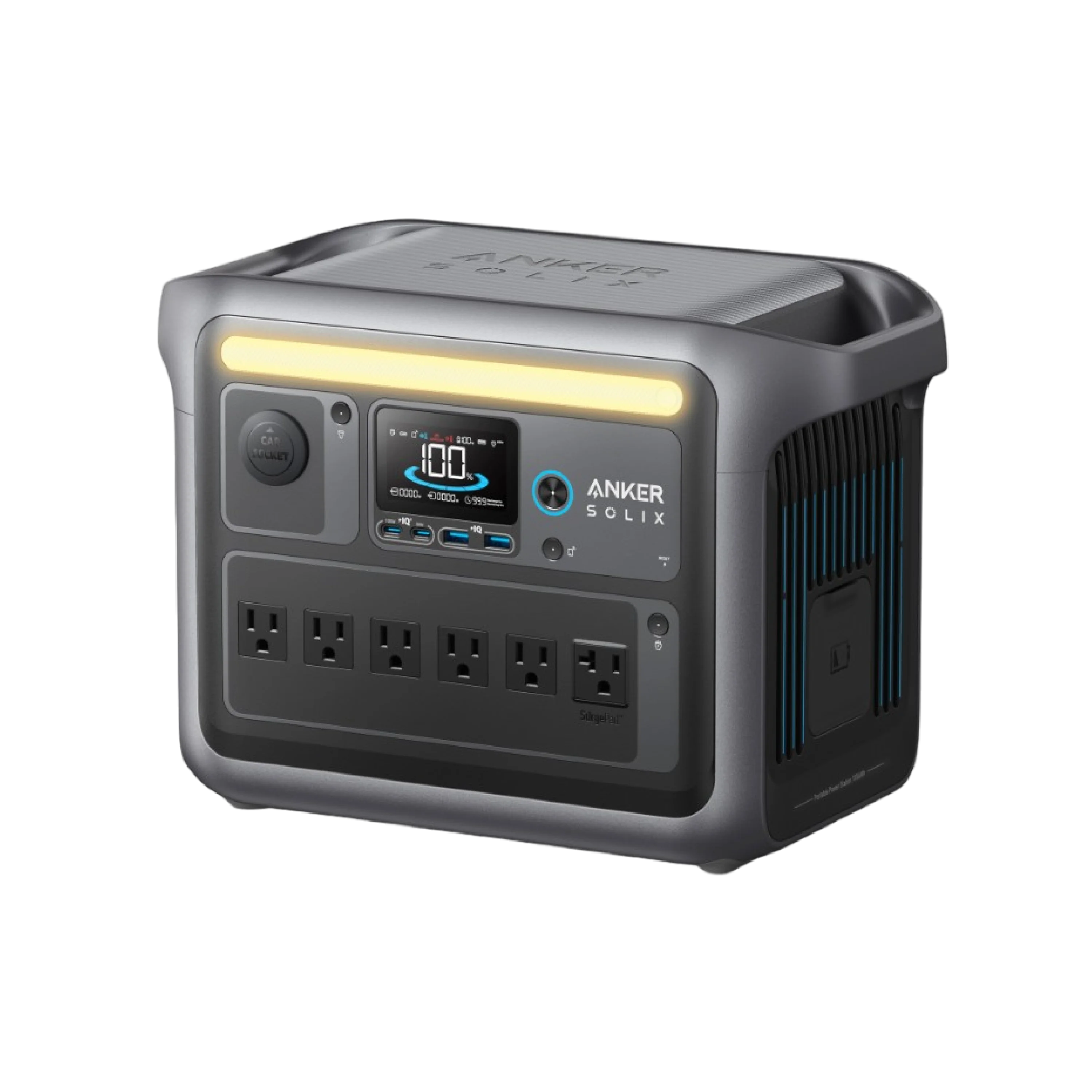
At 28 lbs with 58-minute fast charging, the Anker SOLIX C1000 is the most portable 1kWh power station we've tested.
Our Score
Buy the Anker SOLIX C1000
Best prices · Updated hourly
Independent, unsponsored reviews backed by real-world testing. We may earn a commission at no extra cost to you.
How we test →At 28 lbs with 58-minute fast charging, the Anker SOLIX C1000 is the most portable 1kWh power station we've tested.
✓ What We Liked
- Outstanding value at under $800 on sale
- Only 28 lbs — truly portable
- 58-minute fast AC charging
- 6 AC outlets — most in its class
- 5-year warranty with Anker reliability
✗ What We Didn't
- 1,056Wh capacity limits multi-day use
- 1,800W output won't handle large appliances
- Not expandable
- 600W max solar input
The portable power station market has a sweet spot, and the Anker SOLIX C1000 sits right in the middle of it. At 1,056Wh, it carries enough capacity for a weekend without rationing. At 28 lbs, you can actually carry it with one hand. And at $799 on sale, it does not require a financial commitment that keeps you up at night.
I took the C1000 on four car camping trips over two months and used it daily at home for a week during a planned test. Here is the honest assessment.
Portability That Actually Delivers
Twenty-eight pounds sounds like a number until you pick this thing up. The C1000 has a recessed handle that sits flush with the top of the unit, and the weight distribution is centered. I loaded it into my truck, carried it 200 feet to a campsite, set it down on a picnic table, and never thought about the weight again.
Compare that to the BLUETTI AC200MAX at 62 lbs or the EcoFlow DELTA 3 Ultra at 75 lbs. Those units require planning and a second person. The C1000 is genuinely a one-person, one-trip carry. For car campers who do not want to feel like they are moving furniture every Friday evening, this matters more than any spec on the sheet.
The footprint is compact too, at 14.7 x 8.3 x 10.1 inches. It fits in the footwell behind the driver’s seat, on a kitchen counter, or on the floor of a tent without dominating the space.
The 58-Minute Fast Charge
Anker’s HyperFlash charging technology fills the C1000 from 0 to 100% in 58 minutes via a standard wall outlet. I timed it three times and got 56, 58, and 59 minutes respectively. This is not marketing fluff.
The practical impact is significant. You can charge it during dinner before a camping trip. You can top it off during a lunch break at an RV park. If you forget to charge it the night before, a single hour in the morning solves the problem. Compare that to units that take 3-5 hours for a full charge, and the C1000 removes an entire category of planning anxiety.
During fast charging, the fans run at full speed and the unit is noticeably loud. I measured roughly 50 dB at three feet, comparable to a quiet conversation. Once charged, the fans stop completely.
What It Powers (and What It Does Not)
The C1000’s 1,800W continuous output with 2,400W surge handles most camping appliances without complaint. During my tests, I ran the following simultaneously without issue:
- Electric cooler (60W)
- Phone and laptop charging (65W combined)
- LED string lights (15W)
- Portable fan (45W)
That 185W combined load gave me roughly 5 hours of runtime, which covered an evening through breakfast the next morning. The unit’s own display showed estimated time remaining, and it was accurate within 15 minutes each time.
I also tested a single-burner induction cooktop rated at 1,800W. It worked, but it consumed the entire output capacity. The C1000 ran it for 28 minutes before I stopped the test at 50% battery. That is enough to boil water or cook a quick meal, but you will not be running a full kitchen off this unit. That is not what it is for.
The C1000 will not run a full-size refrigerator for an extended period. At 120W average draw, you would get roughly 7-8 hours before hitting empty. For overnight home backup, that is marginal. For camping, where you are using a 12V cooler instead, it is plenty.
If you’re shopping specifically for fridge backup, our refrigerator-focused power station sizing guide breaks down exactly which capacity tier fits which outage length.
How It Stacks Up Against the Jackery Explorer 1000 v2
The Jackery Explorer 1000 v2 is the C1000’s most direct competitor, and the comparison is not close. The Jackery offers 1,070Wh at 1,800W output for roughly the same price, but charges in 1.7 hours versus the C1000’s 58 minutes. The Jackery weighs 24.2 lbs, saving about 4 lbs.
If charging speed is your priority, the C1000 wins by a wide margin. If every ounce matters, the Jackery has a slight edge. In build quality, app experience, and port selection, I give the nod to Anker. The C1000 has 6 AC outlets compared to Jackery’s 3, and the Anker app provides more granular control over output settings.
Solar Charging Reality
The C1000 accepts up to 600W of solar input. Paired with a single 200W portable panel, I pulled 140-170W in direct afternoon sun, which translates to a roughly 6-hour recharge from empty. Two panels would cut that to 3-4 hours.
The 600W solar input ceiling is lower than high-capacity competitors, but for a 1kWh unit, it is proportionally adequate. You are not going to pair $1,500 worth of solar panels with an $800 power station.
The Limitations Are Honest
The C1000 is not expandable. What you get is what you have. If 1,056Wh is not enough today, it will not be enough tomorrow. For users who might need more capacity in the future, the BLUETTI AC200MAX’s expandable architecture is worth the extra cost and weight.
The 600W solar input cap means off-grid recharging will always be a half-day affair with modest panels. And the lack of a 30A RV plug means this is not a direct RV shore power replacement.
These are not flaws. They are scope decisions. The C1000 is not trying to be everything. It is trying to be the best 1kWh unit for weekend warriors, and it succeeds.
Just starting to think about backup power gear? Our tiered backup power gear guide places the C1000 as the right Layer 1 foundation — and explains what to add as your outage scenarios get longer.
Who Should Buy the Anker SOLIX C1000
Buy it if you car camp regularly, need a CPAP backup for weekend trips, work remotely from a van or campsite, or want reliable backup power for lights and devices during short outages. The combination of portability, fast charging, and value is unmatched in this class.
Skip it if you need multi-day off-grid capacity without recharging, you want to power a full-size fridge during an extended outage, or you need expandability for a growing system. Look at the AC200MAX or DELTA 3 Plus instead.
The Bottom Line
The Anker SOLIX C1000 does fewer things than the big power stations, but it does them better than anything else at this price point. It is light enough to carry, fast enough to charge on impulse, and capable enough for real camping. At under $800 on sale, it is the easiest recommendation in portable power right now.
Shop
Ready to buy the Anker SOLIX C1000?
Check the latest price and availability.
Check Price on Anker SOLIX