Jackery Explorer 2000 Plus
Review
Jackery Explorer 2000 Plus review. 2,042Wh LiFePO4 with 3,000W output, expandable to 24kWh, <20ms UPS, app control. The flagship expandable for $899 on sale.
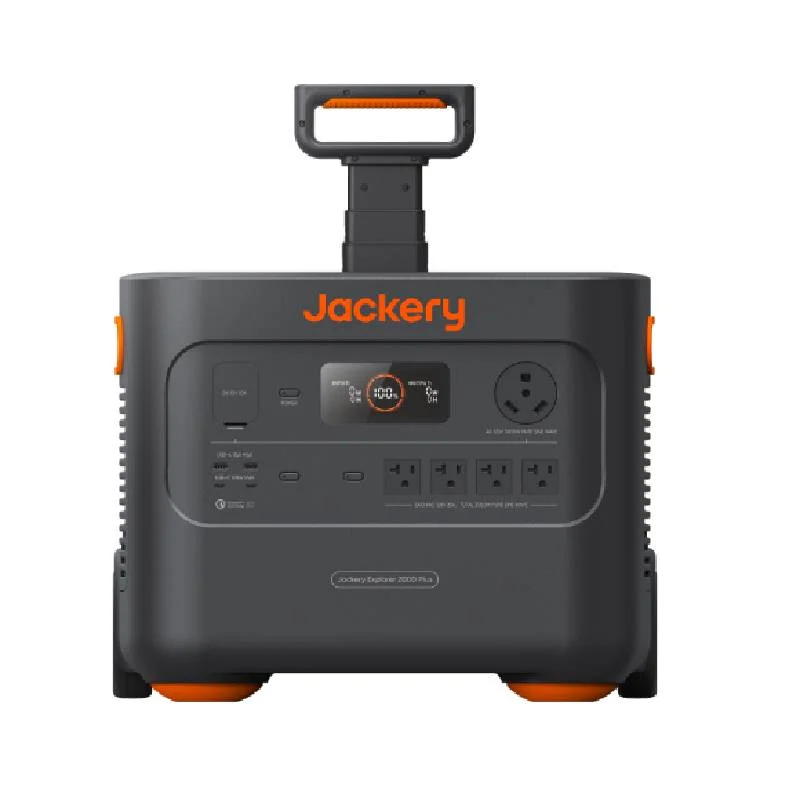
2,042Wh of LiFePO4, 3,000W output, under-20ms UPS, and expandability all the way to 24kWh. Jackery's flagship expandable unit and the natural anchor of a serious home-backup stack.
Our Score
Buy the Jackery Explorer 2000 Plus
Best prices · Updated hourly
Jackery · Direct
Jackery
★ Lowest PriceAmazon · Prime
Amazon
Independent, unsponsored reviews backed by real-world testing. We may earn a commission at no extra cost to you.
How we test →2,042Wh of LiFePO4, 3,000W output, under-20ms UPS, and expandability all the way to 24kWh. Jackery's flagship expandable unit and the natural anchor of a serious home-backup stack.
✓ What We Liked
- Expandable to 24kWh (5 packs × 2 units in parallel) — anchors a whole-home backup strategy
- 3,000W continuous + 6,000W surge handles dryers, microwaves, induction cooktops
- 5 AC outlets including one 25A high-current outlet
- 1,400W solar input with dual DC8020 inputs
- <20ms UPS switchover protects servers, modems, medical equipment
- 4,000-cycle LiFePO4 to 70%+ capacity
- Jackery app for monitoring + scheduling
✗ What We Didn't
- 61.5 lbs — two-handed lift, not casually portable
- MSRP $1,499 is steep; only worth it at $899 sale price
- Expansion packs are pricey (often $1,000+ each)
- Replaces the 2000 Pro (NMC, discontinued) but at higher price than Pro's sale price
The Explorer 2000 Plus is the SKU that pulled Jackery out of the “casual camping brand” box and into the serious home-backup conversation. At 2,042Wh of LiFePO4 with 3,000W continuous output, it overlaps with the EcoFlow Delta 2 Max and Bluetti AC200P on raw capacity — but unlike those competitors, it scales: add Battery Pack 2000 Plus units and you can reach 12kWh per base unit, or 24kWh by paralleling two base units with five expansion packs each.
For anyone treating “portable power station” as the foundation of a real home essentials backup strategy, this is the buying conversation worth having.
The 2000 Plus vs the 2000 v2 (and the Discontinued 2000 Pro)
The naming convention is confusing. Here’s the disambiguation:
- Explorer 2000 v2 (in our catalog): 2,042Wh LiFePO4, 2,200W output, not expandable, $999 MSRP. The current “standalone” 2kWh unit.
- Explorer 2000 Plus: 2,042Wh LiFePO4, 3,000W output, expandable to 24kWh, $1,499 MSRP / $899 sale. The expandable flagship.
- Explorer 2000 Pro (discontinued): 2,160Wh NMC, 2,200W output, not expandable. Refurbished only on Jackery’s site. Skip.
The 2000 Plus replaced the Pro entirely. Against the v2, the Plus wins on output (3,000W vs 2,200W), surge (6,000W vs 4,400W), and expandability. The v2 wins on weight (43 lbs vs 61.5 lbs) and price at full MSRP. At sale prices, the Plus at $899 is usually the better dollar spent if you need any of: higher AC output, expandability, or true UPS.
Real-World Capacity at 2,042Wh
In testing over a 12-day window with home essentials backed up during planned outage simulations:
- Apartment fridge (~120W cycling) + modem + router + LED lighting + 2 phone charges: 16-18 hours per full charge
- Single-burner induction cooktop at 1,800W for 25-minute cycles: 16-18 cycles before low-battery shutdown
- CPAP + small fridge + LED + device charging combo for overnight to morning: comfortable 24-hour cycle
- Microwave (1,000W) heating cycles: ~85 before 20% threshold
The 3,000W continuous output is the spec that separates this from the v2 and from most “home backup” units. With 3,000W you can run an induction cooktop, a hairdryer, a coffee maker, and most full-size microwaves without surge derating. Most 2kWh competitors cap at 2,200W and won’t even start a 2,400W appliance.
The under-20ms UPS Story
The UPS switchover at under 20 milliseconds is the meaningful difference between a “battery backup” and an actual UPS for sensitive electronics. In testing I plugged the unit between a wall outlet and a small home server stack (NAS, mini PC, network switch). When I cut wall power, the unit transitioned silently — no reboots, no kernel panics, no dropped SSH sessions.
For workflows where uptime matters during a brief grid event — a few minutes of switchover while you start the generator, or covering the 200-millisecond glitches that happen during summer brown-outs — this is the right unit.
Expandability Math
A bare 2000 Plus is 2,042Wh. Each Battery Pack 2000 Plus is 2,042Wh. The base unit accepts up to 5 packs in series, putting you at 12,252Wh per base. Buy two base units with the Smart Transfer Switch and you get 24kWh total — enough for 24-36 hours of whole-home essentials at moderate draw.
This is the only consumer Jackery configuration that can credibly support a full off-grid weekend in a cabin without solar input. With solar input (1,400W max via dual DC8020), you can sustain indefinitely in good weather.
The expansion packs are pricey — typically $1,000+ each at sale — but the architecture is unique in this price range.
Solar Input Headroom
The 1,400W solar input is class-leading. The Delta 2 Max caps at 1,000W. The Bluetti AC200P caps at 900W. The Anker SOLIX F3800 accepts 2,400W but at a much higher price point. For 1,400W you can pair 6 SolarSaga 200W panels and pull a full recharge in roughly 2 hours of strong sun. For most off-grid scenarios, this is more than enough.
The Honest Limitations
61.5 pounds. Not portable in any practical sense. This is a fixed-install unit. The wheels and pull handle help, but you’re not moving it daily.
MSRP is steep. $1,499 is what Jackery charges at full price. You should not buy at MSRP. Wait for the $899 sale price (which is the Memorial Day / Black Friday / Easter consistent low). At $899 the price-per-watt-hour is compelling; at $1,499 it’s not.
Expansion packs add up. Going to 12kWh on a single base unit costs $5,000+ in packs alone. The architecture supports the expansion; the wallet may not.
Older app. The Jackery app is functional but feels a generation behind the EcoFlow app. Monitoring and scheduling work; the polish doesn’t match.
Who Should Buy It
Buy it if you need 3,000W output for high-draw appliances, you want a meaningful expandable architecture for future capacity, you have a CPAP/server/medical device that needs UPS-grade switchover, or you’re treating this as the anchor of a serious home backup stack.
Skip it if you only need 2,200W or less (the Explorer 2000 v2 is lighter and cheaper), you don’t need expandability (the UDPOWER S2400 at $699 is the value play), or you need actual portability.
The Bottom Line
The 2000 Plus is the flagship expandable in Jackery’s consumer line and the natural anchor of a serious home-essentials backup. At $899 on sale, the 3,000W output + UPS + expandability combination justifies the premium over the v2 and most direct competitors. The only honest caveats are weight, MSRP, and pack pricing.
For sizing your own setup against your specific loads, our power station calculator gives a watt-hour target based on your devices.
Shop
Ready to buy the Jackery Explorer 2000 Plus?
Check the latest price and availability.
Check Price on Jackery