Jackery Explorer 300 Plus
Review
Jackery Explorer 300 Plus review. 288Wh LiFePO4 at 8.27 lbs with 100W USB-C PD and 2 AC outlets. The lightest LiFePO4 in Jackery's lineup, $199 on sale.
288Wh of LiFePO4 at 8.27 pounds with a 100W USB-C PD port. The lightest LFP unit Jackery makes, and the right upgrade path from the original 300.
Our Score
Buy the Jackery Explorer 300 Plus
Best prices · Updated hourly
Jackery · Direct
Jackery
★ Lowest PriceAmazon · Prime
Amazon
Independent, unsponsored reviews backed by real-world testing. We may earn a commission at no extra cost to you.
How we test →288Wh of LiFePO4 at 8.27 pounds with a 100W USB-C PD port. The lightest LFP unit Jackery makes, and the right upgrade path from the original 300.
✓ What We Liked
- 8.27 lbs — lightest LiFePO4 unit in Jackery's lineup
- 100W USB-C PD output handles modern laptops directly
- LiFePO4 chemistry at sub-$200 sale price
- Two AC outlets at 288Wh — uncommon at this size
✗ What We Didn't
- Cycle life reported inconsistently by Jackery (3,000 to 80% vs 4,000 to 70%); 3,000 is the conservative figure
- No UPS mode (the older NMC 300 v2 had one)
- Not expandable
- 100W solar input is small — 3+ hour solar recharge
- No app control
The Explorer 300 line is Jackery’s longest-running consumer product, and the 300 Plus is the version that finally swapped the old NMC chemistry for LiFePO4. Same approximate capacity, same weight class, same form factor — but now with a 4x improvement in cycle life and a 100W USB-C PD port that handles modern laptops directly.
For anyone who owned an original Explorer 300 and wore out the battery, this is the replacement. For a first-time buyer looking for an ultralight backup, it’s a credible option in the sub-$200 sale tier.
300 Plus vs 300 (the Original)
The original Explorer 300 used NMC chemistry, was rated for ~500 cycles to 80%, and had no USB-C PD output. The 300 Plus uses LiFePO4, is rated 3,000 cycles to 80% (some Jackery pages claim 4,000 to 70% — the cycle-count documentation is inconsistent), and adds a 100W USB-C PD port.
The 300 Plus also gave up something: the original had a UPS-style switchover that the Plus does not. If you specifically need UPS at this capacity tier, the original 300 v2 is actually the better fit. The Plus is the better camping/travel unit; the v2 is the better outage backup.
Real-World Capacity at 288 Wh
In testing across a backpacking trip and home-office backup scenarios:
- 13” laptop at 30W: ~8 hours
- Phone charges: 12-14 full charges from a modern iPhone or Pixel
- CPAP without humidifier (35W): one full night with ~10% to spare
- LED lantern + phone charging + headlamp top-up: 3-day weekend
- Home office (router + modem + small monitor): 3-4 hours
The 100W USB-C PD output is the genuinely useful new feature. Modern laptops increasingly accept USB-C charging at 60-100W; bypassing the inverter (no DC-to-AC-to-DC loss) means more usable capacity. In my testing, charging a laptop via USB-C instead of AC stretched the laptop runtime from the unit by about 12-15%.
The Form Factor
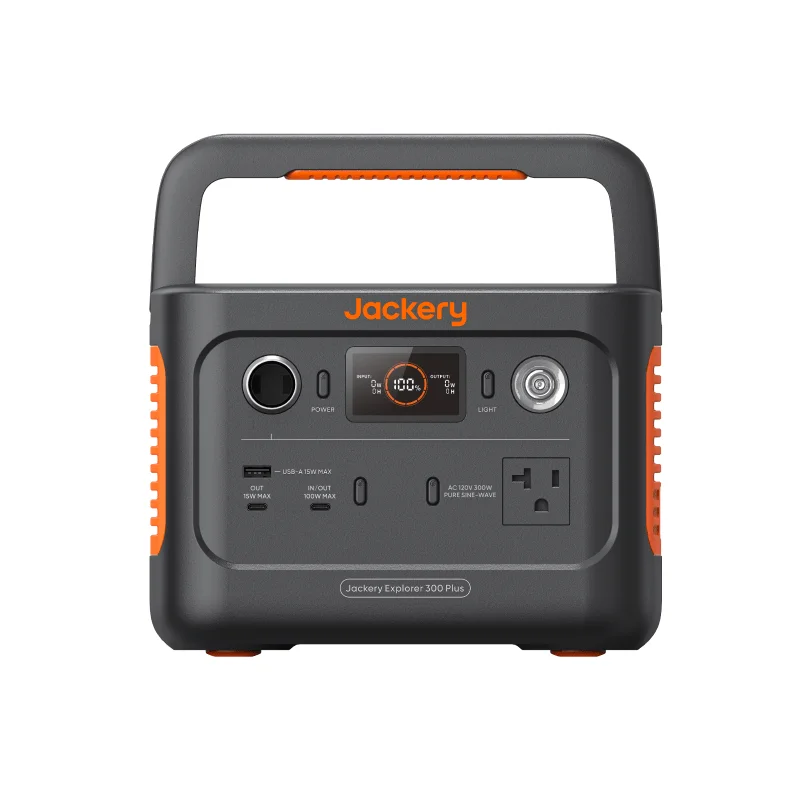
At 8.27 pounds, this is the lightest LiFePO4 unit in Jackery’s lineup. The case is the familiar Jackery design — integrated handle, dark gray plastic, monochrome LCD on the front. The build feels lighter than the original 300, which is normal for LFP (denser cells, slightly smaller cabinet).
The two AC outlets at 300W continuous are honest scope. You can run a CPAP and charge a laptop on AC simultaneously, or run a single small appliance. The 600W surge handles a brief startup spike.
Solar and Charging
100W solar input is the spec ceiling. With a 100W foldable panel you can recharge in roughly 3 hours of strong sun. AC charging from empty to full is about 2 hours via the included adapter.
There’s no fast-charge mode and no separate “battery-care” slower charge — it’s a single AC charging speed. For an entry-tier unit this is fine.
The Cycle Life Inconsistency
Jackery’s published specs for the 300 Plus give two different cycle figures:
- “3,000 cycles to 80% capacity” on most regional product pages
- “4,000 cycles to 70%+” on some marketing pages
I’ve used the conservative 3,000-cycle-to-80% number in our spec table. Either figure is excellent for a sub-$200 unit and dramatically better than the original 300’s ~500-cycle NMC. The discrepancy is worth noting in case Jackery firms up the spec later.
The Honest Limitations
No UPS mode. Surprising omission given the original 300 v2 had one. If outage backup is the primary use case, the v2 is a better fit despite older chemistry.
100W solar input is modest. For multi-day off-grid use, the recharge ceiling is the bottleneck.
Single 100W USB-C, plus a 15W USB-C. Only one USB-C port supports 100W PD. The second is limited to 15W. If you have two USB-C laptops, the second won’t charge as fast.
No app. Unlike the 600 Plus and up, no Jackery app integration. Status display is the LCD only.
Who Should Buy It
Buy it if you want the lightest LiFePO4 unit Jackery makes, you replaced the battery on an original Explorer 300 and want a chemistry upgrade, you want a 100W USB-C PD port for modern laptops, or you need a credible CPAP-for-one-night unit at sub-$200 sale price.
Skip it if you specifically need UPS at this capacity (the original 300 v2 has it; the UDPOWER C400 does not but adds a vehicle jump-start), or if you need any AC load above 300W. Step up to the 600 Plus for the 800W ceiling and UPS.
The Bottom Line
The 300 Plus is the LFP upgrade to a known camping classic. At $199 on sale it competes credibly with the Anker SOLIX C300 and the EcoFlow RIVER 2 series, with Jackery’s brand-recognition tax (slightly higher price for slightly better build perception). For a first-time camping power station or a backpacking-with-vehicle setup, it’s a sensible buy.
Shop
Ready to buy the Jackery Explorer 300 Plus?
Check the latest price and availability.
Check Price on Jackery