Jackery SolarSaga 200W vs UDPOWER 120W Solar Panel
Jackery SolarSaga 200W vs UDPOWER 120W Solar Panel compared spec-by-spec. Rated output, efficiency, pricing, pros, cons, and our verdict on which solar panel to buy.
| Specification | ||
|---|---|---|
| Wattage | 200 | 120 |
| Bifacial Wattage | 225 | — |
| Panel Type | monocrystalline | monocrystalline |
| Cell Type | TOPCon bifacial | — |
| Efficiency Pct | 25 | 22 |
| Weight | 14.33 lbs | — |
| Dimensions | 89.76 x 23.50 x 0.98 in (unfolded) | 58.82 x 18.58 x 0.79 in (unfolded) |
| Folded Dimensions | 23.62 x 23.50 x 1.57 in | 18.58 x 15.94 x 1.57 in |
| Connector Type | DC8020 (DC8020 to DC7909 adapter included) | Designed for UDPOWER stations (DC7909 input); connectors in box not published |
| Usb Outputs | USB-A 5V 2.4A, USB-C 5V 3A | — |
| Ip Rating | IP68 | IP65 |
| Warranty | 3 years ✓ Winner | 1 years |
| Warranty Note | 3 years, plus 2 more when bought at jackery.com | — |
| Foldable | Yes | Yes |
| Bifacial | Yes | — |
| Voc | 22 | 21.5 |
| Isc | 12.5 | 6.03 |
| Vmp | 18 | 17.92 |
| Imp | 11.5 | 5.58 |
| Max System Voltage | 60 | — |
| Operating Temp | -4 to 149F | -40 to 185F |
| Kickstand | Yes | Yes |
| Kickstand Angle | — | 60-90 degrees |
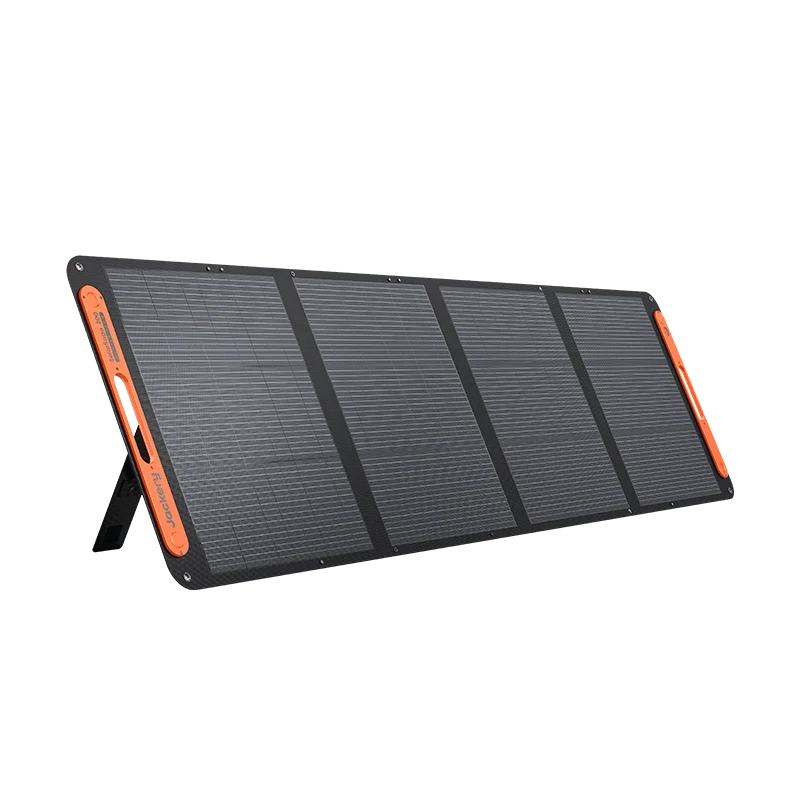
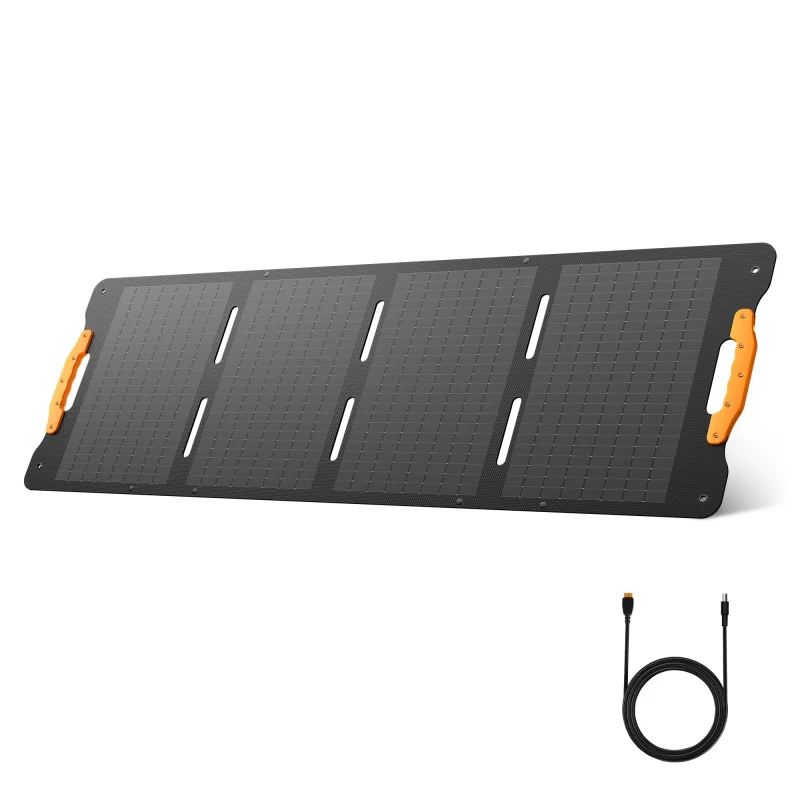
Buy the Jackery SolarSaga 200W
Typical prices · Check the retailer for today's price
Buy the UDPOWER 120W Solar Panel
Typical prices · Check the retailer for today's price
Who Should Buy the Jackery SolarSaga 200W?
The Jackery SolarSaga 200W is the right fit for car camping, emergency preparedness, tailgating. At 200W with 25% efficiency, it delivers solid output for portable and rooftop arrays.
Key advantages include: bifacial topcon cells, rated 200w front-side and 225w with rear-side gain; ip68 rated for dust and water; 14.33 lb, light for a 200w foldable. At 14.33 lbs, it's manageable for rooftop and portable installs.
At $429 ($2.15/W), the Jackery SolarSaga 200W scores 8.3/10 — a strong all-around performer.
Who Should Buy the UDPOWER 120W Solar Panel?
The UDPOWER 120W Solar Panel is the right fit for car camping, emergency preparedness, portable power stations. At 120W with 22% efficiency, it works well as a compact, flexible charging option.
Key advantages include: wide -40 to 185f operating range; suitcase-style fold with a 60-90 degree adjustable stand; $200 on sale is competitive with non-jackery 100-120w panels.
At $200 ($1.67/W), the UDPOWER 120W Solar Panel scores 8.2/10 — a strong all-around performer.
How Do the Specs Compare?
Wattage: The Jackery SolarSaga 200W puts out more power at 200W versus 120W for the UDPOWER 120W Solar Panel. Higher wattage means faster charging and more energy harvested per square foot of roof or ground space — a priority for larger systems.
Efficiency: The Jackery SolarSaga 200W converts more sunlight to power at 25% efficiency versus 22% for the UDPOWER 120W Solar Panel. That efficiency gap matters most when you have limited roof or ground space and need to maximize output per panel.
Cost per watt: The UDPOWER 120W Solar Panel offers better value at $1.67/W versus $2.15/W. Cost-per-watt is the most useful metric for comparing solar panels at different wattage levels.
Price: The UDPOWER 120W Solar Panel costs $200 versus $429 for the Jackery SolarSaga 200W — a $229 difference. When scaling to a multi-panel system, that per-panel cost difference compounds quickly.
🏆 Our Verdict
Choose the Jackery SolarSaga 200W if you need higher performance and top-tier efficiency.
Choose the UDPOWER 120W Solar Panel if you prioritize value (typically $229 less) .
Related
Go Deeper
More Comparisons